

Researchers from National Taiwan University have developed a simple solvent-mixing strategy that optimizes the microstructures of all-polymer organic solar cells, enabling ultrafast energy transfer and boosting power conversion efficiency beyond 17%.
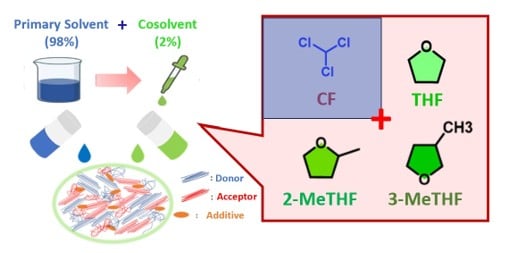
Schematic of the solvent-mixing strategy for high-efficiency polymer solar cells. Adding a small fraction (2%) of cosolvent to the primary solvent (98%) optimizes polymer domain morphology and solidification kinetics, paving the way for enhanced charge transport and superior device performance.
National Taiwan University
In a study recently published in the Chemical Engineering Journal, a research team from National Taiwan University and their international collaborators has developed a straightforward solvent-mixing strategy to significantly boost the performance of next-generation all-polymer organic solar cells. By adding small fraction of a cosolvent during fabrication, the team successfully resolved a long-standing challenge in controlling film quality, opening new possibilities for commercializing flexible, efficient, and sustainable clean energy technology.
Unlike traditional rigid silicon solar panels, organic solar cells offer high flexibility, light weight, and lower production costs, making them ideal for integration into wearable devices and smart building windows. However, achieving high power conversion efficiency has remained difficult. The key challenge lies in the drying process when liquid polymer solutions solidify into thin active films. During this transition, polymers often aggregate haphazardly or separate unevenly, creating structural defects that trap generated electricity and cause energy loss.
To solve this issue, the researchers introduced a smart processing strategy by mixing a standard primary solvent (chloroform) with 2% of a secondary solvent, such as 2-methyltetrahydrofuran (2-MeTHF), 3-methyltetrahydrofuran (3-MeTHF) and tetrahydrofuran (THF). Because these cosolvents evaporate at a slightly slower rate, they slow down the drying speed just enough to give the polymer molecules time to arrange themselves into neat, ordered layers. Advanced characterization techniques revealed that this balanced solidification process drastically reduces internal energy disorder, creates larger crystalline domains, and strengthens molecular stacking within the film.
Consequently, the optimized solar cells demonstrated remarkably efficient charge transport, reduced energy recombination losses, and achieved power conversion efficiencies exceeding 17%. Ultrafast optical spectroscopy further confirmed that the refined film structure enables photogenerated charges to separate and move instantly, overcoming traditional energy bottlenecks.
“By simply fine-tuning the solvent evaporation dynamics during film formation, we have unlocked a practical pathway to control molecular architecture, bringing organic solar cells one step closer to practical, high-efficiency clean energy applications,” says co-corresponding author Chu-Chen Chueh, professor of chemical engineering at National Taiwan University.
Prof. Chu-Chen Chueh‘s email address: [email protected]
Advertisement