
New organic–inorganic nanocomposite combines stretchability and piezoelectric properties, maintaining stable performance even under 50% strain
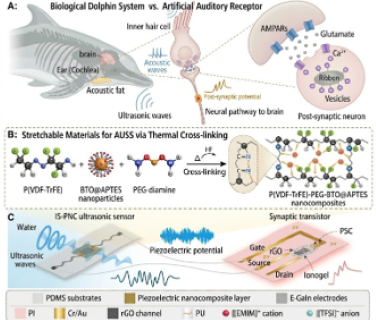
▲ Schematic illustration of the artificial ultrasonic sensory synapse (AUSS) inspired by the dolphin auditory system
Do, T. D., Trung, T. Q., Bhuyan, P., Nguyen, M. C., Nguyen, Q. T., Jo, N., Kim, Y., Ha, T. D., Kim, M., Park, S., Yu, W. J., & Lee, N. (2026). Intrinsically stretchable piezoelectric nanocomposites for artificial ultrasonic sensory synapse. Advanced Mater
A research team led by Professor Nae-Eung Lee of the School of Advanced Materials Science and Engineering at Sungkyunkwan University (SKKU) has developed a new material that can stretch like rubber while generating electricity. Using the material, the team successfully created an “artificial ultrasonic sensory synapse” that mimics the way dolphins detect underwater ultrasound and use it to perceive their surroundings.
Dolphins navigate even in dark and murky waters by emitting ultrasonic waves and detecting the echoes reflected from surrounding objects, allowing them to accurately identify underwater terrain and locate prey. This ability is known as echolocation. With recent advances in robotic skin and wearable electronics, technologies capable of detecting ultrasonic signals and processing them in a manner similar to the nervous system have attracted growing attention. However, conventional inorganic materials are prone to fracture, while flexible polymer materials often fail to recover their original shape after being stretched or suffer significant losses in piezoelectric performance—the ability to generate electricity when subjected to mechanical force. These limitations have made it difficult to develop stretchable ultrasonic sensors.
To overcome these challenges, the research team applied a cross-linking method in which a flexible polymer, P(VDF-TrFE), was lightly linked with soft-chain PEG-diamine molecules. The researchers then incorporated nanoscale barium titanate (BaTiO₃) particles with strong piezoelectric properties to create a new nanocomposite. By inducing strong chemical interactions, particularly hydrogen bonding, between the polymer and nanoparticles, the team significantly increased the formation of crystalline structures responsible for electrical performance while preserving the material’s inherent stretchability.
The newly developed nanocomposite maintained stable piezoelectric performance even when stretched to 50% beyond its original length. It also demonstrated excellent durability, showing no significant performance degradation after more than 1,000 cycles of mechanical pressing and stretching.
The research team further integrated the stretchable ultrasonic sensor with a flexible artificial neural device known as a synaptic transistor. When ultrasound propagates through water, the sensor detects the ultrasonic waves and converts them into electrical signals. These signals are then transmitted to the artificial synaptic device, which stores information from the ultrasonic input in a manner similar to biological nerve cells. The system is designed to mimic the biological mechanism through which sensory cells in a dolphin’s auditory system receive ultrasonic vibrations and transmit the resulting signals to neural networks in the brain. The achievement is expected to serve as a foundation for the development of artificial ultrasonic sensory systems inspired by biological hearing.
Professor Nae-Eung Lee said, “This study is significant in that we overcame the limitations of conventional brittle piezoelectric materials and developed a new material that combines elasticity with high performance. We expect this technology to play a key role in the development of soft marine exploration robots capable of operating underwater, as well as wearable medical devices that conform naturally to human skin for health monitoring.”
Supported by the Nanomaterial Technology Development Program and the Basic Science Research Program funded by the Ministry of Science and ICT and the National Research Foundation of Korea, the study was published in Advanced Materials, a leading international journal in materials science.
Advertisement
Advertisement