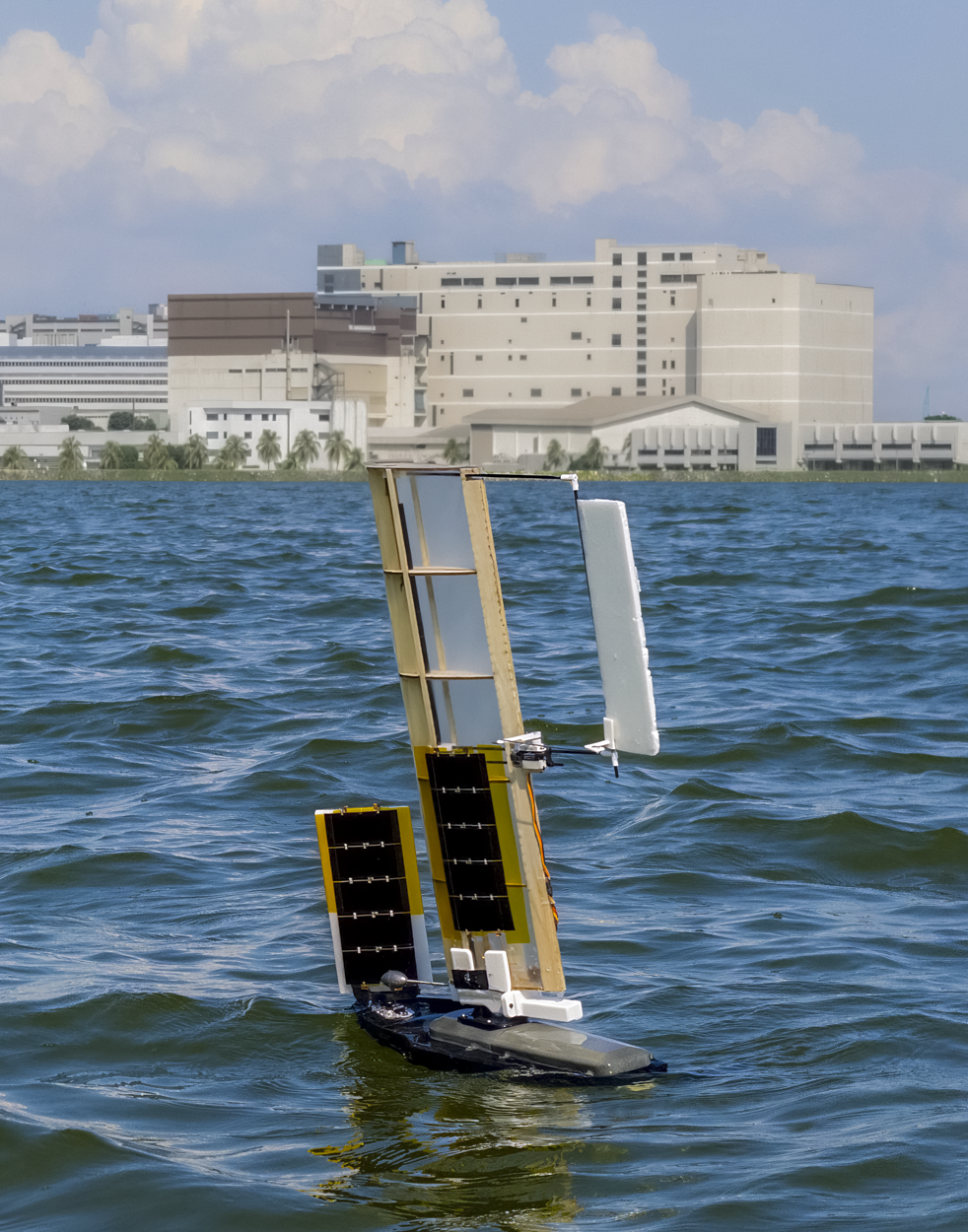


Researchers at SUTD have built a robotic platform that can be dropped from the air onto remote waters and sail autonomously using wind energy, pairing rapid aerial deployment with the potential for long duration marine monitoring.
ALBATROSS prototype sailing in the reservoir
SUTD
Remote waters are difficult to monitor. Boats can take a long time to reach them, while aircraft cannot remain there for extended periods.
To close that gap, researchers at the Singapore University of Technology and Design (SUTD) have developed a nature-inspired robotic platform. Released from the air, it lands on water, rights itself and then sails autonomously using wind energy.
Called ALBATROSS, short for Airborne Lander with Buoyant AuToROtating Sailing Sensor, the concept platform is designed to reach remote waters quickly and in future deployments, remain there monitoring environmental conditions for weeks at a time.
“Surface systems are useful because they can remain at sea, but they are constrained by how long it takes to get to the target location,” said Professor Foong Shaohui, Associate Head of the Engineering Product Development Pillar at SUTD.
“With ALBATROSS, we wanted to use the best of both worlds: the speed of aerial deployment to reach remote waters quickly, and the endurance of sailing to remain there for long-duration monitoring.”
At the heart of ALBATROSS are rigid wingsails designed to do two jobs: slow its fall through the air, then power it across the water. This removes the need for a separate parachute or landing mechanism.
During descent, the wings passively autorotate like a maple seed, slowing and stabilising the platform before it reaches the water. Once afloat, those same wings act as sails, using the wind to move the robot. A fish-tail-inspired rudder helps it steer, particularly when wind conditions are weak.
ALBATROSS prototype in mid flight during its autorotating descent
SUTD
Using the same components in both phases keeps the design relatively simple and lets ALBATROSS transition directly from an airborne vehicle into a sailing robot. The system uses just three actuators and three navigation sensors, compared with six to eight actuators and broader sensor suites used by other hybrid aerial-marine platforms.
“We designed ALBATROSS to use the environment rather than fight it. It falls through the air using passive autorotation, rights itself on water through its weight distribution, and then uses wind to move,” said Dr Shane Kyi Hla Win, from Temasek Laboratories @ SUTD and lead author of the paper ALBATROSS: A bio-inspired, aerially deployable, autonomous sailing sensor platform, published in Science Robotics. “That simplicity could enable lower-cost and more scalable platforms for sensing in places that are difficult to reach.”
In field trials, the team released ALBATROSS from an altitude of 150 metres. It descended in stable autorotation and landed on the water with low impact. It then righted itself without assistance and sailed off on its own.
The researchers estimate that a similar platform without autorotation would experience about 18.5 times more impact energy when it hits the water.
Once on the surface, ALBATROSS navigates autonomously between set waypoints. In reservoir trials in Singapore, a larger test version reached a peak sailing speed of just under 1 km/h and operated for around three hours while recording environmental measurements including humidity, heat levels and wind direction.
The ability to reach remote waters quickly could eventually make the platform useful for environmental monitoring, climate change research, search and rescue, and maritime security. Once deployed, wind-powered sailing could allow sensing platforms to remain in the area while using relatively little energy.
For now, ALBATROSS remains a proof of concept rather than a system ready for the open sea. Testing to date has been conducted in sheltered reservoir conditions, and future versions will need to withstand stronger winds, currents and waves.
“The next step is to take the design principles we have demonstrated in sheltered waters and scale them towards open-sea operation,” said Professor Foong. “That means making the platform more rugged, more durable and ready for harsher maritime environments.”
Future versions could also carry a wider range of sensing equipment, including underwater sensors and sonar, as well as larger energy-storage systems.
Its heavy keel and ballast currently provide the stability needed for water landing and sailing. Future designs could adapt this keel and ballast space to carry additional equipment.
By giving the same wings more than one job, first helping the robot descend and then helping it sail, ALBATROSS shows how nature-inspired design could simplify the transition between air and water — offering a faster way to deploy marine sensors and keep them operating in hard-to-reach waters for longer.
Advertisement