
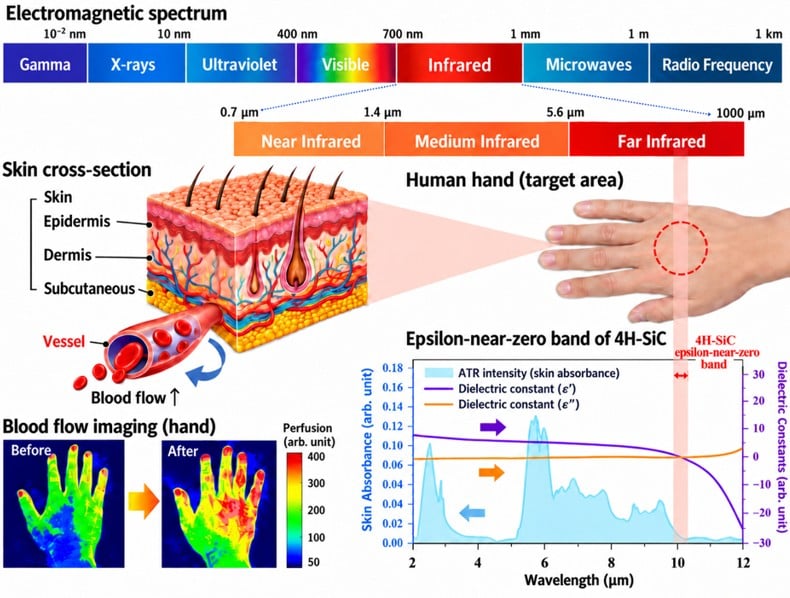

This study published in Advanced Science reports a wavelength-matched far-infrared approach for enhancing peripheral blood circulation using silicon carbide (SiC), which exhibits epsilon-near-zero behavior near 10.3 μm. By matching the selective thermal emission of SiC with the low-absorption optical window of human skin, the study demonstrates enhanced cutaneous blood flow compared with a conventional broadband graphite emitter. After 20 minutes of irradiation, SiC increased blood perfusion by 30.2%, compared with 18.6% for graphite, while maintaining skin temperature below 36 °C and without significant changes in blood pressure or heart rate. These results demonstrate the potential of wavelength-selective ENZ emitters for localized and thermally safe biomedical thermal modulation.
Figure: The schematic summarizes the infrared spectral ranges, the optical window of human skin, the use of 4H-SiC as an epsilon-near-zero emitter, and the observed increase in blood flow after irradiation.
National Taiwan University
Researchers at National Taiwan University, MacKay Medical University, and MacKay Memorial Hospital reported a wavelength-matched far-infrared (FIR) approach to enhance peripheral blood circulation. Instead of using a conventional broadband FIR source, the team focused on a natural low-absorption optical window in human skin near 10 μm. The study is published in Advanced Science.
To target this spectral window, the researchers used silicon carbide (SiC), which exhibits epsilon-near-zero (ENZ) behavior near 10.3 μm and selective thermal emission in this wavelength range. This wavelength closely aligns with the low-absorption region of human skin. It provides a physical basis for more efficient thermal interaction with deeper skin layers while minimizing unnecessary superficial heating.
The team then carried out a thermally controlled within-subject study in 25 healthy volunteers, corresponding to 50 hands. Under identical heating conditions, one hand was irradiated with a SiC emitter and the other with a conventional graphite emitter. Scientists monitored changes in cutaneous blood flow in real time using laser speckle contrast imaging (LSCI), and recorded blood pressure, heart rate, oxygen saturation, and skin temperature.
After 20 minutes of irradiation, the SiC emitter increased cutaneous blood flow by an average of 30.2% relative to baseline, compared with 18.6% for graphite. The enhancement produced by SiC was significantly greater than that produced by graphite after 10 minutes of illumination. Importantly, blood pressure and heart rate showed no significant changes, and skin surface temperature remained below 36 °C.
These findings show that spectral matching is an important design parameter for FIR therapy. By aligning the thermal emission of an ENZ material with the optical properties of human skin, the study demonstrates a practical strategy for localized and thermally safe enhancement of peripheral circulation.
The study suggests that ENZ-based, wavelength-selective FIR emitters may provide a more effective alternative to conventional broadband emitters for biomedical thermal modulation. Future studies may further explore the clinical potential of this approach in applications related to circulation support, wound healing, and other noninvasive therapeutic platforms.
Contact:
Corresponding author Hsuen-Li Chen, distinguished professor of materials science and engineering at National Taiwan University
More information:
W.-T. Yao, S.-C. Yang, M.-F. Tsai, and H.-L. Chen*, “Enhancing Blood Circulation with Epsilon-Near-Zero (ENZ) Materials via the Far-Infrared Window of Human Skin.” Advanced Science, 2026, e75938.
https://doi.org/10.1002/advs.75938
Acknowledgment:
The team would like to acknowledge and appreciate the financial support from the National Science and Technology Council (NSTC), Taiwan.
Advertisement
Advertisement