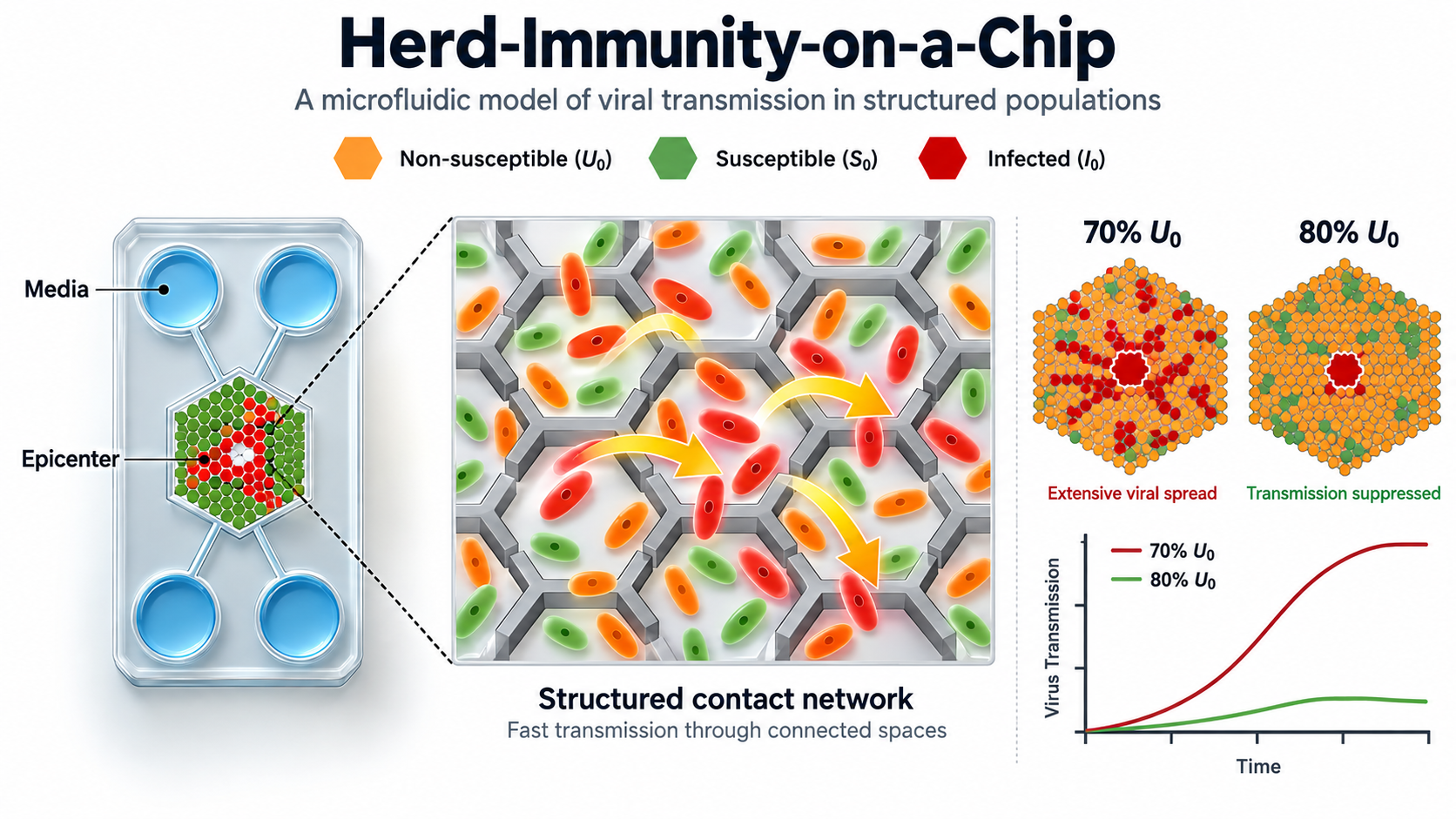
▲ Conceptual schematic of viral transmission and herd-immunity-like suppression using a compact microfluidic Herd-Immunity-on-a-Chip platform
A research team led by Professor Sungsu Park of the School of Mechanical Engineering and Professor Byung Mook Weon of the School of Advanced Materials Science and Engineering at Sungkyunkwan University (SKKU) has developed a compact, centimeter-scale microfluidic “Herd-Immunity-on-a-Chip” platform that recreates key features of viral transmission in human societies within a controllable laboratory system.
The study moves beyond conventional cell-infection assays by treating the chip as a simplified society. In this design, lung fibroblast cells act as individuals, hexagonal microchambers serve as spatially organized social spaces, and interconnecting microchannels function as controllable contact routes between those spaces. This configuration allowed the researchers to observe, in real time, how infection spreads—or fails to spread—through a structured population.
Until now, the spread of infectious diseases and the level of population immunity needed to suppress transmission have been studied largely through epidemiological observations, mathematical models, and computer simulations. These approaches are powerful, but they often rely on assumptions such as uniform mixing within a population. Such assumptions can make it difficult to reflect real-world factors, including population density, spatial separation, social distancing, and heterogeneous patterns of contact.
To address this limitation, the research team created a Herd-Immunity-on-a-Chip (HIC), a compact microfluidic platform composed of 444 interconnected hexagonal microchambers. Coronavirus-infected lung fibroblast cells were placed at the epicenter of the chip, while susceptible lung fibroblast cells and non-susceptible cells were arranged in the surrounding chambers to mimic individuals with different levels of vulnerability to infection. Viral transmission across the chip was then monitored over seven days.
The experiments revealed how population structure shapes viral spread. When susceptible cells were densely packed, or when the initial number of infected cells was high, frequent cell-to-cell contact accelerated transmission across the network. By contrast, when the proportion of non-susceptible cells was increased to 80% or higher, transmission pathways became fragmented and viral spread was effectively suppressed, reproducing a herd-immunity-like phenomenon on a chip. Restricting cell movement also slowed transmission, experimentally recapitulating the effect of social distancing.
“This is the first study to directly recreate and experimentally validate viral transmission and herd immunity—phenomena that have previously been predicted mainly through mathematical modeling and epidemiological studies—on a laboratory chip,” said Professor Sungsu Park. “We expect this platform to help predict the population-level protection required when new viral variants emerge, design effective distancing strategies, and rapidly evaluate therapeutic or antiviral interventions.”
Ph.D. student Jiande Zhang of SKKU, Dr. Narina Jung of the Korea Institute for Advanced Study, Dr. Min-Hyeok Kim of SKKU, and Researcher Wanyoung Lim of Samsung Electronics participated as co-first authors. Professors Sungsu Park and Byung Mook Weon served as corresponding authors. The study was published in the international journal Advanced Science on September 3.