

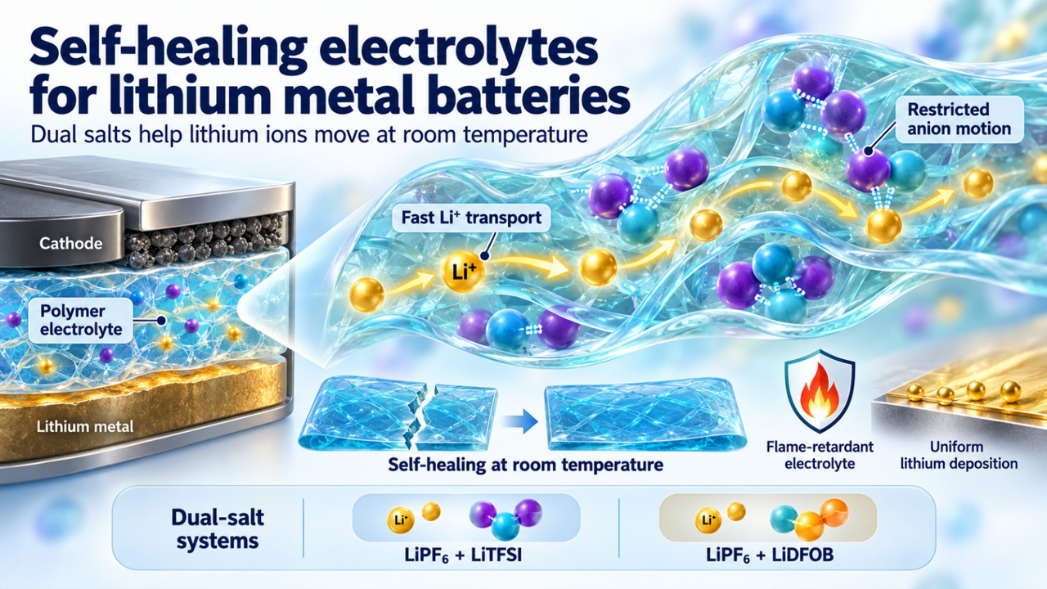

This work presents a dual-salt synergistic strategy in a self-healing polymer electrolyte system to overcome the bottlenecks of low ionic conductivity and a low Li⁺ transference number, enabling stable room-temperature operation of lithium batteries with various cathode chemistries, including LFP and NMC811. Furthermore, the electrolyte's intrinsic flame-retardant properties enhance battery safety, while its self-healing capability enables effective crack repair, promoting stable and dendrite-free lithium battery operation.
Self-healing dual-salt polymer electrolyte with fast Li⁺ ion conduction and flame-retardant properties.
National Taiwan University
Gel polymer electrolytes (GPEs) are promising materials for developing high-energy-density lithium metal batteries. However, conventional polymer materials often have high crystallinity, which limits ionic conductivity (IC) and the Li⁺ transference number (tLi⁺). They can also cause high interfacial resistance and uncontrolled lithium dendrite growth, making room-temperature battery operation challenging.
Researchers introduce a dual-salt strategy into a self-healing polymer electrolyte to overcome these limitations. The interactions between the two salts help restrict anion movement within the polymer network, allowing more Li⁺ ions to participate in charge transport. The study is published in Advanced Functional Materials.
At the same time, interactions between the salts and polymer improve ion transport, resulting in an ionic conductivity of 2.23 mS cm⁻¹ and a Li⁺ transference number of 0.55. The electrolyte enables stable lithium plating and stripping in Li||Li symmetric cells for more than 2000 hours.
In full-cell configurations, the LiFePO₄||Li cell delivers a capacity of 133 mAh g⁻¹ at 1C and retains 75% of its initial capacity after 700 cycles, while the NMC811||Li cell delivers 135 mAh g⁻¹ and maintains 72% capacity retention after 250 cycles.
Moreover, the electrolyte exhibits flame-retardant properties and promotes uniform lithium deposition, effectively suppressing dendrite growth.
“Overall, this dual-salt strategy offers a promising approach to developing room-temperature self-healing gel polymer electrolytes with improved battery performance, enhanced safety, and reduced dead lithium formation,” says co-corresponding author Prof. Chih Wei Chu, research fellow of Research Center for Applied Sciences, Academia Sinica and Institute of Applied Mechanics, National Taiwan University.
Prof. Chih Wei Chu’s email address: [email protected]
Energy Storage and Generation Laboratory of Prof. Chu linked to
https://sites.google.com/view/energystoragercascwchu/profile
Advertisement
Advertisement