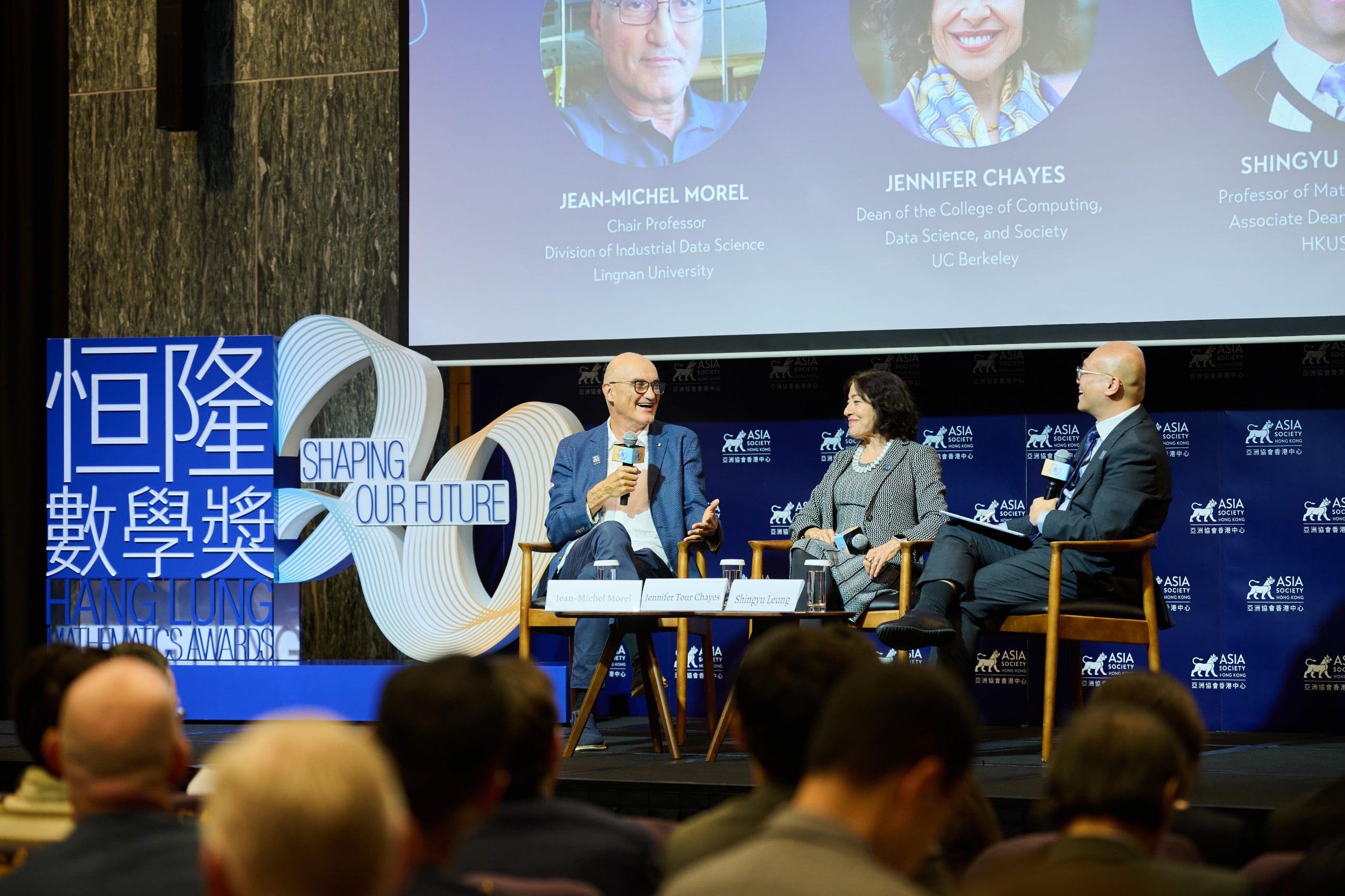
From left: Prof Jean-Michel Morel, Prof Jennifer Chayes, and Prof Leung Shing-yu.
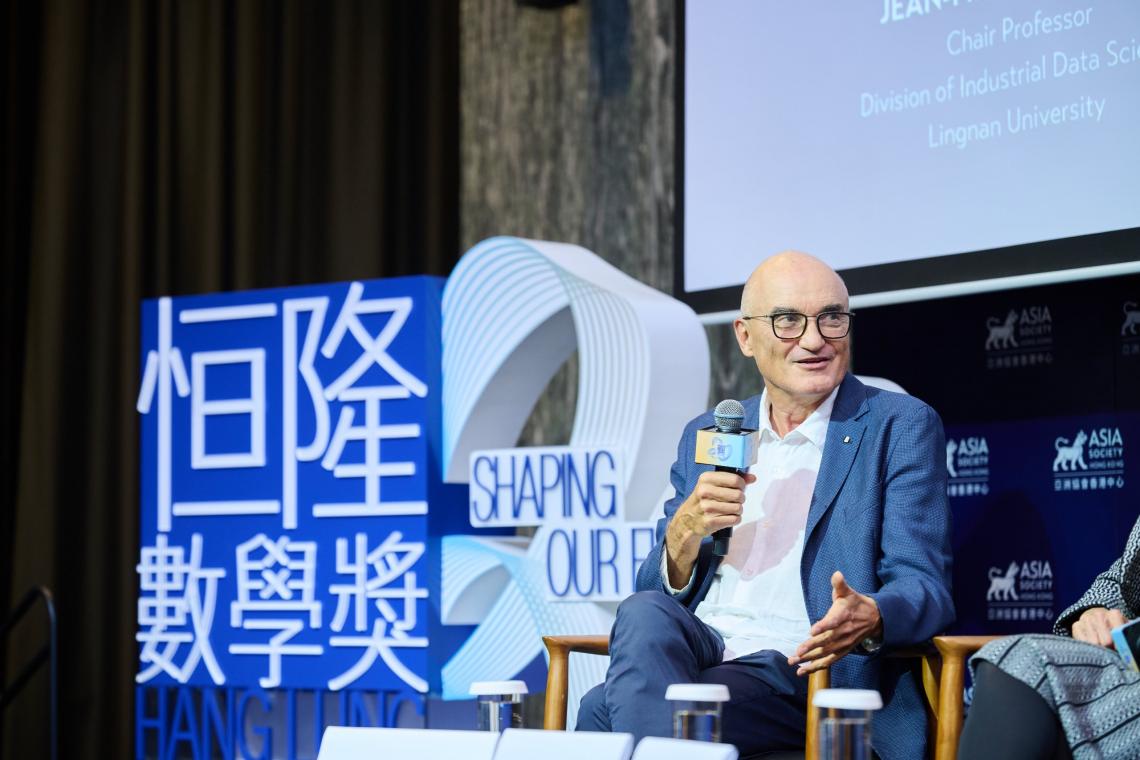
Prof Jean-Michel Morel, Chair Professor of the Division of Industrial Data Science at Lingnan University, and a world-renowned mathematician and computer vision scientist.
With AI models now capable of solving highly challenging mathematical conjectures, many people wonder about the value of learning mathematics. Sharing his insights ahead of the talk, Prof Morel pointed out that AI would not replace mathematics. On the contrary, it would make mathematics even more important. Taking the development of large language models as an example, he explained that the new technology used to build AI models derives directly from the mathematical theory of stochastic differential equations. Mathematics therefore provides an essential foundation for technological development. The professor believes that AI research and development require more mathematicians than ever before, and will create more job opportunities for them.
Prof Morel also said that Lingnan University is actively exploring and planning the establishment of a Division of Mathematics under the School of Data Science. The new division will further strengthen its integration with the Division of Artificial Intelligence under the School, promoting the integration of mathematics and AI in both teaching and research. In terms of curriculum development, AI will be taught through its underlying mathematical theories, and at the same time be used to teach different stages of mathematics, particularly to help students reason logically, develop mathematical arguments step by step, and verify their rigour. Established only around two and a half years ago, Lingnan University’s School of Data Science has achieved encouraging results in the 2026 ShanghaiRanking's Global Ranking of Academic Subjects (GRAS), with Artificial Intelligence recording a significant improvement and entering the global top 100 for the first time in the 76th to 100th band. Two science and engineering disciplines, Computer Science and Engineering, and Electrical and Electronic Engineering, made the list for the first time.
Prof Morel said, “To use AI effectively, you must have a deep understanding of your discipline. If you do not ask the right questions, you will not receive good answers. Even if you receive good answers, you might not be able to make good use of them without in-depth training in your discipline.”
He pointed out that AI is, in a sense, “too human”. Although it can provide answers to questions, it cannot explain how it reaches a particular conclusion. Just as people cannot explain exactly which neurons in their brains were involved in reaching a particular judgement, the neural networks underlying AI are similarly unable to explain their internal processes. This makes rigorous mathematical verification tools even more necessary to complement AI and ensure that its results can withstand verification.
Addressing the perception that mathematics is an abstract subject, Prof Morel said that mathematics is already deeply embedded in everyday life. Taking smartphone photography as an example, he explained that the raw digital image captured by a camera cannot be viewed directly as the photograph people see. A series of mathematical operations must first be applied by a smartphone to process the image, including colour restoration, noise removal, and contrast balancing, before it becomes a viewable photo. These processes make the image viewable, and each is based on a distinct mathematical theory.
Prof Morel is a world-renowned mathematician and computer vision scientist. An image denoising algorithm co-invented by him has been deployed in more than 700 million camera-equipped smartphones to enhance image quality. Furthermore, his research team has collaborated with the French space agency Centre National d’Etudes Spatiales (CNES) on the design of several Earth observation satellites, applying their research outcomes directly to satellite image processing.
The public talk was moderated by Prof Leung Shing-yu, Professor of Mathematics and Associate Dean of Science at The Hong Kong University of Science and Technology. Co-organised by the HLMA and Asia Society Hong Kong, the event was part of the “Shaping Our Future” series, which explores the future development of fundamental sciences and AI in a rapidly changing world.