

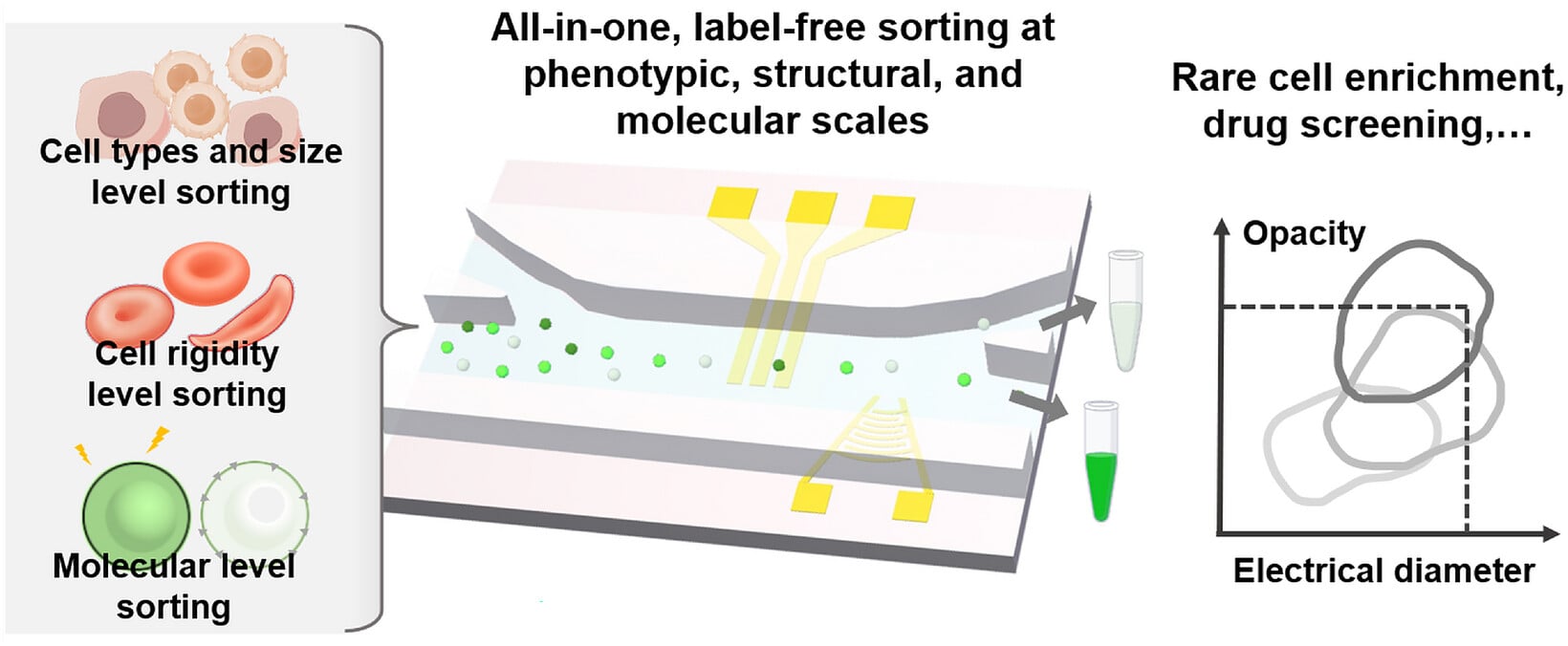

A Singapore-China study led by SUTD has built a microfluidic system that identifies and sorts cells using their electrical signature, then separates them with a precisely aimed pulse of sound.
This work presents an all-in-one, label-free microfluidic platform coupling multifrequency impedance profiling with real-time acoustic sorting. Beyond size and rigidity-related phenotypes, the platform resolves membrane electrical responses induced by optogenetic stimulation and pharmacological modulation, enabling noninvasive sorting of molecularly regulated cell states across multiple biological scales. This capability broadens functional cell analysis and precision biomedical applications.
SUTD
In biomedicine, sorting cells accurately without damaging them remains a persistent problem. Current methods, like fluorescence-activated cell sorting, rely on labelling the cells extrinsically, which can stress the cells, alter their behaviour and even interfere with the assay. A collaborative study between researchers in Singapore and China has now developed a non-invasive, label-free method to sort cells.
“The cell sorting platform is an integrated system that requires pre-focusing, cell sensing, and single-cell level manipulation,” said Associate Professor Ye Ai from Singapore University of Technology and Design, who co-led the published study, “Label-free impedance-activated acoustic sorting of cells from structural to molecular scale in microfluidics”.
Three components work together in this novel cell sorting platform: a viscoelastic fluid that lines cells up in a single file as they travel down the channel, a pair of electrodes that interrogate each cell electrically at two frequencies, and a focused acoustic wave generator that can nudge a chosen cell sideways on command.
“Imagine each cell passing through an electrical checkpoint in an ordered manner. The electrodes apply weak alternating signals at 1 and 5 megahertz and record how the passing cell changes those signals,” described Associate Prof Ai. “The system extracts features related to the cell’s effective size and electrical behaviour, compares them with preset sorting criteria, and predicts when that same cell will reach a downstream junction. If the cell ‘qualifies’, the system briefly switches on a focused sound wave, nudging the cell sideways into the collection outlet.”
Getting every cell to take the same, predictable path through the detection zone is essential to making the system work reliably. A viscoelastic polymer solution is used to focus cells into a single line before they reach the electrodes, ensuring that each cell experiences the same sensing-activated acoustic nudge, which maximises the sorting efficiency.
The research team tested the platform across three distinct problems. First, sorting cells purely by size — separating HeLa cells from EA.hy926 cells based on differences in their effective electrical diameter — reached up to 98 percent purity.
Second, the platform was able to detect and sort red blood cells whose stiffness had been altered by chemical treatments that mimic disease-related changes to the cell membrane and cytoskeleton.
Third, and most demanding, the platform sorted HEK293T cells engineered with light-sensitive proteins. It was able to distinguish cells in an electrically “activated” state from those pharmacologically blocked from responding to blue light. These cells look structurally identical and differ only in how their membranes handle charge.
“The cell sorting platform is an integrated system that requires pre-focusing, cell sensing, and single-cell level manipulation,”
Associate Professor Ye Ai, Singapore University of Technology and Design
This last result is the one Associate Prof Ai is most excited about. “The 98 percent result is an important engineering benchmark, but it was achieved with differently sized beads, which are relatively easy to distinguish,” he explained. “Sorting cells whose light- and drug-modulated states had no obvious size or shape difference demonstrates a more distinctive capability: we can sort cells based on a subtle functional electrical signature.”
Yet the system achieved a purity of only 85.4 percent on this third problem. “Functional responses are smaller and more variable. Drug-treated cells may respond incompletely or at different rates, so their impedance features partly overlap with those of activated cells,” Associate Prof Ai added. “Closing the gap would require careful control of event spacing and timing, as well as better signal quality and processing to allow more discriminating and faster classification.”
Associate Prof Ai sees research and drug-screening workflows as the nearest-term application. For instance, researchers can shed more light on red blood cell deformability or enrich living cells that respond differently to a treatment affecting membrane function to study them further. Clinical applications, such as flagging disease-associated changes in blood cells, remain a longer-term goal.
Looking ahead, the team wants to extend the platform to primary, more fragile, clinically relevant samples, and to sharpen its ability to pick out cells with subtler functional differences — in part by bringing in machine learning.
“Rather than relying mainly on fixed thresholds, we could train machine-learning models to recognise patterns across signal amplitude, phase, waveform shape, and frequency-dependent features,” Associate Prof Ai said. “The challenge is to make that identification both reliable and fast enough to trigger acoustic sorting in real time.”
Advertisement