

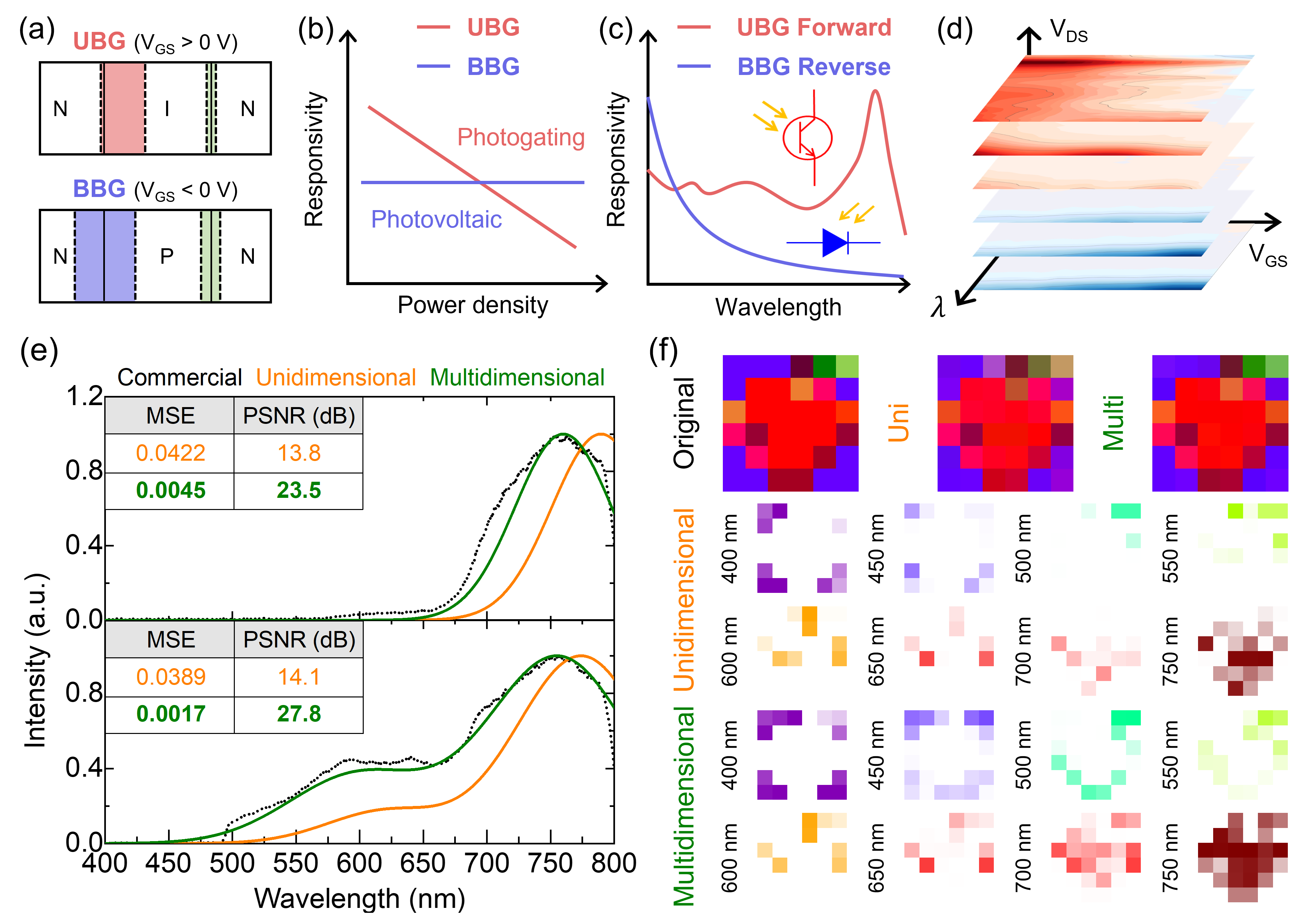

- Research teams led by Professors Jong-Soo Lee of DGIST, Hoon Hahn Yoon of GIST, and Hyun-Soo Ra of Kyungpook National University develop an ultra-high-precision computational spectrometer based on a single photodetector
- Technology expected to pave the way for commercialization of ultra-compact, low-power spectrometers for integration into smartphones, drones, and autonomous vehicles; findings published in Advanced Functional Materials, an international journal covering materials science and applied engineering
□ Research teams led by Professor Jong-Soo Lee of the Department of Energy Engineering at DGIST (President Kunwoo Lee), Professor Hoon Hahn Yoon of the Department of Semiconductor Engineering at GIST, and Professor Hyun-Soo Ra of the School of Electronics Engineering at Kyungpook National University have jointly developed a multidimensional computational spectroscopy technology. The technology uses a single sensor (photodetector) to reconstruct the intensity of light at individual wavelengths with ultra-high precision.
□ A spectrometer is an essential instrument for identifying the composition of materials by analyzing the intensity of light at different wavelengths. However, conventional spectrometers are difficult to miniaturize because they require complex optical components, such as prisms that separate light into different wavelengths, or large numbers of sensors. To overcome these limitations, computational spectrometers that use artificial intelligence (AI) algorithms have emerged. However, existing approaches rely on simplistic voltage control, making it difficult to accurately distinguish wavelength information in mixed light and resulting in substantial noise-induced errors.
□ The joint research team addressed this challenge by stacking three semiconductor layers (MoS₂/WSe₂/MoS₂) in a step-like configuration and introducing a specialized structure known as a floating-base bidirectional junction, which enables precise, simultaneous control of two types of voltage. By combining the two voltages, the researchers could flexibly control the energy barriers at interfaces within the sensor. This allowed them to vary both the magnitude and shape of the sensor's response, even when the incoming light contained multiple wavelengths, thereby enabling the wavelength information of each component to be clearly distinguished.
□ Analysis of the reconstructed spectral signals, obtained using semiconductor interface control technology based on the floating-base bidirectional junction structure and a multidimensional spectral input method, showed that the overlap between spectral responses—which had previously made it difficult to distinguish mixed-wavelength information—was reduced by more than 32%. In particular, the team reduced the reconstruction error rate for light with complex spectra by up to 95.6% compared with conventional methods. The researchers also significantly improved image reconstruction quality, as measured by the peak signal-to-noise ratio, from 14.1 dB to 27.7 dB, demonstrating the technology's outstanding performance. Furthermore, the team successfully reconstructed spectra and color distribution images with high accuracy, even under extreme conditions in which only minute electrical currents flowed.
□ "This achievement represents a major technological breakthrough, substantially improving both spectral and image reconstruction quality using only a single sensor," stated Professor Jong-Soo Lee of the Department of Energy Engineering at DGIST. "By replacing conventional large, heavy spectrometers, this technology could drive innovation across various industries, including smartphones, portable mobile spectrometers, ultra-compact, low-power wearable devices, and intelligent optical sensors."
□ "By controlling the interface barriers, we were able to regulate the separation and transport of photogenerated charge carriers, enabling more accurate differentiation of information from individual wavelength components in mixed-wavelength light," stated Professor Hoon Hahn Yoon of the Department of Semiconductor Engineering at GIST. "This is a representative example of convergent research integrating AI, semiconductors, and sensors, in which electrical control of semiconductor interfaces and multidimensional AI learning have substantially improved sensor performance."
□ This research was supported by the Individual Basic Research Program (Outstanding Young Scientist Grants) of the Ministry of Science and ICT (MSIT) and the National Research Foundation of Korea (NRF), the Creative Allied Project (CAP) of the National Research Council of Science and Technology (NST), and the Strategic Research Programs of DGIST and GIST. Professors Jong-Soo Lee of DGIST, Hoon Hahn Yoon of GIST, and Hyun-Soo Ra of Kyungpook National University served as co-corresponding authors. Dr. Sang-Hyeon Lee of DGIST, integrated master's–doctoral student Junho Min of GIST, and Dr. Yonas of GIST contributed as co-first authors.
□ The findings were published online in October in Advanced Functional Materials, an international journal covering materials science and applied engineering.
Advertisement