

- Identifies the causes of excessive heavy rare-earth accumulation and proposes a precision diffusion design strategy
- Reduces dysprosium (Dy) usage by 80% while maintaining comparable magnetic performance, potentially easing supply chain risks and cost pressures
- Findings published in Chemical Engineering Journal (IF: 12.5), a leading international journal in chemical engineering and materials science
□ A research team led by Jeongmin Kim and Donghwan Kim of the Division of Nanotechnology at DGIST (President Kunwoo Lee) has developed a materials design technology that dramatically reduces waste by maximizing the efficiency of expensive “heavy rare-earth elements” essential for manufacturing high-performance permanent magnets.
□ Neodymium–iron–boron (Nd–Fe–B) permanent magnets are key components in electric vehicle traction motors and wind turbines. In particular, heavy rare-earth elements, which are added to maintain coercivity (resistance to demagnetization) even at high temperatures, are extremely expensive and have unstable supply chains, consequently placing a significant burden on industry. Since completely eliminating heavy rare-earth elements remains difficult, the most important technical challenge is to minimize their use while maintaining magnetic performance.
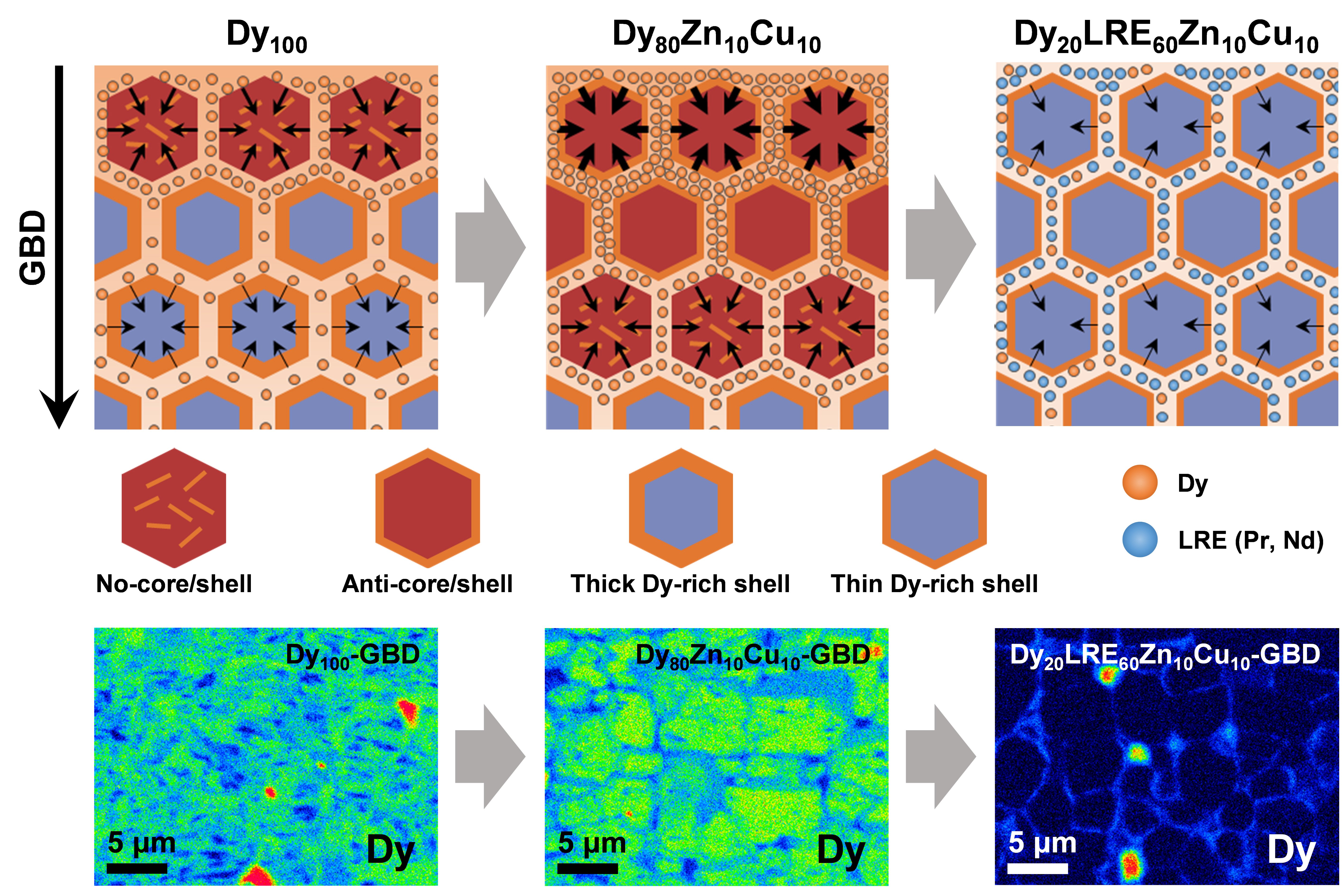
□ To achieve this, the “grain boundary diffusion process” is widely used, during which heavy rare-earth elements are applied to the magnet surface and then diffused into the interior through heat treatment. As these elements diffuse along the boundaries of grains within the magnet, they form thin shells on the grain surfaces, enhancing magnetic performance. However, if the heavy rare-earth elements fail to diffuse uniformly into the magnet and instead accumulate excessively within grains near the surface, the shells become unnecessarily thick, resulting in waste of these expensive elements.
□ The research team precisely identified the causes of excessive heavy rare-earth consumption and redesigned the composition of the diffusion source applied to the magnet surface, taking the proportion of light rare-earth elements in the base magnet into account. This suppressed the excessive accumulation of heavy rare-earth elements near the magnet surface and promoted the formation of thin, uniform shells on the grain surfaces, thereby maximizing heavy rare-earth utilization efficiency.
□ When the research team applied the technology they developed, they successfully reduced dysprosium (Dy) usage by as much as 80% compared with the conventional use of dysprosium alone, a representative heavy rare-earth element, while maintaining excellent magnetic performance equivalent to that achieved with the conventional method.
□ The significance of this achievement lies in identifying the causes of wasteful consumption of expensive heavy rare-earth elements and providing practical materials design guidelines to address the problem. Furthermore, the findings are expected to provide an important foundation for developing next-generation magnet manufacturing processes that use only inexpensive light rare-earth elements, without relying on heavy rare-earth elements.
□ “This study presents a materials design strategy that can dramatically reduce the use of expensive heavy rare-earth elements by precisely controlling their movement and distribution,” stated Principal Researcher Jeongmin Kim of the Division of Nanotechnology at DGIST. “We aim to extend this approach to light rare-earth-based processes, contributing to the efficient utilization of rare-earth resources and strengthening the technological competitiveness of next-generation high-performance permanent magnets.”
□ Meanwhile, this research was supported by the DGIST R&D Program, the Leading Research Center for Regional Innovation in Carbon-Neutral Intelligent Energy Systems at Kyungpook National University, and STAR GROUP IND. CO., LTD. The findings were published in Chemical Engineering Journal, a leading international journal in materials science and chemical engineering.
Advertisement