

Researchers in Taiwan have developed a unique copper-based material that conducts electricity like a metal while exhibiting a rare spin-polarized electronic structure, paving the way for advanced electronic and quantum technologies.
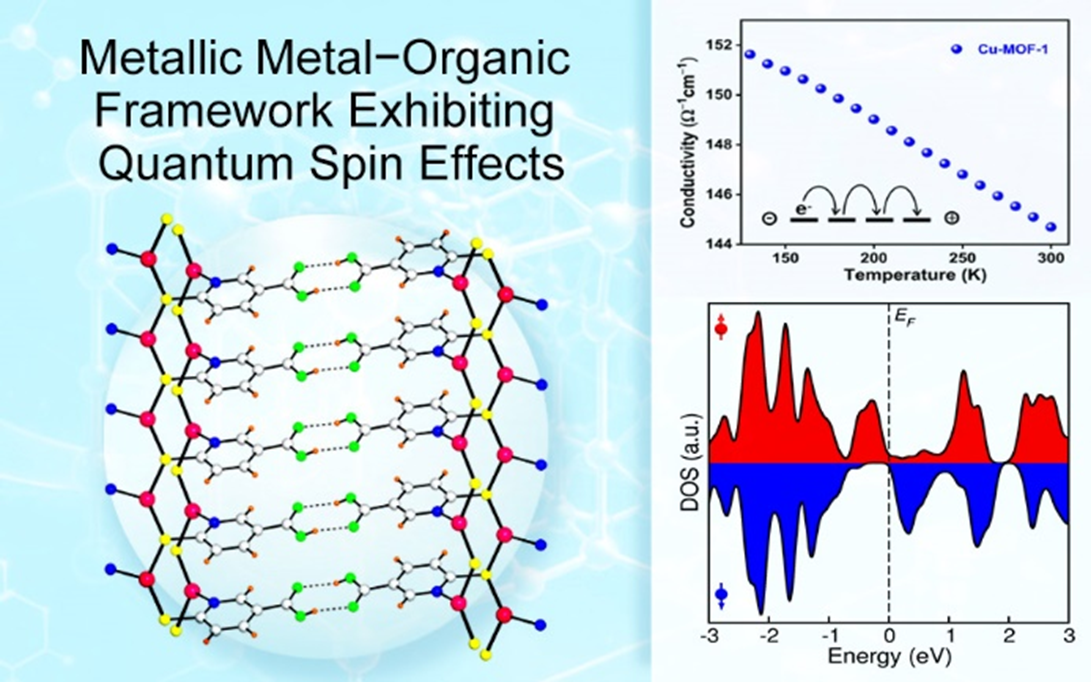
Copper atoms (pink) and sulfur atoms (yellow) form repeating zigzag chains in the crystal. The study identifies that these chains play a role in conductivity and spin polarization. Image cropped from the TOC figure of Kamal et al., Advanced Science (2026), CC BY 4.0.
National Taiwan University
In modern electronics and computing, finding advanced materials that can efficiently move electrical charges without losing energy remains a critical scientific challenge. While traditional metals conduct electricity exceptionally well, researchers continually seek innovative hybrid materials that combine the design flexibility of chemistry with true metallic performance.
A multi-institutional research team spanning four academic and research institutions across Taiwan—led by computational and theoretical investigators alongside close experimental collaborators—has now achieved a major milestone by creating a specialized copper-based crystal system that bridges the gap between conventional semiconducting frameworks and intrinsic metallic conductivity. The study is published in Advanced Science.
The newly synthesized material is a metal-organic framework (MOF) constructed from self-assembled copper-sulfur chains that facilitate seamless electron delocalization across the crystal lattice. Laboratory measurements on single-crystal devices revealed an exceptional electrical conductivity reaching up to 120 Siemens per centimeter, supported by temperature-dependent measurements confirming zero activation energy and metallic transport behavior.
Furthermore, under infrared light illumination, the material demonstrated outstanding photoconductive properties, achieving a photocurrent responsivity of 8,100 amperes per watt.
These remarkable figures highlight the material’s high sensitivity to light, wide linear dynamic range, and robust carrier mobility, making it a strong candidate for future high-performance optoelectronic devices, sensors, and energy storage systems. The extended carrier lifetimes observed in the single-crystal devices further underscore the material's potential for high-speed detection and stable operational performance.
Beyond its high conductivity, the material reveals a fascinating quantum phenomenon uncovered through advanced theoretical modeling and quantum-mechanical first-principles simulations.
The research team discovered that the system exhibits an exotic half-metallic electronic state, where electrons behave in two distinct ways depending on their spin orientation. Specifically, one spin channel demonstrates metallic behavior with multiple bands crossing the Fermi level, while the other spin channel behaves as a semiconductor featuring a narrow bandgap.
This unique combination of properties is exceptionally rare in metal-organic frameworks and opens up exciting new avenues for spintronics—emerging technologies that exploit electron spin rather than solely relying on electrical charge to process and store information. The steep valence band dispersion further contributes to a reduced effective mass, enhancing carrier mobility and solid-state efficiency.
By bridging fundamental quantum physics with scalable materials engineering, this collaborative study provides a robust new design paradigm for next-generation electronic materials across diverse technological fields.
"This work redefines the understanding of MOF conductivity by establishing spin as a key quantum descriptor of electronic transport," says co-corresponding author Dr. Michitoshi Hayashi, research fellow of Center for Condensed Matter Sciences at National Taiwan University.
Dr. Michitoshi Hayashi’s email address: [email protected]
Advertisement
Advertisement