


An international team of researchers led by The University of Tokyo Kavli Institute for the Physics and Mathematics of the Universe (Kavli IPMU, WPI) graduate student Takumi Tanaka, has analyzed data from the James Webb Space Telescope and uncovered a Little Red Dot believed to have existed approximatively 400 to 500 million years after the Big Bang. This makes it the furthest Little Red Dot found to date.
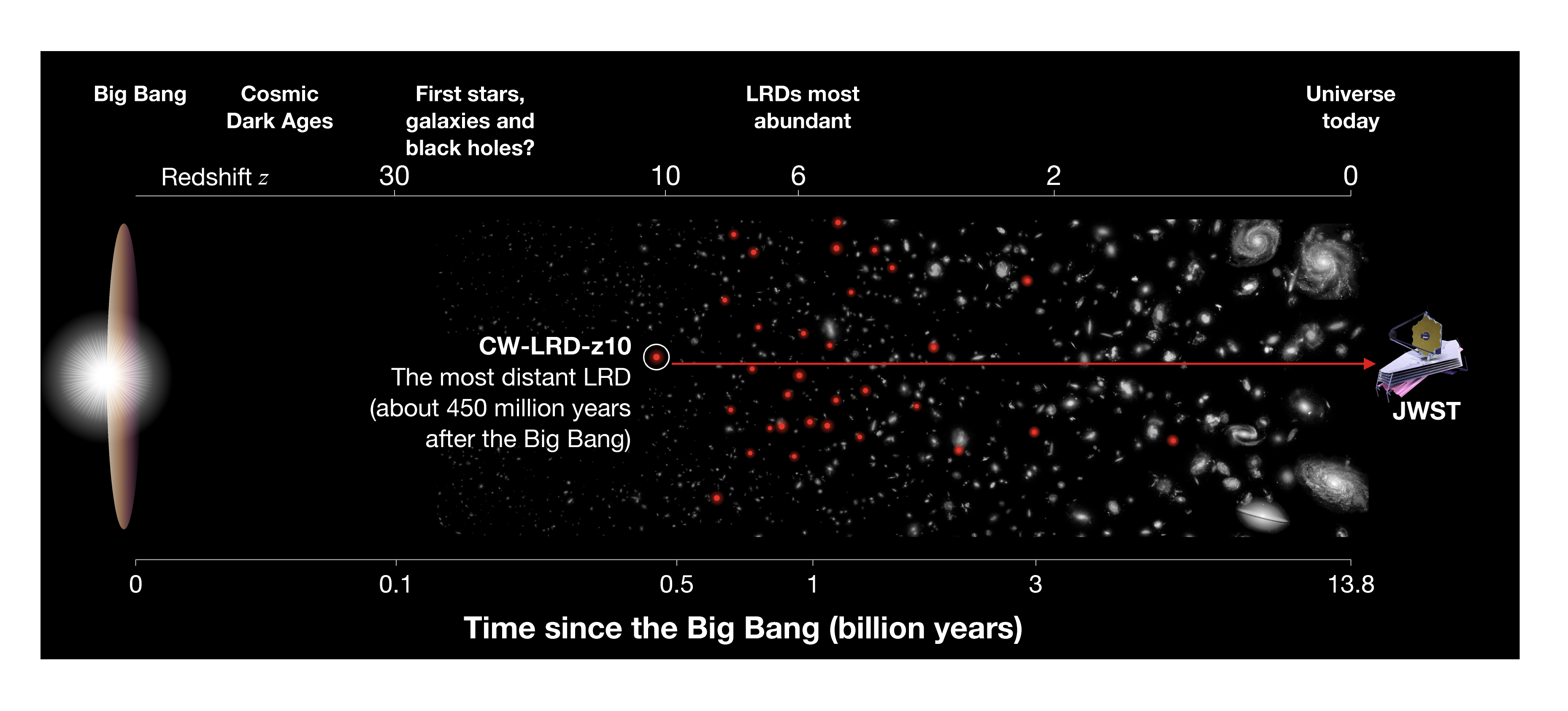
Figure 1: Schematic diagram summarizing the paper’s results. CW-LRD-z10 is a leading candidate for a Little Red Dot, measured at redshift z = 10.36, making it the oldest and furthest Little Red Dot observed to date.
Kavli IPMU (galaxy images: NASA, ESA, CSA, STScI, S. Finkelstein, M. Bagley, R. Larson (UT Austin), ESA/Hubble, The Hubble Heritage Team (STScI/AURA), modified)
Following the discovery of faint supermassive black holes called Little Red Dots (LRD) in the early universe in 2022, an international team of researchers have found the furthest Little Red Dot to date, reports a new study in the The Astrophysical Journal Letters.
Researchers believe that supermassive black holes exist at the center of many galaxies in the universe today. These black holes have masses that are orders of magnitude greater than ordinary black holes, which form when massive stars reach the end of their life. They have even been detected when the universe was 700 to 800 million years old, or about 13 to 13.1 billion years ago. How these supermassive black holes formed in the early universe has remained a mystery.
These have masses that are orders of magnitude greater than those of ordinary black holes, which form when massive stars reach the end of their lifespans. Furthermore, such supermassive black holes have already been discovered from a very early period in the universe’s history—approximately 700 million to 800 million years after the Big Bang (about 13 billion to 13.1 billion years ago). How supermassive black holes formed during this brief period in the early universe remains one of the great mysteries of modern astronomy.
When the James Webb Space Telescope (JWST) began detecting LRDs in the early universe, researchers have been studying them in detail, because they might hold the key to resolving this mystery.
Promising theories have suggested that black holes acting as precursors to supermassive black holes may have formed 500 million years after the Big Bang, but until now the only LRDs researchers could find had existed between 600 million to 1.5 billion years after the Big Bang.
A team led by The University of Tokyo Kavli Institute for the Physics and Mathematics of the Universe (Kavli IPMU, WPI) graduate student Takumi Tanaka, and including Professor John Silverman, analyzed high-resolution infrared images obtained through the JWST’s COSMOS-Web large-scale observation program.
Their biggest challenge was identifying LRDs in the very early universe. JWST’s near-infrared instruments could only study astronomical objects with wavelengths between 0.6–5 µm, but the wavelength of objects the researchers wanted to study had been stretched much longer due to the expansion of the universe.
So, the team developed a new method combining data from NIRCam (near-infrared) and MIRI (mid-infrared), both on JWST. Using this, they were able to identify CW-LRD-z10, a likely candidate for a LRD believed to have existed approximately 400 to 500 million years after the birth of the universe (Figure 2). This object was extremely small and exhibited the characteristic color of an LRD. The discovery of this LRD has already been published in The Astrophysical Journal on 2 December 2025.
To make sure the distance was correct, the team double checked their result using spectroscopic observations of CW-LRD-z10, which also revealed that CW-LRD-z10 has a spectrum similar previously discovered LRD objects, confirming that CW-LRD-z10 is the most distant LRD yet discovered.
Next, the researchers will study CW-LRD-z10 in more detail by looking at its hydrogen emission lines, which reveal black hole activity, and by analyzing its distribution of light.. Finding other LRDs at a similar point in cosmic history will also help researchers piece together evidence about when LRDs first appeared, how they formed, and what effect they have had on shaping our universe.
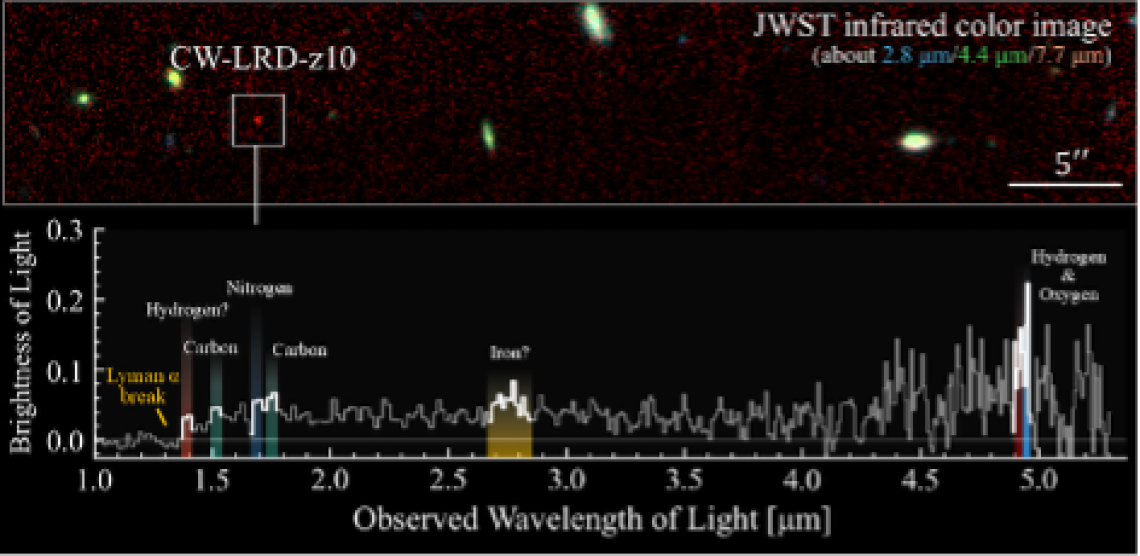
A pseudocolor image (top) and spectrum (bottom) of CW-LRD-z10. The red object at the center is CW-LRD-z10, a strong candidate for a Little Red Dot. The false-color image was created using images taken with the JWST’s near-infrared instruments using filters centered at approximately 2.7 µm, 4.4 µm, and 7.7 µm. Spectra analysis confirms the presence of the Lyman-alpha break, formed by absorption by neutral hydrogen, as well as emission lines from hydrogen, carbon, nitrogen, oxygen, and iron. This made it possible to precisely measure the distance to CW-LRD-z10.
COSMOS-Web / Tanaka
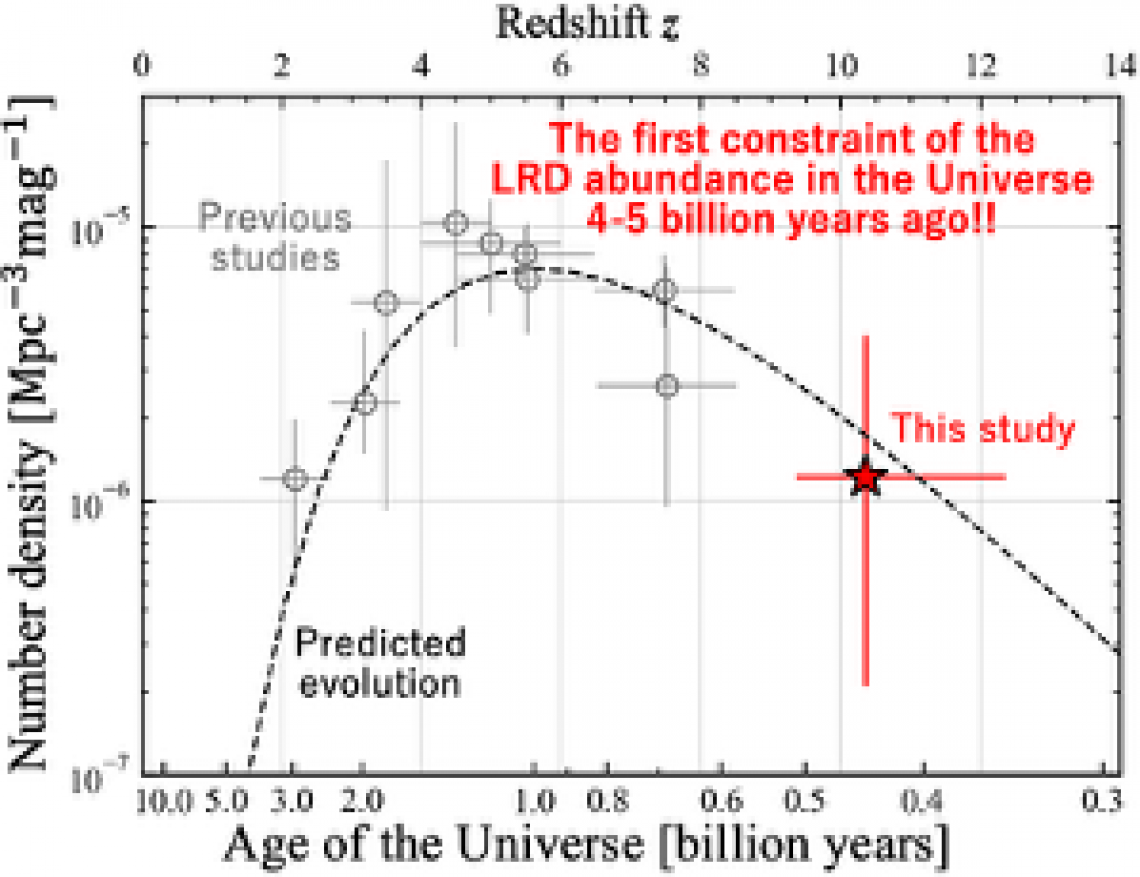
Evolution of the LRD abundance (number density). The LRD number density (red stars) determined in this study was consistent with the predictions for the cosmic evolution of LRD proposed in previous studies (black dashed line).
Adapted from Tanaka et al. 2025, ApJ
Advertisement