

Chemistry Nanotechnology
News
05 Oct 2026
Researchers at the University of Osaka have developed a method for distinguishing the L- and D-forms of amino acids based on current waveforms generated by single molecules passing through a nanogap. The L/D ratio of amino acids is a potential biosignature of life. Major features of the amino acid composition were captured for astrobiologically relevant samples. The method could be used to develop electrical instruments for extraterrestrial life detection.
17 Sep 2026
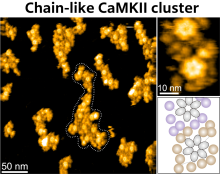
Researchers at the Nano Life Science Institute (WPI-NanoLSI) at Kanazawa University, Kyoto University, SOKENDAI, and the National Institute for Physiological Sciences have revealed how a key brain protein involved in learning and memory organizes itself into chain-like structures. Their study was published in Science Advances.

03 Sep 2026
A team led by researchers from the Institute of Industrial Science, The University of Tokyo shows that controlling the spin of hydrogen atoms can regulate chemical reactions
27 Aug 2026
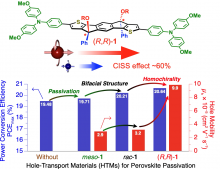
Researchers at the University of Osaka developed chiral hole-transport materials that selectively conduct electrons according to spin. Across three classes of materials, molecular handedness consistently determined the direction of spin polarization. The homochiral material also showed nearly threefold higher hole mobility and improved charge extraction and surface passivation in perovskite solar cells, highlighting new possibilities for controlling spin, charge transport, and interfaces through molecular design.
21 Aug 2026
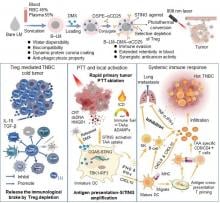
Triple-negative breast cancer (TNBC) accounts for roughly 15–20% of all breast cancer cases and is difficult to treat. Patients are often left with chemotherapy as their only treatment option. This is because TNBC tumors contain a large number of T cells that suppress the immune system. Yet researchers from Tohoku University have come up with a three-pronged approach to overcome this problem.
20 Aug 2026
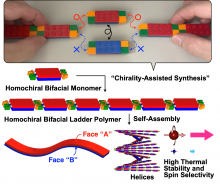
Researchers from the University of Osaka have developed a new class of chiral semiconducting polymers that can generate highly spin-polarized electrical currents. The team’s unique molecular design allows the polymers to self-assemble into helical structures that efficiently filter electron spins, offering a promising platform for future spintronic devices and clean-energy technologies.
30 Jul 2026
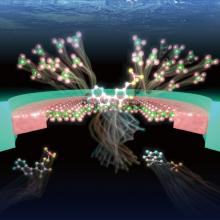
Researchers from the University of Osaka and collaborating institutions developed an autonomous solid-state nanopore that combines sensing, memory, and signal generation in a single device. Unlike conventional nanopores, the sensor continually reshapes itself through chemical reactions, producing unique electrical signatures as molecules pass through, providing a basis for memory. The device successfully identified a variety of nucleotides and amino acids, providing a new platform for molecular sensing and future iontronic computing.
10 Jul 2026
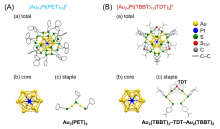
Catalysts are everywhere—from fertilizer production to clean energy—but making them more active without sacrificing stability has remained a major challenge. Researchers have now engineered a gold-platinum nanocluster catalyst that can be activated at lower temperatures while maintaining its precise atomic structure, boosting low-temperature carbon monoxide oxidation performance. Yet a clever ligand design could pave the way for more efficient and durable catalysts.
06 Jul 2026
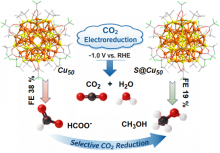
Researchers at Tohoku University have discovered a promising strategy that converts harmful carbon dioxide into valuable fuels and chemicals by precisely altering nanoclusters made of copper.
08 Jun 2026
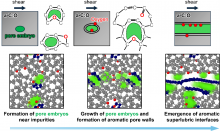
Scientists found that certain chemical impurities, such as hydrogen and oxygen, help amorphous carbon form graphite-like, ultralow-friction interfaces under mechanical stress. The findings reveal how impurities can enable self-forming lubricating surfaces, offering a new strategy for designing durable, energy-efficient materials.
18 Feb 2026
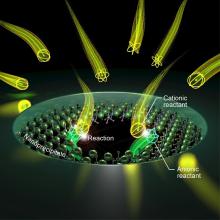
Researchers at The University of Osaka have developed a method to reproducibly form subnanometer pores within a solid-state nanopore. A voltage-driven chemical reaction produces a precipitate that fills and closes the nanopore, while dissolution reopens conductive pathways. This process forms many subnanometer-sized pores, whose effective size can be tuned by changing reactant composition and pH. These ultrasmall pores mimic biological ion channels and enable studies of ion transport in confined spaces.

21 Jan 2026
Mixing two or three liquids can achieve the right combination of functions for soft electronics.
09 Jan 2026
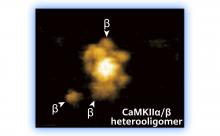
Scientists at the Nano Life Science Institute (WPI-NanoLSI), Kanazawa University, have captured real-time images showing how a key brain enzyme organizes itself to help memory formation. Their study, published in Nature Communications, reveals that the enzyme CaMKII forms mixed α/β subunit structures whose interactions stabilize learning-related signals in neurons.
26 Nov 2025
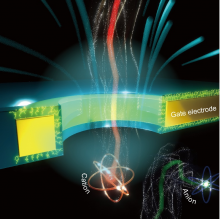
Researchers from The University of Osaka fabricated a nanopore surrounded by a gate as a cooling system with enhanced efficiency for semiconductor chips. Applying a voltage to the gate induces the flow of ions through the nanopore. Creating a salt gradient makes the ion flow unidirectional. Heat is dragged along with the ions, resulting in heat transfer. Changing the applied voltage from negative to positive switches the system from cooling to heating.
23 Oct 2025
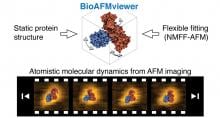
A collaboration team of researchers from the Nano Life Science Institute (WPI-NanoLSI), Kanazawa University, the Institute of Transformative Bio-Molecules (WPI-ITbM), Graduate School of Science at Nagoya University, and the RIKEN Center for Computational Science (R-CCS) reports in ACS Nano an integrative modeling workflow to understand with atomistic precision biomolecular dynamics from high-speed atomic force microscopy experiments.

01 Jul 2025
A new nanoparticle capable of carrying much higher doses of drugs while staying stable for extended periods could make treatments more effective

26 Jun 2025
Researchers at the Nano Life Science Institute (WPI-NanoLSI), Kanazawa University, report in Small, a weekly peer-reviewed scientific journal covering nanotechnology, published by Wiley-WCH, Germany, how short peptides self-assemble linearly on atomically-thick solid surfaces, such as graphite and MoS₂. The research addresses a longstanding challenge in materials science: understanding the complex, sequence-specific interactions between peptides and solid substrates, and the critical role of local hydration structures in guiding nanoarchitecture formation. This work offers new strategies for integrating biomolecules with advanced materials in future bioelectronics and sensor devices.

21 May 2025
Portable technology offers instant, power-free ethanol detection across concentrations

28 Apr 2025
The power conversion efficiency of all-organic solar cells was doubled through the development of novel organic electrodes that can be fabricated using a moderate process.

17 Apr 2025
Shin-Etsu Chemical and Hokkaido University have developed system for the production of lipid nanoparticles (LNPs) that incorporates a microfluidic device.

27 Jan 2025
The team’s findings have potential applications in photonics and memory devices.

16 Dec 2024
Redefining the art of matter manipulation at the nanoscale

10 Dec 2024
Nanostructured two-dimensional gold monolayers offer possibilities in catalysis, electronics, and nanotechnology.

19 Sep 2024
Light-induced immunoassay coated with novel coronavirus spike proteins found highly sensitive even with weak light like a laser pointer

09 Sep 2024
Researchers at the Nano Life Science Institute (WPI-NanoLSI), Kanazawa University, develop a biosensor that improves sensitivity to 1-methylnicotinamide (1-MNA) in urine by orders of magnitude without the need for sample purification.

05 Sep 2024
New filter removes chemical contaminants from water even at very low concentrations

05 Aug 2024
Researchers at Nano Life Science Institute (WPI-NanoLSI), Kanazawa University, IMDEA Nanoscience (Madrid, Spain) and CNB-CSIC (Madrid, Spain) report in ACS Nano experiments that reveal a cycle of conformational stages that recombinant Influenza A genomes pass through during RNA synthesis.

17 Jul 2024
Researchers at Nano Life Science Institute (WPI-NanoLSI), Kanazawa University report in Biosensors and Bioelectronics: X a novel approach for detecting a particular biomolecule associated with several diseases. The results show good sensitivity and selectivity, and may lead to the development of a low-cost, rapid detection device useful in cancer prognosis.
27 Feb 2024
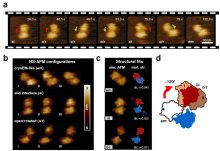
Researchers from Nano Life Science Institute (WPI-NanoLSI), Kanazawa University report in Nature Communications that TMEM16F, a transmembrane protein that facilitates the passive movement of phospholipids and ions across membranes, explores a larger conformational landscape than previously thought to perform its unique functions. The finding refines our molecular understanding of crucial physiological processes such as blood coagulation and COVID-19 pathogenesis, and highlights the importance of probing membrane proteins in native-like environments.
03 Oct 2023
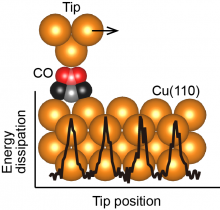
Friction, an everyday phenomenon, has perplexed scientists for centuries. Though extensively researched, our understanding remains fragmented, primarily due to the multifaceted interactions that span across varying scales. Achieving an accurate grasp of the precise contact conditions between objects has been a longstanding challenge, a
feat recently made possible through advancements in scanning probe microscopy.
Events
Sorry, nothing coming up for this discipline
Researchers

Professor Shinya Maenosono leads his research group at Japan Advanced Institute of Science and Technology (JAIST). His research in JAIST has focused on two main areas of interest in the field of materials chemistry and nanotechnology. The first area involved wet chemical synthesis of semiconductor nanoparticles with controlled size, shape and composition for energy conversion device applications. The second area has focused on the synthesis and bioapplication development of monometallic and alloyed multimetallic nanoparticles.

Lecturer in Forensic Chemistry field. Actively engaging in agricultural waste upcycling into nanatechnology products.

A Tenured Professor at the Institute of Space Technology (Pakistan), Dr. Shabbir is working on Polymer based Nanomaterials for food safety, nano-drug delivery systems, water treatment, solar cells and carbon dioxide capture.

Madoka Ono is an associate professor at the Research Institute for Electronic Science/Green Nanotechnology Research Center at Hokkaido University and is the principal researcher at AGC Inc. Materials Integration Laboratories.

A pioneering researcher in Systems Chemistry for autonomous behavior in multi-molecular systems. The interdisciplinary field of chemistry and physics can be contributes the development in micro-robotics and comprehension of origin-of-life.

Dr. Leung is an Associate Professor and Programme Director at the Department of Chemistry, The Hong Kong Baptist University (HKBU), Hong Kong SAR, P. R. China. He concurrently holds the Honorary Associate Professorship at the Faculty of Dentistry, The University of Hong Kong (HKU). He is a Chartered Scientist, Chartered Chemist of the Royal Society of Chemistry in UK and a member in the State Key Laboratory of Environmental and Biological Analysis at HKBU. He was elected as a Founding Member of The Hong Kong Young Academy of Sciences. His research interests are in the field of supramolecular chemistry, organic materials catalysis, nanoscience, and nanomedicine.

Dr. Omachi is Associate Professor, Research Center for Materials Science, Nagoya University
Giants in history
Sorry, nothing coming up for this discipline