

ACS Catalysis
About ACS Catalysis
ACS Catalysis focuses on experimental and theoretical studies on molecules, macromolecules, and materials that are catalytic in nature.
- Website: https://pubs.acs.org/journal/accacs
- Current Issue: https://pubs.acs.org/toc/accacs/current
News
29 Sep 2026
Tohoku University
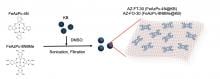
What if the blue pigment in your ink or dye could help power the future of clean energy? A research group has fine-tuned blue pigment molecules to create a blue-pigment based catalyst that is high-performing and free of the more expensive platinum.
27 Aug 2026
The University of Osaka
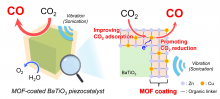
Researchers at the University of Osaka developed a catalyst that uses ultrasonic vibration to convert CO2 into CO. By modifying the catalyst with a metal–organic framework (MOF) incorporating isolated copper atoms, the catalyst is designed to concentrate CO2 near copper reaction sites and make better use of piezo-induced charges generated by vibration. It achieved a CO production rate of 114 μmol g-1 h-1, nearly five times that of pristine BaTiO3. The findings provide a new strategy for using mechanical energy to support more efficient carbon recycling.
07 Aug 2026
Kanazawa University
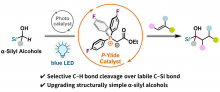
Kanazawa University, Japan – Research group led by Prof. Keiichi Hirano and Assistant Prof. Akira Matsumoto have developed a novel synthetic method for the selective cleavage of strong carbon–hydrogen (C–H) bonds while preserving weaker carbon–silicon (C–Si) bonds. This transformation enables the upgrading of structurally simple α-silyl alcohols into functionalized derivatives that are difficult to access by conventional methods. The key to this success lies in utilizing a finely tuned phosphonium ylide catalyst in combination with an organophotoredox catalyst under visible-light irradiation.
06 May 2026
National Taiwan University
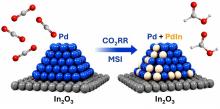
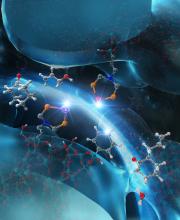
Dynamic catalyst interfaces offer a smarter route for converting CO2 into formic acid.
03 Apr 2026
YOKOHAMA National University
Holds potential for use in developing next-generation catalysts

19 Feb 2026
Tohoku University
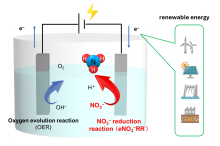
Storing hydrogen efficiently is still challenging. Researchers at Tohoku University have developed a new catalyst that coordinates the two key steps of hydrogen formation in alkaline water electrolysis, helping the reaction run more smoothly. A promising step toward practical green hydrogen.
11 Dec 2025
Tohoku University
Sometimes the simplest solution is the best one. This research shows how exposing a single active site has huge implications for producing green energy.
08 Dec 2025
Daegu Gyeongbuk Institute of Science and Technology (DGIST)
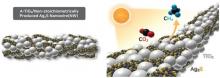
- Developed a photoresponsive Z-structure combining amorphous TiO2 and Ag2S nanowires
- Maximized light energy conversion efficiency through defect control and structural design.
- Research results published in ACS Catalysis.
22 Oct 2025
The University of Osaka
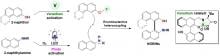
The University of Osaka researchers developed a world-first sustainable method for synthesizing pharmaceutical-grade NOBIN. By cooperatively utilizing a vanadium catalyst and energy-efficient LED light, the process eliminates byproducts, reduces waste, and allows for ideal raw material ratios, paving the way for greener and more efficient chiral molecule production.
09 Sep 2025
National Taiwan University
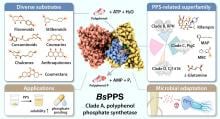
Researchers at National Taiwan University have discovered a versatile enzyme from Bacillus subtilis that efficiently attaches phosphate groups to natural compounds. This breakthrough offers a greener way to boost drug solubility and develop more effective nutraceuticals and prodrugs.

21 Jul 2025
Daegu Gyeongbuk Institute of Science and Technology (DGIST)
- A joint research team led by Kyoungsoo Park at DGIST, Sungkeun Kim at Seoul National University, and Graham Hutchings at Cardiff University, the UK, has developed a selective catalyst technology to convert carbon dioxide into an industrial raw material by controlling the interaction between rhodium and the carrier
- The study findings were published in ACS Catalysis, one of the most renowned journals worldwide

02 Jul 2025
Tohoku University
Researchers have explored how artificial intelligence and machine learning are helping scientists identify catalysts for methane pyrolysis, a reaction that produces hydrogen without emitting carbon dioxide.

26 Feb 2025
Tohoku University
The less carbon dioxide polluting our air, the better. Researchers are investigating non-toxic, low-cost electrocatalysts to turn our sustainability goals into reality.

15 Nov 2024
Hokkaido University
A new method streamlines the design and effectiveness of ligands used in chemical reactions in catalysis and drug delivery.

13 Sep 2024
Tohoku University
The oxygen evolution reaction (OER) is an electrochemical process in which water or hydroxide ions are oxidized to produce oxygen gas, playing a crucial role in water splitting and energy conversion. The OER requires efficient catalysts, and now a research group has enhanced the efficiency of traditional cobalt oxide catalysts by doping them with erbium.

11 Sep 2024
Tohoku University
As global demand for clean energy solutions grows, the development of cost-effective and efficient catalysts will be pivotal in advancing renewable energy systems. Now, a group of researchers has made significant progress in this regard by employing chromium doping on transition metal hydroxides.
20 Sep 2023
The University of Osaka
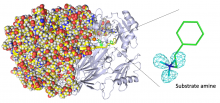
A team led by researchers at SANKEN (The Institute of Scientific and Industrial Research), at Osaka University has used neutron crystallography to image all of the atoms in a radical intermediate of a copper amine oxidase enzyme. They disclosed previously unknown details, such as precise conformational changes, that help to explain the enzyme's biochemistry. This work might help researchers engineer enzymes that facilitate unusual chemistry or are highly efficient at room temperature that are useful in chemical industry.
26 Jul 2023
Tohoku University
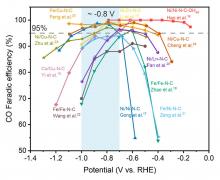
Researchers at Tohoku University have unraveled the reasons behind the underperformance of a promising field of catalysis known as dual atom catalysts (DACs). Their findings shed light on the challenges faced by DACs in converting carbon dioxide into valuable multicarbon products.
07 Feb 2023
Hokkaido University
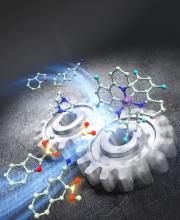
Two catalysts working in tandem enable inexpensive formate salts to perform difficult dearomative reactions, giving products potentially useful for drug development.
14 Mar 2022
Hokkaido University
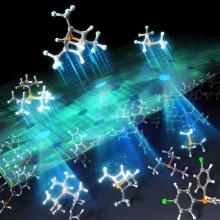
Researchers aim to streamline the time- and resource-intensive process of screening ligands during catalyst design by using virtual ligands.
20 Feb 2022
Kanazawa University
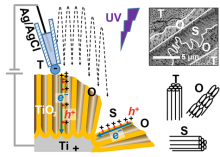
In a recent study published in the journal ACS Catalysis researchers from Kanazawa University describe novel scanning electrochemical cell microscopy measurements to determine sites of photoelectrochemical activity in titanium dioxide nanotubes.
10 Feb 2021
Nagoya University
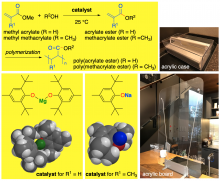
Scientists have found catalysts that improve an important industrial reaction and make it more eco-friendly.

20 Nov 2020
Ulsan National Institute of Science and Technology (UNIST)
A recent study, affiliated with South Korea's Ulsan National Institute of Science and Technology (UNIST) has succeded in developing high-performance perovskite oxide catalysts, using late transition metal oxide materials.
14 Aug 2020
Kanazawa University
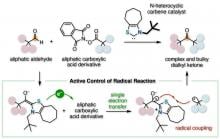
In catalytic reactions with organocatalysts, it is difficult to control radical reactions. We designed a thiazolium-type N-heterocyclic carbene catalyst having an N-neopentyl group. This catalyst was found to actively control radical reactions and enabled production of more than 35 species of bulky dialkyl ketones from an aliphatic aldehyde and an aliphatic carboxylic acid derivative through a radical relay mechanism. This catalyst is expected to open the way for acceleration of drug discovery research.
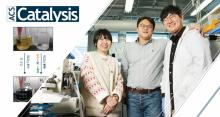
02 Mar 2020
Ulsan National Institute of Science and Technology (UNIST)
A recent study, affiliated with South Korea's Ulsan National Institute of Science and Technology (UNIST) has presented a new biofuel system that uses lignin found in biomass for the production of hydrogen.

26 Aug 2019
Ulsan National Institute of Science and Technology (UNIST)
A recent study, affiliated with South Korea's Ulsan National Institute of Science and Technology (UNIST) has introduced an artificial catalytic reactor that can take control of chemical reactions inside living cells, as desired.
17 Apr 2019
Hokkaido University
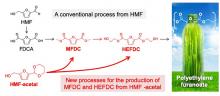
A one-step method enables scalable and more environmentally friendly production of plant-derived plastic monomers, paving the way towards the mass production of a sustainable alternative to petroleum-based materials.
07 Feb 2019
Daegu Gyeongbuk Institute of Science and Technology (DGIST)
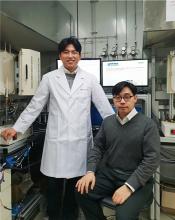
New material used as an electrode of solid oxide fuel cell.

17 Feb 2017
The Agency for Science, Technology and Research (A*STAR)
Dropping the carbon from a key battery component could finally enable long-life, low-cost grid-connected batteries for renewable energy storage.
16 Nov 2015
Zelinsky Institute of Organic Chemistry, Russian Academy of Sciences
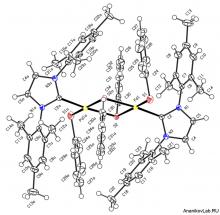
Pd/NHC Catalytic system, developed in the Ananikov laboratory, targeted on alternative technology of chemical utilization of organic sulfur species from crude oil (DOI: 10.1021/acscatal.5b01815).