

Advanced Materials
About Advanced Materials
Advanced Materials, one of the world's most prestigious journals and the foundation of the Advanced portfolio, has been the home of choice for best-in-class materials science for decades.
News

03 Sep 2026
Sungkyunkwan University
Targeting the spleen with engineered mycobacterial nanocomplexes turns tumor-supporting cells into active cancer fighters through trained immunity.

27 Aug 2026
National Taiwan University
Researchers redesigned C-shaped organic dyes so they lose less energy while emitting near 1000 nanometres. In an OLED, the optimized design reached an external quantum efficiency of 3.56% at 995 nanometres.
29 Jul 2026
The University of Osaka
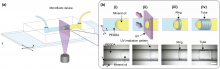
Researchers at the University of Osaka have developed a method to build stable, tubular hydrogel structures at the arteriole scale. Using a technique called meniscus-guided interfacial ring-by-ring assembly, UV light is used to form ring-shaped structures at an oil–hydrogel interface, which combine to form hollow tubes. Different tubes could be created with good stability, controlled sizes, complex shapes, and multi-component structures. These structures could help to create vascular networks for artificial tissue models.
16 Jun 2026
Sungkyunkwan University
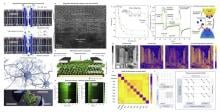
Single-Step Plasma Process Produces Optoelectronic Synapse for 3D Stackable Neuromorphic Vision
11 May 2026
Sungkyunkwan University
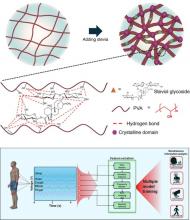
Development of Stevia-PVA Hydrogel-Based Triboelectric Nanogenerator Technology
21 Apr 2026
Daegu Gyeongbuk Institute of Science and Technology (DGIST)
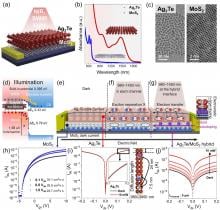
- Prof. Jong-Soo Lee’s team realizes a “hybrid photosensor” combining quantum dots and two-dimensional semiconductors
- Proposes a low-cost, large-area platform to replace expensive conventional sensors; successfully fabricates a 32×32 pixel image sensor array
- Published in the world-leading materials science journal Advanced Materials
03 Apr 2026
Sungkyunkwan University
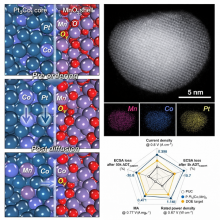
A novel computational approach reveals an oxygen vacancy-mediated synthesis mechanism, overcoming longstanding limits in atomic-level structural control
30 Mar 2026
Daegu Gyeongbuk Institute of Science and Technology (DGIST)
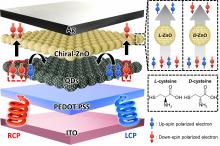
- Professor Jiwoong Yang’s team has developed a quantum-dot-based “circularly polarized light” sensor covering ultraviolet to infrared spectrum.
- Breakthrough design introduces chiral structures into charge transport pathways, overcoming material and wavelength limitations of conventional optical sensors.
- Published in Advanced Materials, a top-tier international journal in the field of materials science.
05 Feb 2026
Tohoku University
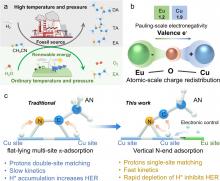
Researchers at Tohoku University have developed a much more efficient way to produce ethylamine - a crucial component for dyes, pharmaceuticals, and more. It all starts with a catalyst.

01 Dec 2025
Daegu Gyeongbuk Institute of Science and Technology (DGIST)
- Joint research team from DGIST, KAIST, POSTECH, Kyung Hee University, and Kongju National University develops a next-generation, eco-friendly heating and cooling technology that operates without electricity
- The research result was selected as the cover study in ‘Advanced Materials’
17 Nov 2025
The University of Osaka
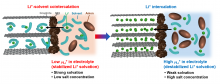
Researchers from The University of Osaka and Daikin Industries, Ltd. have discovered a key metric, "electrolyte lithium-ion chemical potential," that governs lithium-ion battery performance. This quantitative indicator shows that efficient charging occurs when lithium ions are sufficiently “unstable” in the electrolyte. This breakthrough replaces trial-and-error methods with a rational design approach, enabling faster development of safer, higher-performance batteries for applications like EVs and renewable energy storage.
29 Oct 2025
National Taiwan University
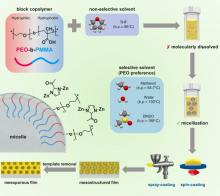
Researchers led by Prof. Kevin C.-W. Wu at National Taiwan University and Prof. Yusuke Yamauchi at Nagoya University have successfully developed a rapid and scalable evaporation-induced method to create continuous, uniform thin films of mesoporous amorphous metal-organic frameworks (aMOFs).
27 Oct 2025
Daegu Gyeongbuk Institute of Science and Technology (DGIST)
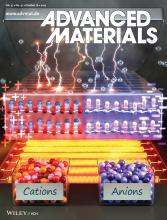
- Proposed the world’s first strategy to precisely control triboelectric polarity through polymer structure design, drawing attention to it as a next-generation energy-harvesting material.
- Developed an ion-anchored polymer electrolyte that overcomes the limitations of conventional ionic liquids, achieving both output stability and controlled polarity.
- Research findings published in Advanced Materials, a world-renowned journal in the field of material science.
20 Oct 2025
Daegu Gyeongbuk Institute of Science and Technology (DGIST)
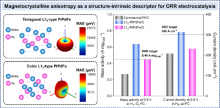
- Introducing “magnetic properties” into platinum-based alloys, dramatically improving oxygen reduction reaction performance and durability
- Exceeding the U.S. Department of Energy’s 2025 targets–expected to contribute to the commercialization of next-generation eco-friendly hydrogen energy
06 Oct 2025
The University of Osaka
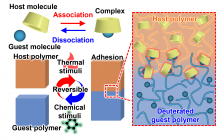
Researchers from The University of Osaka have developed a polymeric adhesion system by introducing reversible bonds at the adhesion interface based on the formation and dissociation of host–guest complexes. The adhesive can be decomposed on demand using temperature or chemicals and reused multiple times. Visualization of the interface using neutrons revealed the mechanism underlying repeatable sticking and peeling. This technology can be used for sustainable material applications.

08 Sep 2025
Daegu Gyeongbuk Institute of Science and Technology (DGIST)
- Development of a highly stretchable color conversion layer through direct cross-linking between eco-friendly quantum dots and stretchable polymers
- Research findings published in Advanced Materials, a top-tier international journal in the field of materials science

02 Jul 2025
National Taiwan University
Operando X-ray spectroscopy is a powerful tool for probing electrocatalyst dynamics—but intense X-ray exposure can distort structural insights. This study reveals flux- and dose-dependent artifact thresholds and proposes practical protocols to ensure accurate, artifact-free measurements.

05 Jun 2025
Tohoku University
Researchers at Tohoku University found a method to break down specific contaminants in water in order to help replenish one of our most precious resources: fresh water.

02 Apr 2025
Singapore University of Technology and Design
A research team led by the Singapore University of Technology and Design, in collaboration with the Agency for Science, Technology and Research, National University of Singapore, University of Southern Denmark, and University of Birmingham, demonstrates a novel way to control the colour of quantum light at room temperature, unlocking new applications in quantum communication and photonics.

01 Mar 2025
Daegu Gyeongbuk Institute of Science and Technology (DGIST)
- DGIST Professor Sohee Kim’s research team has developed the world’s first three-dimensional neural electrode that deforms smoothly using soft actuation technology.
- It is expected to be used in various next-generation soft bioelectronic devices, including electroceuticals for peripheral nerve treatment

15 Nov 2024
Tohoku University
A sprinkling of magnetic nanoparticles is just enough to power up catalysts, so they can make hydrogen peroxide production more efficient.

25 Oct 2024
Daegu Gyeongbuk Institute of Science and Technology (DGIST)
- DGIST, KAIST, and Korea University collaborated to develop a three-dimensional device with reversible heating/cooling based on the thermal radiation phenomenon
- Research published as a cover article in Advanced Materials

07 Oct 2024
Tohoku University
Unearthing new LEDs, solar cells, and photodetectors requires extensive knowledge surrounding the optical properties of materials. Calculating these takes time and resources. Yet researchers from Tohoku University and the Massachusetts Institute of Technology have unveiled a new AI tool that can accurately, and crucially much faster than quantum simulations, for predicting optical properties.

11 Sep 2024
Tohoku University
How can we make certain electrochemical reactions faster and more efficient? Researchers at Tohoku University investigated the use of Co X-ides for the electrocatalytic hydrogenation of quinoline.
09 Apr 2024
Tohoku University
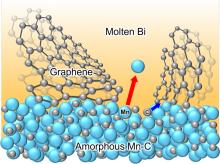
Nanocellular graphene, a specialized form of the revolutionary material graphene, is coveted for its ability to improve the performance of electronic devices, energy devices and sensors. But its development has been stymied by cracks that appear during the manufacturing process. Now, researchers have discovered a means to achieve crack-free, robust NCG - something they successfully put to use in a sodium battery.

28 Feb 2024
Daegu Gyeongbuk Institute of Science and Technology (DGIST)
Magnetic nanorobots delivering nerve cells to targeted tissues could potentially be used to repair damaged brain tissue, as well as other organs.
26 Jan 2024
Daegu Gyeongbuk Institute of Science and Technology (DGIST)
- DGIST Prof. Park Jin-hee and her team detected unknown sample components by analyzing color change patterns and developed a technology that allows analyzing concentrated amounts through a mobile phone camera
- Expected to secure source technologies and open new avenues in the environmental sensor field
23 Jan 2024
The University of Osaka
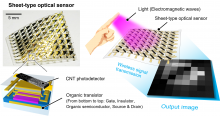
Researchers from SANKEN (The Institute of Scientific and Industrial Research), at Osaka University developed an optical sensor consisting of carbon nanotube photodetectors and organic transistors formed on an ultrathin, flexible polymer film. A wireless system reads the images from the sensor. Experiments showed the sensor has high sensitivity, a wide bandwidth, and robustness to extreme deformation such as bending and crumpling. This sensor has high potential for use in applications such as non-destructive imaging, non-sampling liquid quality evaluation, wearable devices, and soft robotics.
13 Sep 2023
Hokkaido University
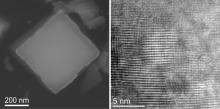
Systematic copper doping boosts all-solar utilization in tungstic acid nanocrystals.
10 Jul 2023
Tohoku University
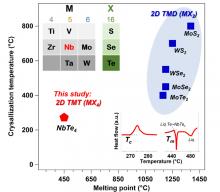
Tohoku University researchers have engineered a new material that overcomes some of the barriers to furthering phase change memory – a potentially revolutionary form of data storage that is still in its infancy. Using sputtering, they created a 2D Van Der Waals Chalcogenide that possesses an ultra-low melting point.