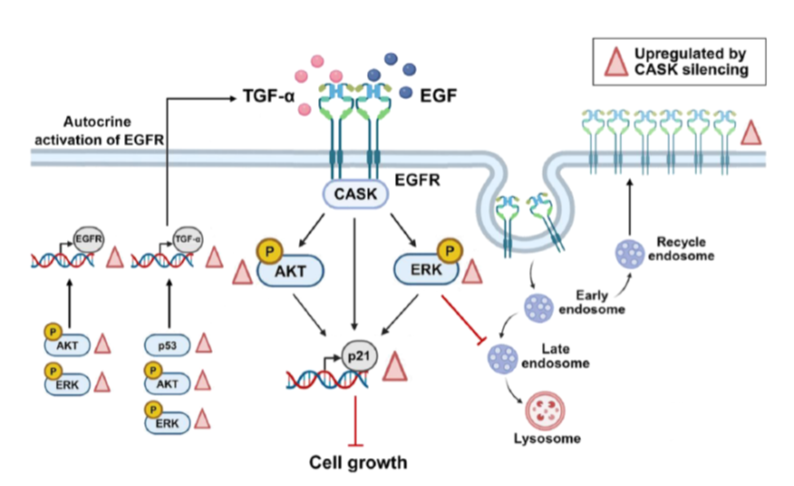
CASK silencing upregulates p21 protein expression via the EGFR autocrine loop, thereby inhibiting cell growth.
In this study published in Journal of Biomedical Science, researchers from National Taiwan University found that CASK helps promote the growth of non-small cell lung cancer (NSCLC) by regulating the EGFR–p21 signaling pathway. Reducing CASK levels slowed cell growth and blocked cell cycle progression in NSCLC cells. At the same time, p21 expression increased significantly after CASK depletion under both normal and serum-free culture conditions.
This increase was mainly caused by enhanced p21 gene transcription rather than changes in protein stability. In addition, the p21 inhibitor UC2288 reversed the growth suppression caused by CASK silencing, indicating that p21 is important in the effects mediated by CASK.
Although p53 normally contributes to basal p21 expression, the increase in p21 caused by CASK depletion occurred independently of p53. Further experiments showed that loss of CASK increased EGFR gene and protein expression, as well as EGFR protein stability, by delaying ERK-dependent EGFR trafficking to late endosomes. Consistent with this finding, activation of ERK and AKT, two key downstream pathways of EGFR signaling, was also elevated in CASK-silenced cells.
To better understand the relationship among CASK, EGFR signaling, and p21 regulation, cells were treated with inhibitors targeting EGFR, ERK, and AKT. Blocking these pathways reduced the p21 increase induced by CASK silencing.
In particular, EGFR and ERK inhibitors also decreased p21 mRNA expression, suggesting that the EGFR/ERK and EGFR/AKT pathways contribute to p21 induction after CASK depletion.
In addition, CASK also regulated the EGFR autocrine loop. Silencing CASK increased the expression of TGF-α, a major EGFR ligand, through mechanisms involving p53, ERK, and AKT.
“Overall, these findings suggest that CASK acts as a positive regulator of NSCLC growth by modulating EGFR trafficking, AKT/ERK signaling, and p21 expression,” says corresponding author Prof. Wan-Wan Lin in the Department of Pharmacology at National Taiwan University.
Prof. Wan-Wan Lin's email address: [email protected]