

Multifunctional facility associated with more frequent stays among residents
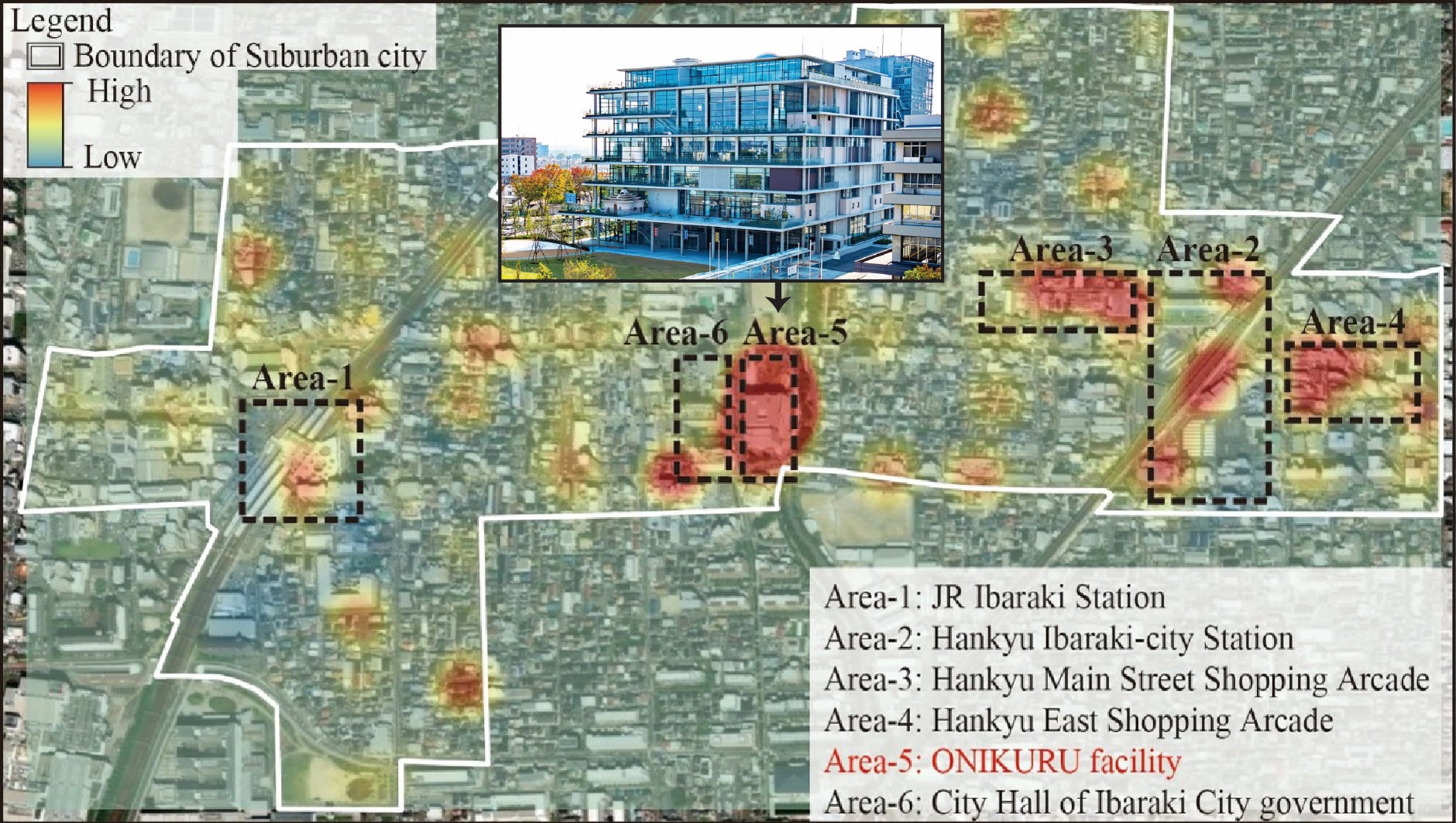
Spatially selective catalytic effect of ONIKURU on stay behavior: Opening the multifunctional facility increased stay density near the facility and adjacent commercial areas (red) while decreasing it near another core station area (blue), revealing a spatial redistribution of urban activity.
Osaka Metropolitan University
Suburban city centers across Japan are gradually declining as residents shift to car-oriented shopping malls in outlying areas. Urban planners have sought to reverse this trend through urban catalytic projects, strategically placed facilities designed to trigger broader regeneration. Yet empirical evidence on whether such projects actually redirect people’s stay behavior beyond the facility itself has remained scarce.
Shuta Maeda and Associate Professor Haruka Kato’s team at Osaka Metropolitan University’s Graduate School of Human Life and Ecology investigated whether the opening of the Ibaraki City Cultural and Childcare Complex “ONIKURU”, a multifunctional facility integrating a library, civic hall, childcare support center, planetarium, and community activity spaces designed by Pritzker Prize laureate Toyo Ito, affected residents’ stay behavior across the wider suburban city center. Using high-resolution GPS trajectory data from smartphone users and quasi-experimental methods, the researchers estimated the effect it had on residents who used the facility and mapped spatial changes in stay locations.
The results showed that residents who visited ONIKURU stayed approximately 0.471 more times per week in the suburban city center than a matched comparison group over the six weeks following the facility’s opening. However, spatial analysis revealed that the effect was not uniform. Stay density increased near ONIKURU and adjacent commercial areas, but concurrently decreased around JR Ibaraki Station, a core node at the opposite end of the center. This suggests a spatially selective catalytic effect, where activity was redistributed rather than increased evenly across the entire district.
“Walkable urban design initiatives are being implemented worldwide, but methods for rigorously evaluating their effects have not yet been established,” said Dr. Kato. “By leveraging smartphone-based GPS big data, this study demonstrates that it is now possible to measure the impact of walkable urban design at the building scale, something that was previously considered extremely difficult.”
The findings were published in Cities.
Conflicts of interest
The authors declare that they have no known competing financial interests or personal relationships that could have appeared to influence the work reported in this paper.
###
About OMU
Established in Osaka as one of the largest public universities in Japan, Osaka Metropolitan University is committed to shaping the future of society through the “Convergence of Knowledge” and the promotion of world-class research. For more research news, visit https://www.omu.ac.jp/en/ and follow us on social media: X, Instagram, LinkedIn.
Advertisement