
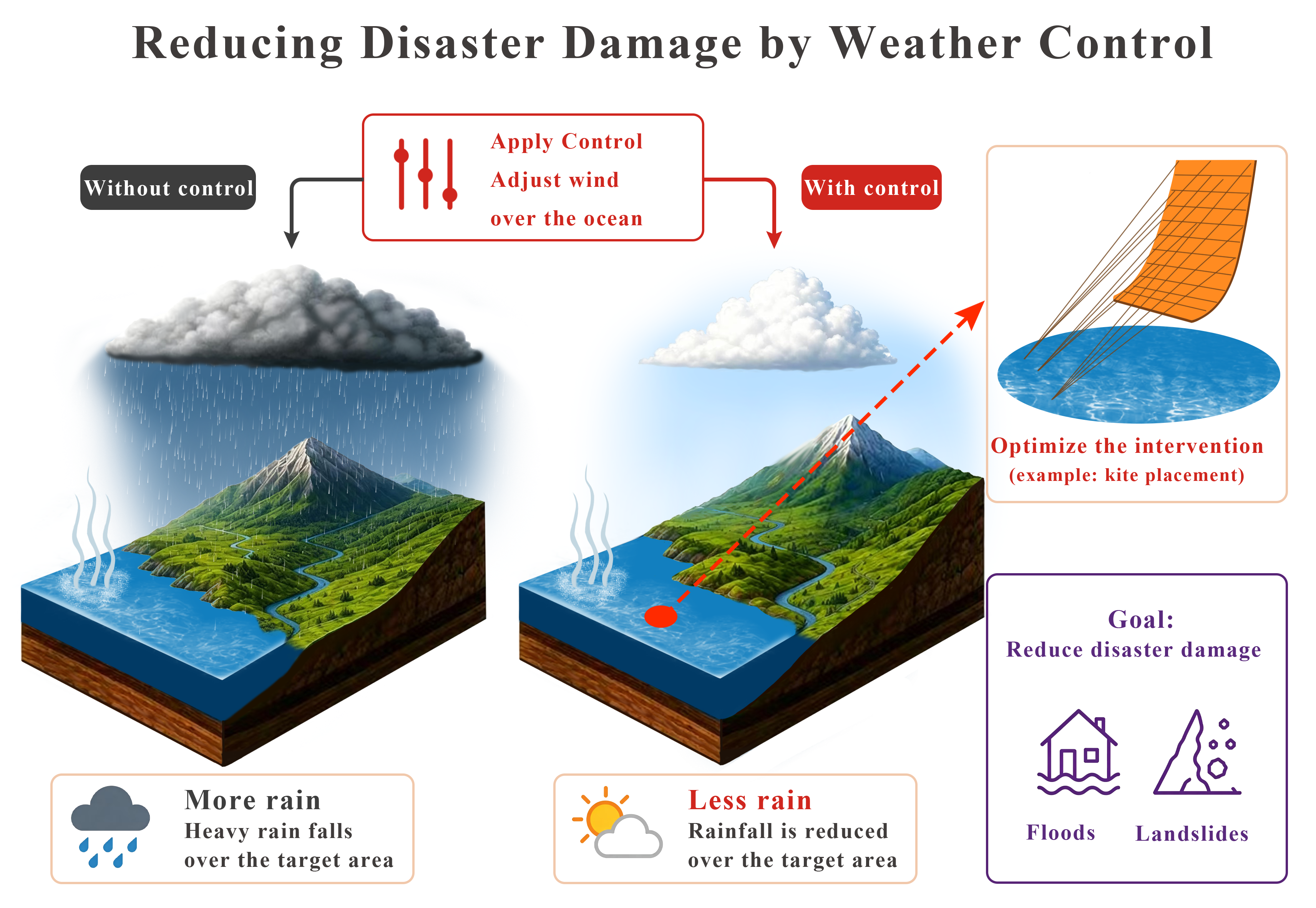

Black-box optimization, particularly Bayesian optimization, is a practical approach for weather-intervention design, achieving meaningful rainfall reduction even under a very limited budget of expensive weather simulations, finding effective actions with only a small number of trials.
Weather control modeling assesses the effectiveness of weather intervention to reduce damage and loss from disasters. (Yuta Higuchi / Hiroshima University)
Yuta Higuchi / Hiroshima University
In recent years, the frequency of weather-related natural disasters – cyclones, torrential rains, floods – has increased as a consequence of global warming. These disasters cause billions of dollars in damage and losses every year. As a result, there is great interest in weather control, the process by which human intervention can deliberately alter the weather.
Modeling weather interventions via computational modeling is the primary means by which weather interventions are studied. However, as weather is a vast and complex system, state-of-the-art numerical weather prediction (NWP) models of interventions are highly limited, requiring enormous computational resources.
A team of researchers led by Hiroshima University have applied black-box optimization algorithms to rainfall control and have demonstrated that they can be used to model rainfall minimization through weather control.
Their findings were published in the Journal of Computational Science on April 10, 2026.
Modeling weather control is an application of control theory, an interdisciplinary field of engineering and mathematics that deals with the behavior of systems. NWP modeling of weather control takes the input, models every step of the control process, and yields the output. It is here that the need for enormous computational resources arises, as weather is a highly complex system that is very difficult to accurately model in full.
“Our study asks how to design effective weather interventions for reducing rainfall when weather simulations are highly nonlinear, expensive, and do not provide reliable gradient information,” says Masaki Ogura, professor at Hiroshima University’s Graduate School of Advanced Science and Engineering and corresponding author of the study. “This is important because ... any practical intervention method must work under strict computational limits.”
The researchers chose to use black box optimization to tackle this issue. Black-box optimization is the process of optimizing a system or function where the internal workings are not known or are too complex to be modeled accurately. The term "black-box" signifies that the system's input-output behavior is the only information available for optimization.
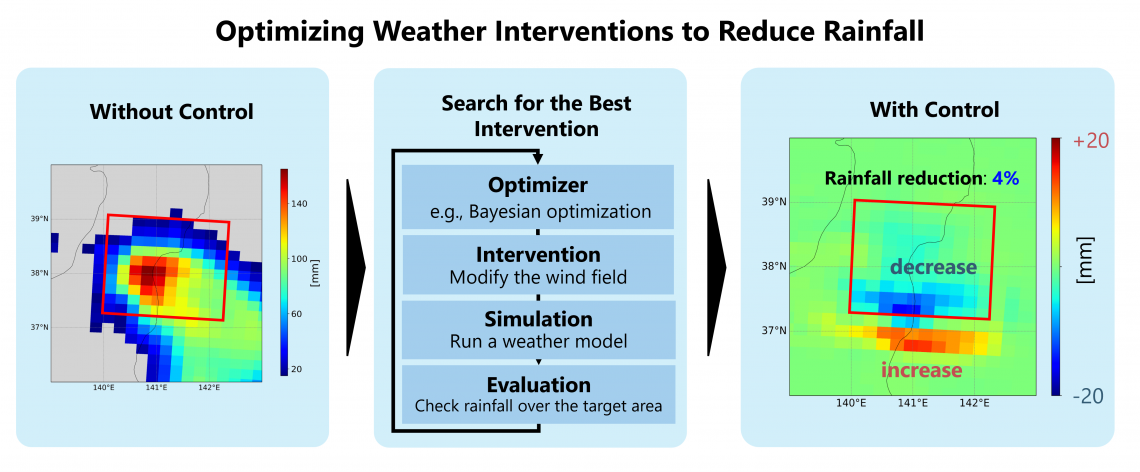
The researchers chose four black-box optimization algorithms: Bayesian optimization, random search, particle swarm optimization, and genetic algorithms, and applied them to two experimental settings with different scales and levels of complexity. They used the NWP model Scalable Computing for Advanced Library and Environment Regional Model (SCALE-RM), specifically developed for climate research, as the base model for their simulations. The two experimental settings were the smaller and limited warm bubble experiment and the larger and more complex real atmosphere experiment. Specifically, they tested how a weather intervention modifying wind-fields would reduce rainfall over a target region. Their models attempted the intervention to a small portion of the simulation, either only at the start of the simulation (one-step) or every 600 or 3600 seconds (multi-step).
Illustration of black box optimization for weather intervention design to reduce rainfall (Yuta Higuchi / Hiroshima University)
Yuta Higuchi / Hiroshima University
“Black-box optimization is a practical approach for weather-intervention design, and Bayesian optimization performed best among the tested methods under the studied settings,” says Ogura, describing the results. “One striking aspect is that meaningful rainfall reduction was achieved even under a very limited budget of expensive weather simulations. This is notable because each candidate intervention had to be evaluated through a full numerical weather simulation, so the optimizer had to find effective actions with only a small number of trials.”
Further, Bayesian optimization exhibits sensitivity to hyperparameters (parameters that define any configurable part of a model's learning process). This indicates that Bayesian optimization can be adjusted, potentially leading to flexibility and adaptability to different atmospheric conditions.
By demonstrating the potential to design effective weather interventions even under limited computational resources, this study accelerates future research and development in disaster-prevention technologies and climate engineering.
The researchers caution that their findings may not generalize to all scenarios of weather interventions. “The next step is to test the framework in more diverse atmospheric scenarios and better understand why the methods perform differently,” Ogura concludes. “The ultimate goal is to build a reliable computational basis for future weather-intervention design for disaster mitigation.”
Yuta Higuchi & Yang Bai at Hiroshima University; Rikuto Nagai & Naoki Wakamiya at The University of Osaka; Atsushi Okazaki at Chiba University co-authored the study.
###
About Hiroshima University
Since its foundation in 1949, Hiroshima University has striven to become one of the most prominent and comprehensive universities in Japan for the promotion and development of scholarship and education. Consisting of 12 schools for undergraduate level and 5 graduate schools, ranging from natural sciences to humanities and social sciences, the university has grown into one of the most distinguished comprehensive research universities in Japan. English website: https://www.hiroshima-u.ac.jp/en
Advertisement