
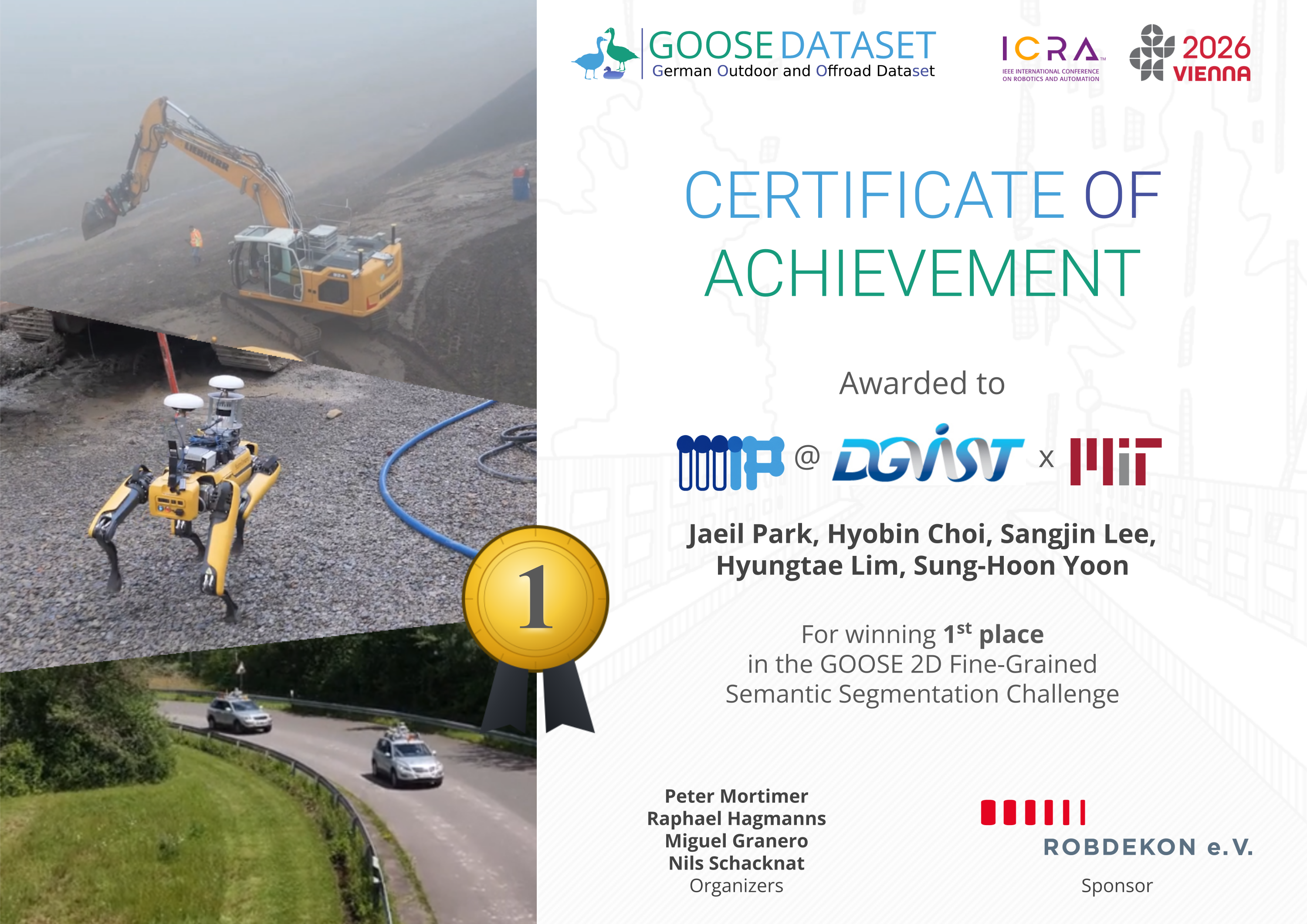
□ A joint research team led by Professor Sung-hoon Yoon of DGIST’s Department of Electrical and Computer Engineering and MIT Postdoctoral Researcher Hyungtae Lim has won first place in the “GOOSE 2D Semantic Segmentation Challenge” at the Field Robotics Workshop during the 2026 International Conference on Robotics and Automation (ICRA), one of the world’s most prestigious robotics conferences. The team outperformed 56 competitors worldwide to secure the top honor.
□ This achievement not only demonstrates the excellence of Korea’s AI-based vision recognition technology on the global stage, but also underscores the potential of core cognitive technologies essential for realizing “Physical AI”—artificial intelligence that interacts directly with real-world environments.
□ The challenge, jointly organized by Germany’s Fraunhofer Institute of Optronics, System Technologies and Image Exploitation (Fraunhofer IOSB), University of the Bundeswehr Munich, and the University of Koblenz, evaluated how precisely field robots can interpret complex, unstructured scenes in real outdoor environments. Unlike conventional autonomous driving datasets collected mainly from well-structured urban roads, the “GOOSE dataset” used in this competition was built from unpredictable, unstructured outdoor environments centered on field robots.
□ Data were collected from diverse platforms such as excavators and quadruped robots, making the task significantly more demanding. This year’s evaluation expanded to 64 detailed classes, requiring participants to accurately recognize even “long-tailed” objects—rare items that appear infrequently in real-world settings—thus demanding highly advanced recognition capabilities.
□ The DGIST–MIT team developed a proprietary framework that integrates Meta’s latest self-supervised foundation model DINOv3 with the image segmentation model Mask2Former. This system delivered stable visual recognition performance even under challenging real-world conditions such as variable lighting, irregular terrain, and complex backgrounds.
□ In particular, the framework maximized recognition of rare objects that AI systems often miss because of limited data, significantly reducing catastrophic failures that could lead to accidents and thereby improving safety. Consequently, the technology is expected to expand broadly into future field robotics applications, including autonomous vehicles, disaster-response robots, smart agriculture, and construction robotics.
□ Professor Sung-hoon Yoon commented, “The ability to precisely understand scenes in unpredictable, unstructured outdoor environments is the most critical technology for ensuring the autonomy and safety of field robots. Building on this achievement on the global stage, we will continue to advance powerful vision recognition technologies that can be immediately applied to real robotic systems and diverse industrial settings.”
□ This accomplishment, achieved through close global collaboration between DGIST and leading international research institutions, is regarded as a valuable milestone that will help position DGIST as a central hub for robotics and artificial intelligence research worldwide.