
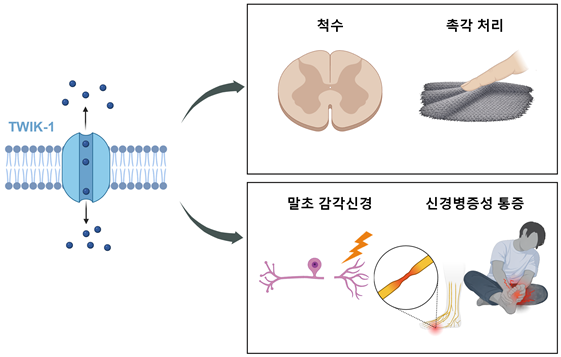

- Prof. Hyosang Lee’s research team identifies the dual role of the TWIK-1 potassium ion channel in the spinal cord and peripheral sensory neurons, suggesting the potential for the treatment of neuropathic pain
- Published in the international journal Signal Transduction and Targeted Therapy
□ A research team led by Prof. Hyosang Lee of the Department of Brain Sciences at DGIST (President Kunwoo Lee) has identified TWIK-1, a type of potassium channel expressed in the spinal cord and peripheral sensory neurons of the somatosensory system, as a key molecular regulator of touch sensation and chronic pain. This study is significant in that it has presented a new molecular mechanism in the spinal cord that regulates touch responses and revealed the cause of the persistence of neuropathic pain, which is an intractable disorder, and a therapeutic target.
□ The somatosensory system is a neural system responsible for detecting touch, pain, and temperature changes, and these sensory signals are transmitted through peripheral sensory neurons to the spinal cord, where they are processed. However, when nerves are damaged, neuropathic pain may occur, in which pain persists for an extended period without any specific cause, significantly reducing quality of life. To date, the precise mechanisms underlying the persistence of pain have not been fully elucidated, leaving effective treatment options limited.
□ Through precise experiments using genetically engineered mouse models, the research team confirmed that the TWIK-1 potassium channel plays a key role in processing tactile information by regulating the activity of inhibitory neurons in the spinal cord.
□ The research team also found that TWIK-1 regulates the persistence of pain and allodynia in peripheral sensory neurons. These findings promote the current understanding of the mechanisms underlying neuropathic pain and suggest new therapeutic possibilities for selectively regulating the persistence of pain.
□ “Through this study, we have demonstrated that the TWIK-1 potassium channel plays distinct roles in the formation of touch sensation and maintenance of chronic pain, depending on its location,” stated Prof. Hyosang Lee of the Department of Brain Sciences at DGIST. “Furthermore, we have provided important experimental evidence for reinterpreting the conventional paradigm that potassium ion channels uniformly suppress pain.” He then added, “We expect this research to help further elucidate how touch is processed in the spinal cord and to lead to the development of neuropathic pain treatments that target TWIK-1.”
□ This research was supported by the National Research Foundation of Korea (NRF) Mid-career Research Program, the Brain Science Leading Convergence Technology Development Program, the Convergence Research Advanced Center for Olfaction, and the Samsung Future Technology Incubation Program. The study was conducted in collaboration with Prof. Byung Chang Suh, Prof. Myungin Baek, and Prof. Pojeong Park of the Department of Brain Sciences at DGIST; Prof. Jae-Yong Park of Korea University; Prof. Yu Shin Kim of the University of Alabama at Birmingham, USA; Prof. Mi-Ryoung Song of the Gwangju Institute of Science and Technology (GIST); Dr. Jaekwang Lee of the Korea Food Research Institute; Dr. Eun Mi Hwang of the Korea Institute of Science and Technology (KIST); and Prof. Young Hoon Sung of Asan Medical Center. The research findings were published in the June issue of Signal Transduction and Targeted Therapy.
Advertisement