

A joint team from UOsaka has uncovered the core principles of the loss maximization in rotor-driven gas-liquid two-phase flows. Performing numerical simulations on the supercomputer "SQUID", they identified the causes as direct collisions between the rotor and the liquid surface and pressure imbalances around the rotor. The findings suggest that, in a resonant state, the enhanced fluid motion is drawn toward the front of the rotor, and the flow instability is intensified behind it. The insights from this research would open the possibility of improving energy efficiency, enhancing reliability and lifespan, and providing new design guidelines for various industrial applications.
Torque enhancement owing to surface impact and pressure imbalance clarified by detailed analysis of the simulated data
Original content, Credit must be given to the creator, Kazuyasu Sugiyama
Providing design guidelines for improving efficiency in power transmission devices
Osaka, Japan – Researchers have clarified the mechanisms by which energy loss is locally maximized at a certain rotational speed in gas-liquid two-phase flows driven by rotors, providing fundamental insights for energy savings and optimal design and operation in complex industrial equipment. Using the supercomputer "SQUID", a joint team from The University of Osaka, The University of Tokyo, and RIKEN analyzed detailed data on fluid motions and revealed that torque maximization arises not only from rotor-liquid surface collisions but also from significant pressure imbalances. This phenomenon was observed when the gas-liquid interface wave was in a resonant state. The outcomes, published in Multiphase Science and Technology, deepen the understanding of fluid resistance and agitation losses in power transmission devices.
Rotor-driven gas-liquid two-phase flows, used in various industrial applications such as power transmission devices, cooling systems and chemical agitators, exhibit complex flow phenomena that depend on rotational speed and liquid fill ratio, significantly impacting performance and efficiency. The total energy loss is dominated by fluid agitation. Therefore, elucidating the mechanism and reducing losses have been long-standing challenges. When a rotating body periodically drives the flow, a sloshing phenomenon occurs, leading to significant oscillations of the gas-liquid interface. Such "time-varying" characteristics during resonance are important from the perspectives of mechanical failure risk and energy efficiency, and have been extensively studied. Recent studies have demonstrated that, under resonance conditions, the torque (a "time-averaged quantity") exhibits peaks, thereby maximizing losses. Although such a local maximization was observed at the natural frequency of interface waves, the underlying mechanism have been unclear.
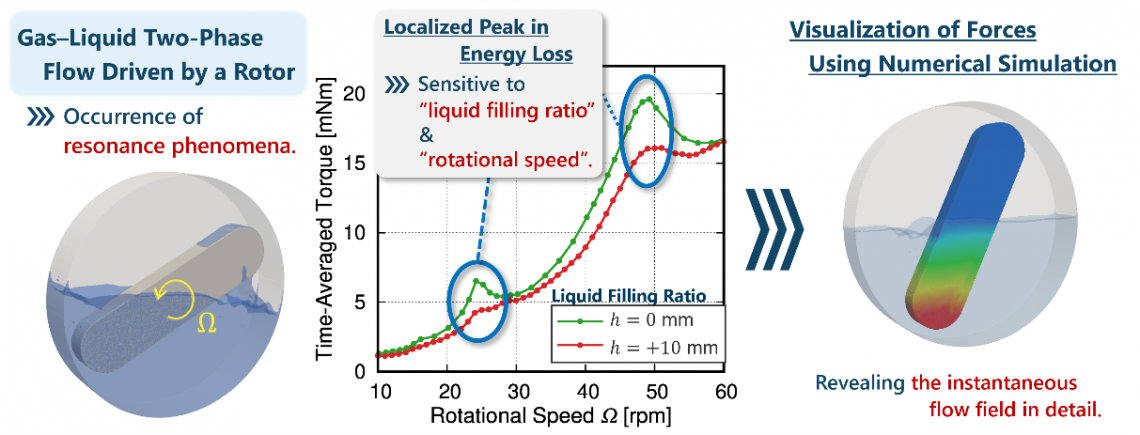
Integration of experiments and numerical simulations uncovered the core principles of loss maximization. Twofold causes are identified as i) direct collisions between the rotor and the liquid surface and ii) pressure imbalances around the rotor, suggesting the relevance of the enhanced fluid motion drawn toward the front of the rotor and the intensified flow instability behind it.
The insights from this research are expected to generate the following benefits:
l Improving energy efficiency: Understanding the mechanism behind loss maximization enables avoiding the resonant state and optimizing the rotor shape. It achieves energy savings, contributing to a sustainable society.
l Enhancing reliability and longer lifespan: Torque maximization can impose excessive loads on mechanical components, potentially leading to failure and wear. Elucidating the mechanism enables preemptive assessment of mechanical failure risks, leading to more robust and longer-lasting designs.
l Providing new design guidelines: The knowledge of the significant pressure imbalance impacting energy loss offers novel design guidelines. It leads to the development of system configurations that optimize agitation, cooling and so on.
"Gas-liquid two-phase flows driven by rotors are commonly observed around us. However, their internal structures remain poorly understood. Large-scale numerical simulations complement experiments, enabling detailed spatiotemporal analysis and helping gain fundamental insights into the factors causing losses. We expect that our outcomes will pave the way for shifting from empirical rule-based to theory-based design and accelerate the development of energy-efficient machinery" affirmed Mayu Kawamura, the lead author of the study.
###
The article, “Mechanisms of torque maximization in gas-liquid two-phase flows driven by a pressure-loss-dominant rotor in a stationary cylindrical container,” has been published in Multiphase Science and Technology at DOI: https://doi.org/10.1615/MultScienTechn.2025060620
Fig. 2
Torque maximization under resonance conditions, and pressure distribution on the rotor wall
Original content, Credit must be given to the creator, Kazuyasu Sugiyama
About The University of Osaka
The University of Osaka was founded in 1931 as one of the seven imperial universities of Japan and is now one of Japan's leading comprehensive universities with a broad disciplinary spectrum. This strength is coupled with a singular drive for innovation that extends throughout the scientific process, from fundamental research to the creation of applied technology with positive economic impacts. Its commitment to innovation has been recognized in Japan and around the world. Now, The University of Osaka is leveraging its role as a Designated National University Corporation selected by the Ministry of Education, Culture, Sports, Science and Technology to contribute to innovation for human welfare, sustainable development of society, and social transformation.
Website: https://resou.osaka-u.ac.jp/en
Advertisement