
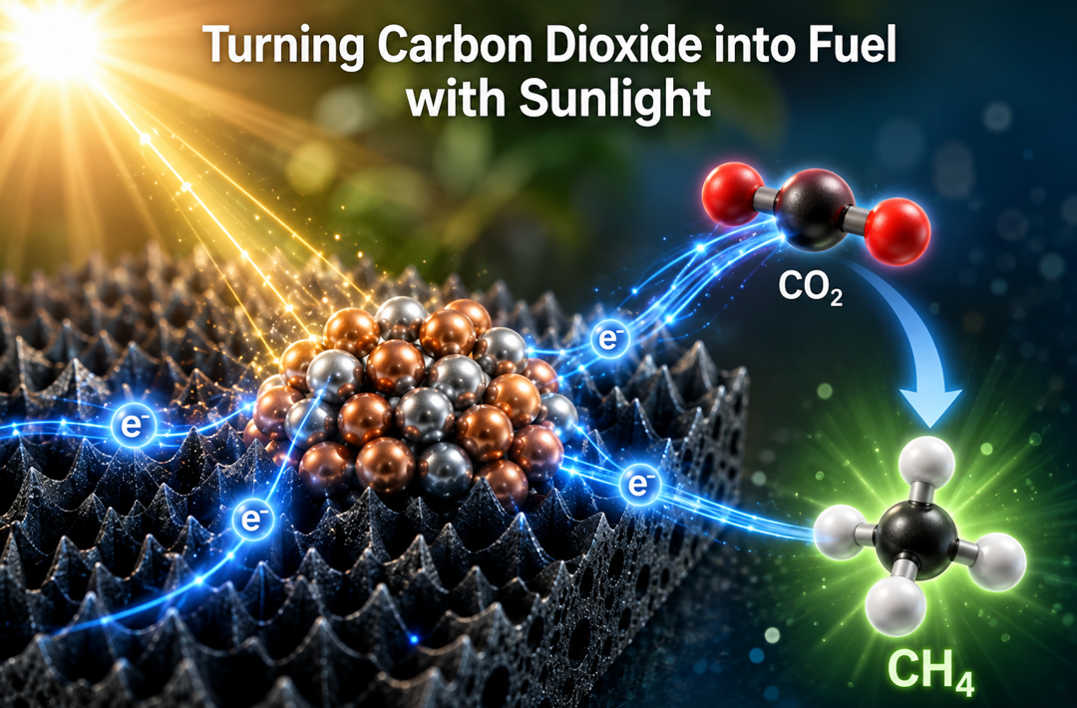
Sunlight powers a specially designed catalyst that dynamically adapts during operation, enabling the efficient conversion of carbon dioxide into methane and offering a new strategy for solar fuel production.
Carbon dioxide is often viewed as a major contributor to climate change, but it can also become a valuable raw material. If scientists can efficiently convert carbon dioxide into useful fuels using sunlight, it would provide a sustainable way to store solar energy while reducing greenhouse gas emissions.
A research team from National Taiwan University has developed a new photoelectrochemical catalyst that brings this vision one step closer. Their device combines a specially engineered black silicon surface with tiny copper-zinc alloy particles. When exposed to sunlight, the system converts carbon dioxide into methane, the main component of natural gas, with significantly improved efficiency compared with conventional copper catalysts. The optimized catalyst produced methane with a Faradaic efficiency of about 40% while requiring less energy to initiate the reaction.
What makes this work particularly important is not only the improved performance but also the discovery of why it works. The study was published in Applied Catalysis B: Environment and Energy.
Using advanced synchrotron X-ray spectroscopy together with in situ Raman spectroscopy, the researchers monitored the catalyst while it was actively converting carbon dioxide. Instead of remaining unchanged, the catalyst continuously adjusted its electronic structure under illumination. Zinc helped stabilize metallic copper, allowing the catalyst to bind carbon dioxide reaction intermediates more effectively. At the same time, sunlight generated energetic electrons that accelerated the chemical steps leading to methane formation. These two effects worked cooperatively, making methane production both easier and more selective.
Beyond methane production, the principles discovered in this work may help researchers develop more efficient systems for converting carbon dioxide into a variety of valuable chemicals and fuels. Such technologies could contribute to future carbon recycling strategies, renewable energy storage, and sustainable chemical manufacturing.
“Understanding how catalysts dynamically respond to sunlight while they are working allows us to design more efficient systems for converting carbon dioxide into useful fuels. Rather than treating catalysts as static materials, we can now begin to engineer their dynamic behavior for cleaner energy technologies,” says co-corresponding author Hao Ming Chen, professor of chemistry at National Taiwan University.
Prof. Hao Ming Chen's email address: [email protected]
The lab of Prof. Chen linked to https://chenhm.wixsite.com/ntuch-hmchen