
An exciting new strategy involving a specially designed iron-based catalyst can speed up the reaction that powers next-gen zinc-air batteries. This means cleaner, more efficient energy for everyone.
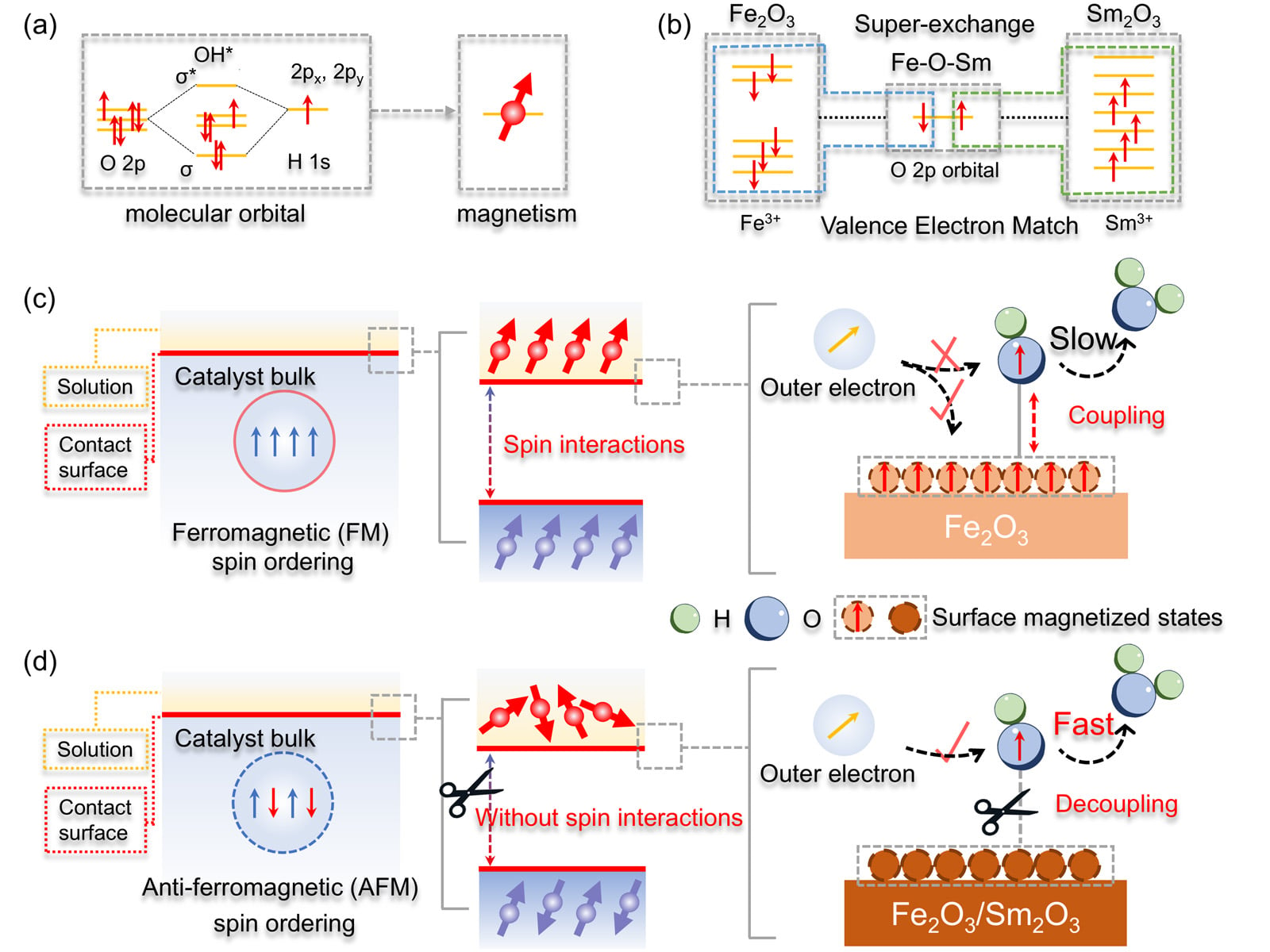
Spin-state regulation at Fe2O3/Sm2O3 interface to promote OH* desorption in ORR: (a) schematic of OH* molecular orbital configuration and its associated magnetic moment; (b) antiferromagnetic alignment induced by super-exchange coupling of [Fe-O-Sm] unit; (c) parallel spin alignment induces OH* trapping at the contact surface via spin-interaction, inhibiting electron transfer, and resulting in sluggish desorption; and (d) antiferromagnetic alignment at the Fe2O3/Sm2O3 heterointerface reduces spin-interaction, enhancing electron accessibility, and facilitating OH* reduction.
Hao Li et al.
Batteries are undergoing rapid advancements. For example, modern zinc-air batteries have the remarkable ability to use oxygen as energy - but that oxygen isn't stored in the battery itself. Zinc-Air batteries take in surrounding oxygen to undergo a reaction to discharge energy called the oxygen reduction reaction (ORR). While this convenient strategy is promising, the slow speed of the ORR limits the practicality of these batteries.
However, researchers at Tohoku University found a method to enhance ORR activity using a catalyst with a precise configuration of iron (Fe). Their remarkable heterointerface - which is a combination of Fe2O3 and Sm2O3 - accelerates ORR kinetics by inducing charge redistribution, orbital hybridization, and super-exchange-mediated spin modulation. In other words, they have fine-tuned an efficient and sustainably sourced catalyst to bring out the true potential of zinc-air batteries.
Fe2O3 was chosen because it is abundant, inexpensive, and structurally stable under alkaline conditions. The issue was getting past the bottleneck of Fe sites binding OH intermediates too strongly, which slows OH desorption and limits overall ORR kinetics. To stop Fe2O3 from holding onto OH so tightly, they created a strongly coupled Fe2O3/Sm2O3 heterointerface. As a result, excessive Fe-OH bonding was weakened, which freed up OH and helped the reaction proceed more smoothly. In addition, further testing supports its potential to power real electronic devices, as it was able to power a small LED lamp and charge a smartphone.
"The catalyst achieves high ORR activity, improved reaction kinetics, excellent durability, and superior performance in both liquid and flexible all-solid-state zinc-air batteries," explains Hao Li, distinguished professor at the Advanced Institute for Materials Research (WPI-AIMR). "For the general public, this means that we may be closer to affordable and sustainable clean-energy technologies."
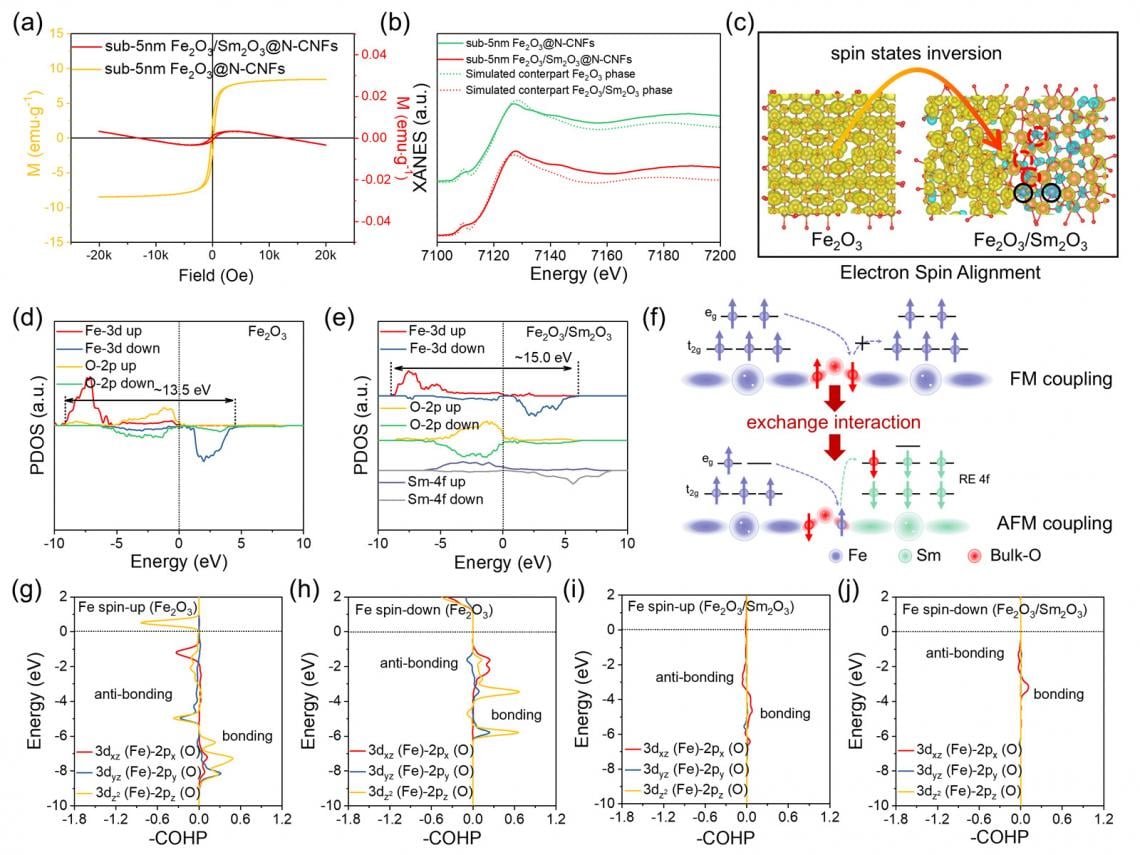
Magnetic and theoretical analysis of sub-5nm Fe2O3@N-CNFs and sub-5nm Fe2O3/Sm2O3@N-CNFs: (a) magnetic hysteresis loops of catalysts at room temperature, (b) the X-ray absorption near-edge structure of actual and simulated Fe2O3@N-CNFs and Fe2O3/Sm2O3@N-CNFs, (c) spin-polarized density of states (DOS) analysis, (d)-(e) projected density of states (PDOS), (f) schematic diagrams of FM and AFM interactions, respectively, (g)-(j) crystal orbital Hamilton population (COHP) analysis.
Hao Li et al.
By developing a noble-metal-free catalyst with high activity and stability, this study provides a possible pathway toward lower-cost, longer-lasting, and more scalable energy-conversion and storage devices. In the long term, such advances could support practical applications including portable electronics, wearable devices, electric transportation, and renewable-energy storage, thereby helping reduce dependence on costly materials and promoting cleaner energy use.
For the next steps, the researchers will focus on extending both the fundamental mechanism and the practical application of this interfacial spin-regulation strategy, to see where else this strategy could be helpfully deployed.
The findings were published in Angew. Chem. Int. Ed. on May 25, 2026.
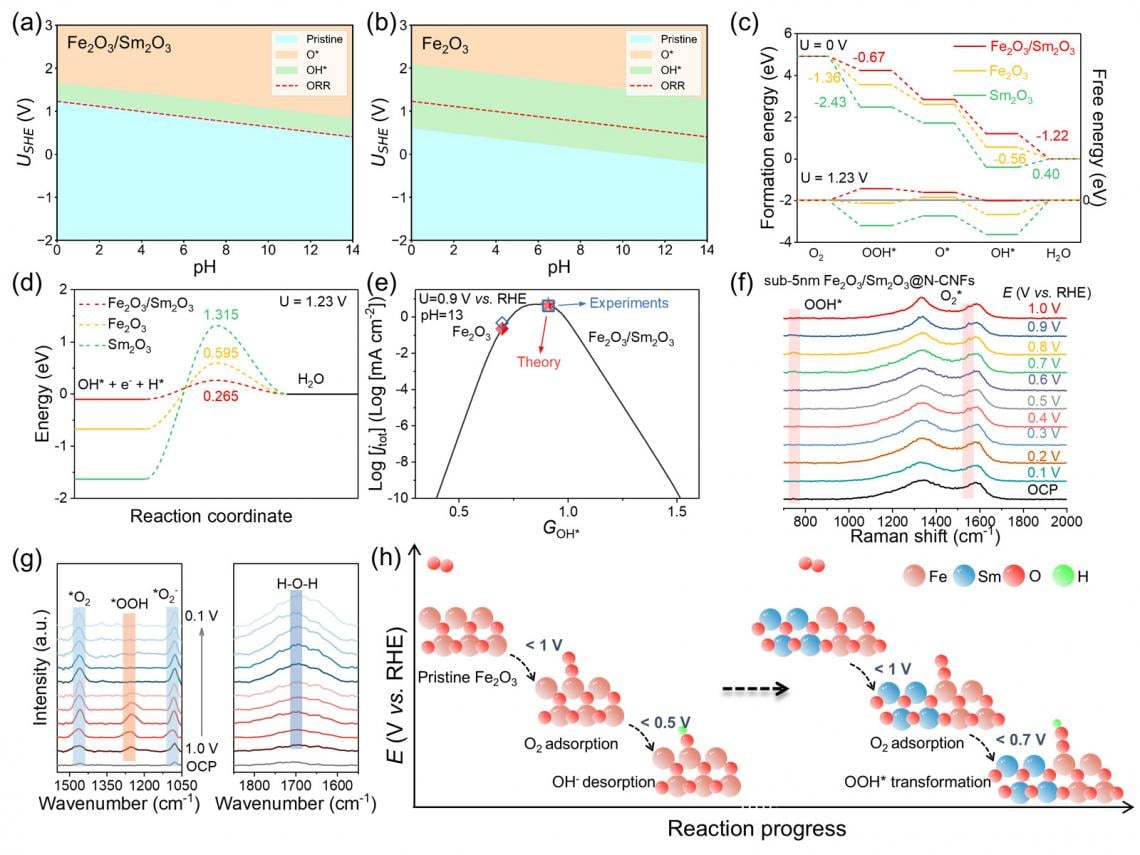
Surface Pourbaix diagrams of (a) Fe2O3/Sm2O3, (b) Fe2O3. Reaction pathway analysis of sub-5nm Fe2O3/Sm2O3@N-CNFs and sub-5nm Fe2O3@N-CNFs: (c) ORR free energy, (d) analysis of the OH* desorption transition state, (e) ORR volcano activity model predicting with the exchange current density (j0) as a function of ΔGOH* (pH = 13, U = 0.9 V vs. RHE), (f) in-situ enhanced Raman spectroscopy of sub-5nm Fe2O3/Sm2O3@N-CNFs, (g) in-situ ATR-SEIRAS of sub-5nm Fe2O3/Sm2O3@N-CNFs, and (h) schematic comparison of the ORR reaction progress.
Hao Li et al.
Advertisement
Advertisement