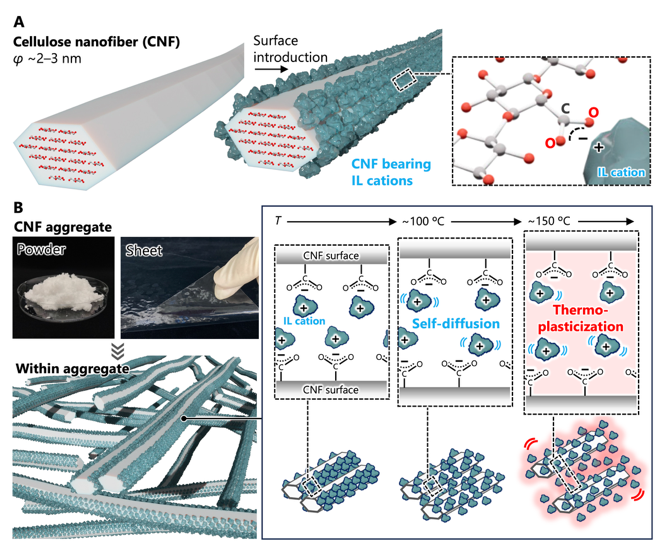
Fig. 1
Material design for thermoplasticization of nanoparticle aggregates. (A) Introduction of ionic liquid cations onto the wood-derived nanoparticle (CNF) surfaces. (B) Thermoplasticization mechanism of its aggregates.
Researchers at The University of Osaka use heat to shape aggregates of nanoparticles
Osaka, Japan – If you have ever warped a cheap plastic cup by pouring coffee into it, then you have witnessed thermoplasticity in action. Thermoplasticity is the ability of a material to become pliable under heating. In industry, thermoplasticity is exploited to form materials into complex shapes using heat. However, some materials, such as aggregates of nanoparticles, are not thermoplastic and cannot be easily processed without affecting their particle morphology and properties.
However, researchers at The University of Osaka have been able to use heat to shape nanoparticle aggregates, specifically cellulose nanofibers (CNFs) derived from wood pulp. This exciting advance, showcasing the mechanical and thermal potential of nanoparticles, will be published in Science Advances.
Aggregates of nanoparticles (material particles 1–100 nanometers in size) often have high mechanical strength, low thermal expansivity, and high thermal conductivity. Therefore, aggregates can be used as lightweight structural parts (e.g., in automotive applications) and as heat dissipation components in electronic devices.
Thermoforming is a low-cost manufacturing process for making materials into complex shapes. A material is heated sufficiently to be pliable and is then molded into a target shape. However, nanoparticle aggregates cannot be thermoformed without the particles losing their shape and crystallite nature (a crystallite is a region of ordered atoms) and can decompose or oxidize under heating.
The research team performed a study in which a novel strategy was developed to make nanoparticle aggregates thermoplastic. Anionic (negatively charged) groups were introduced onto the surface of CNFs and paired with cations (positively charged ions) from an ionic liquid, that is, a salt that is liquid below 100 °C.
“Aggregates of the prepared CNFs expanded considerably upon heating,” explains lead author, Shun Ishioka. “This is the first time nanoparticle aggregates have been thermoformed while preserving the particle shape and crystallites in the material. The sheets of thermoformable CNF aggregates have high strength and low thermal expansivity under ambient conditions, unlike conventional thermoplastics.”
Ionic materials often exhibit increased ion mobility during thermoplasticization. Experiments showed that at high temperatures, the cations diffused at the interfaces between the CNFs in the aggregates. This ion motion was accompanied by expansion of the aggregates. These results led the research team to link thermoplasticization of the CNFs with interfacial dynamics.
“We used our strategy to thermoform a system of two-dimensional carbon nanoparticles (graphene oxide),” reports Tsuguyuki Saito, senior author. “Thus, the strategy may be applicable to diverse systems.”
The novel nanomaterials developed at The University of Osaka provide alternatives to conventional petroleum- or metal-based thermoplastics. The study results suggest that ions could be introduced on nanoparticle surfaces to fine-tune the mechanical and thermal properties of the aggregates while thermoplasticizing them, expanding the potential applications of these materials.
###
The article, “Thermoforming nanoparticle aggregates via interfacial ionic self-diffusion,” will be published in Science Advances at DOI: https://www.science.org/doi/10.1126/sciadv.aeb3281
About The University of Osaka
The University of Osaka was founded in 1931 as one of the seven imperial universities of Japan and is now one of Japan's leading comprehensive universities with a broad disciplinary spectrum. This strength is coupled with a singular drive for innovation that extends throughout the scientific process, from fundamental research to the creation of applied technology with positive economic impacts. Its commitment to innovation has been recognized in Japan and around the world. Now, The University of Osaka is leveraging its role as a Designated National University Corporation selected by the Ministry of Education, Culture, Sports, Science and Technology to contribute to innovation for human welfare, sustainable development of society, and social transformation.
Website: https://resou.osaka-u.ac.jp/en