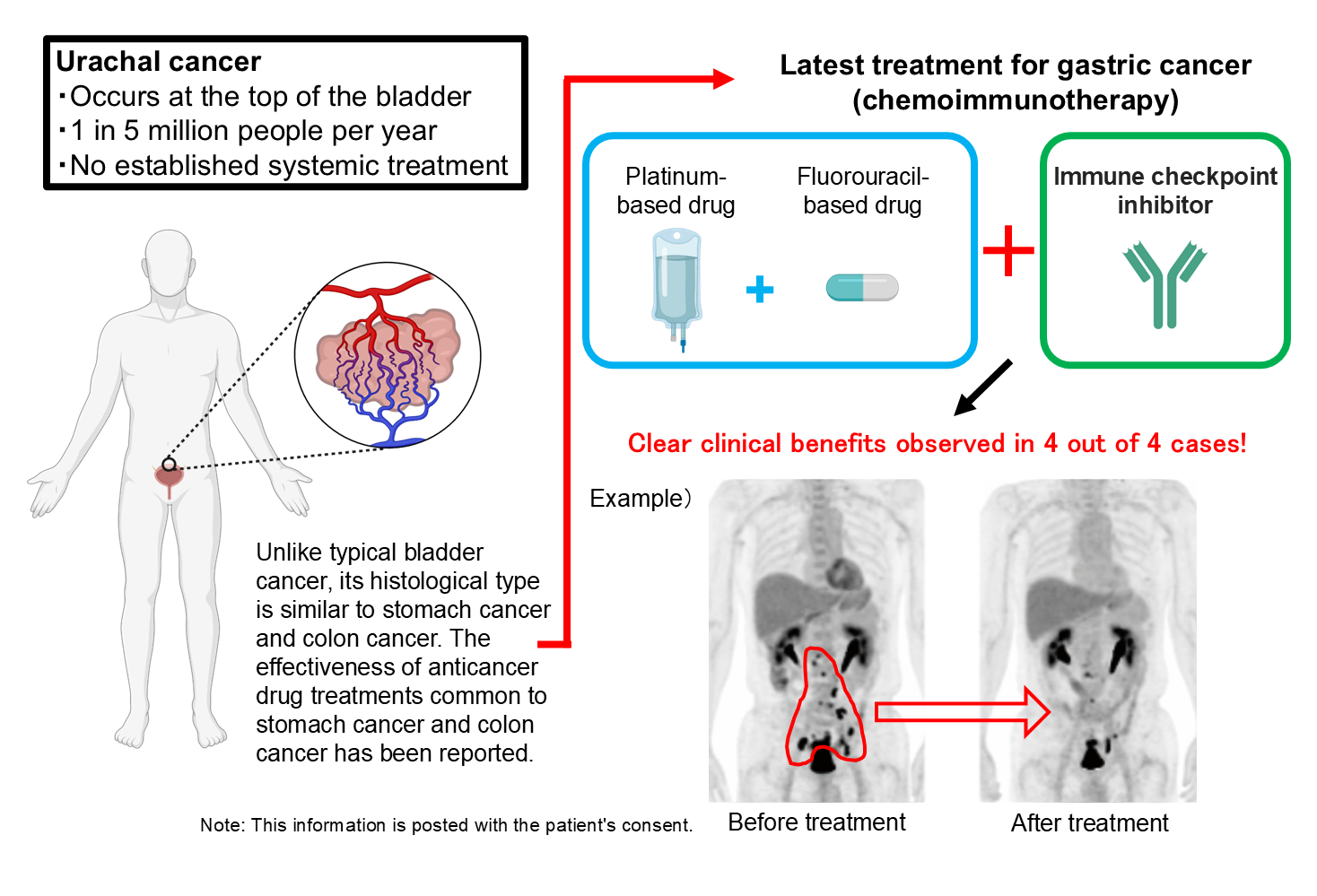

Physician-scientists at Kanazawa University have demonstrated, for the first time worldwide, the clinical efficacy of chemoimmunotherapy in patients with ultra-rare urachal cancer. Furthermore, their reverse translational research elucidated the mechanism by which the addition of immunotherapy enhances the efficacy of chemotherapy.
Study summary: Promising chemoimmunotherapy for ultra-rare urachal cancer.
Adapted from Kotani H. et al., MedComm, 2025, DOI: 10.1002/mco2.70516. Licesed under CC BY.
Urachal cancer is a type of bladder cancer that originates in the upper part of the bladder, accounting for less than 1% of all bladder cancers. With an annual incidence of approximately 1 in 5 million, it is an extremely rare malignancy. For cases where surgery is not feasible, there are no approved drug therapies available domestically or internationally. Although its histology differs from that of typical bladder cancer, it resembles gastric and colorectal cancers, and treatment with a common regimen for those cancers—a combination of platinum-based and fluorouracil-based anticancer drugs—has shown reported efficacy. For the present cases, a multidisciplinary approach was deemed necessary, and treatment was conducted in collaboration with several departments at Kanazawa University Hospital, including Medical Oncology, Urology, Thoracic Surgery, and Respiratory Medicine.
To date, the team have treated four patients with chemoimmunotherapy—specifically, a combination of S-1, oxaliplatin, and nivolumab. This regimen, which is identical to a current standard for gastric cancer, combines chemotherapy with an immune checkpoint inhibitor. Clear therapeutic effects were observed in all four patients. In one case, a previously inoperable tumor shrank sufficiently to become respectable. In other case, the lesions disappeared completely following treatment. For this patient, therapy was discontinued after two years, and they remain disease-free to date.
To understand the basis for this efficacy, they investigated the mechanism of chemoimmunotherapy in urachal cancer at the cellular level. This approach, known as reverse translational research, first confirmed the growth-inhibitory effect of the platinum-fluorouracil combination on urachal cancer cells. Furthermore, we demonstrated that this chemotherapy combination increases the expression of calreticulin, a molecule that serves as a marker for enhanced anti-tumor immune responses.
“These findings not only demonstrate the clinical promise of chemoimmunotherapy for urachal cancer but also elucidate its underlying mechanism of action,” said Dr. Hiroshi Kotani, corresponding author. “This research is expected to facilitate the development of the first-ever approved drug treatment for urachal cancer, for which no effective systemic therapies currently exist worldwide.”
The study was published in MedComm at DOI: 10.1002/mco2.70516.
Advertisement