
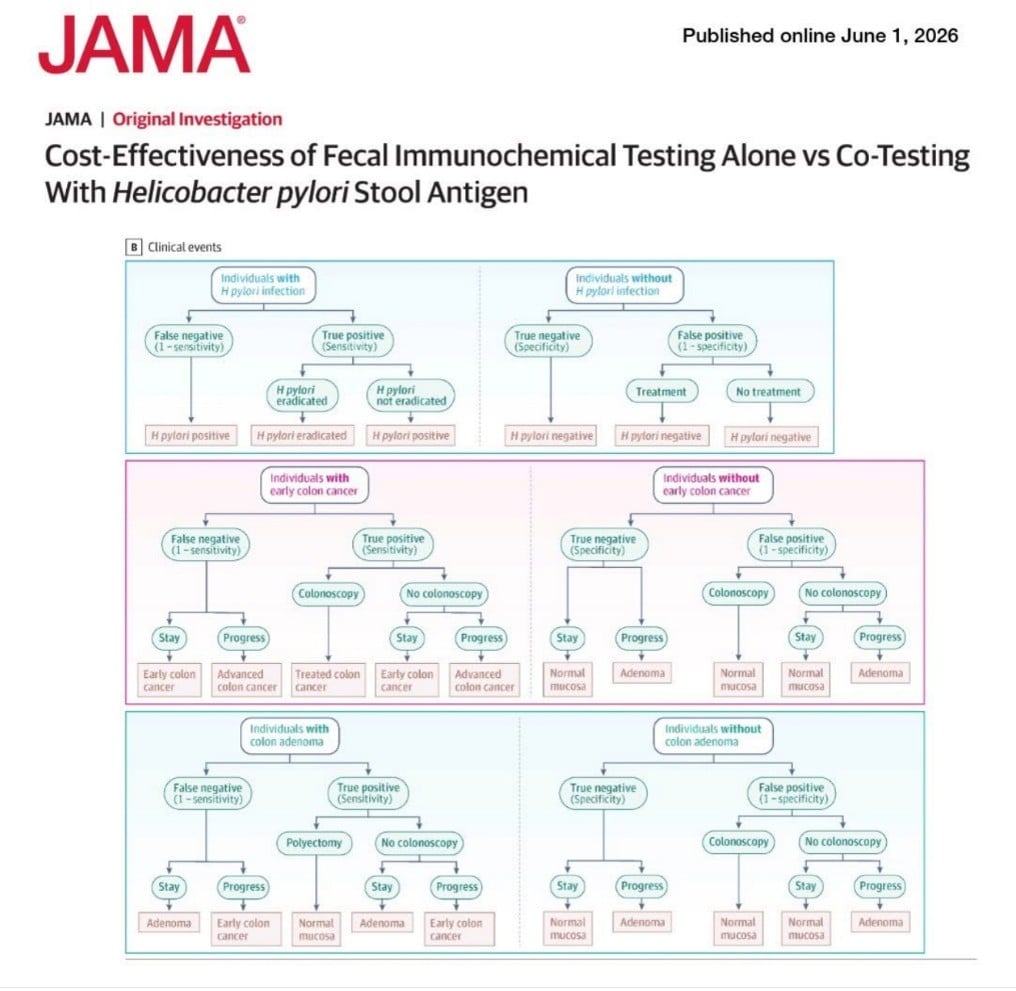
The randomized controlled clinical trial-informed cost-effectiveness analysis.
The gastric cancer prevention research team at National Taiwan University Hospital and College of Public Health, National Taiwan University has pioneered a globally applicable preventive model for gastric cancer control. To inform public health policymaking, the research team developed a globally adaptable decision-tree model to evaluate the cost-effectiveness of H. pylori screening. The findings were published in The Journal of the American Medical Association (JAMA) on June 1, 2026.
Building upon Taiwan’s nationwide fecal immunochemical test-based colorectal cancer screening program, the gastric cancer prevention team has conducted a 10-year randomized clinical trial demonstrating that the additional use of an H. pylori stool antigen test (HPSA) alongside fecal occult blood testing could simultaneously achieve the dual goals of colorectal cancer and gastric cancer prevention. The findings were previously published on September 30, 2024 in JAMA.
“To translate the findings of this pragmatic randomized clinical trial into public health policy, cost considerations are essential,” said first author Dr. Yi-Chia Lee, professor of internal medicine in the Division of Gastroenterology and Hepatology at National Taiwan University.
In this study, the research team developed a Markov decision-analytic model to estimate the 30-year cost-effectiveness of implementing this integrated strategy. The results demonstrated that H. pylori screening is a cost-saving strategy, with every unit of cost invested generating approximately a five-fold return in gastric cancer prevention benefits.
The team further collaborated with European and American researchers to evaluate the strategy under higher healthcare-cost settings. Even in these scenarios, H. pylori screening remained cost-effective. Although initial investments are required for screening and eradication therapy, the strategy is expected to reduce future expenditures related to gastric cancer surgery, chemotherapy, and targeted therapies, while also minimizing quality-of-life losses caused by the disease.
In an accompanying editorial, John M. Inadomi, Deputy Editor of JAMA, wrote, “Countries with gastric cancer incidence greater than or equal to that of Taiwan could expect similar economic value from HPSA screening, assuming costs, antibiotic resistance, and reinfection rates are also similar.”
First author Prof. Yi-Chia Lee’s email address: [email protected]
Co-corresponding author Prof. Tony Hsiu-Hsi Chen’s email address: [email protected]