

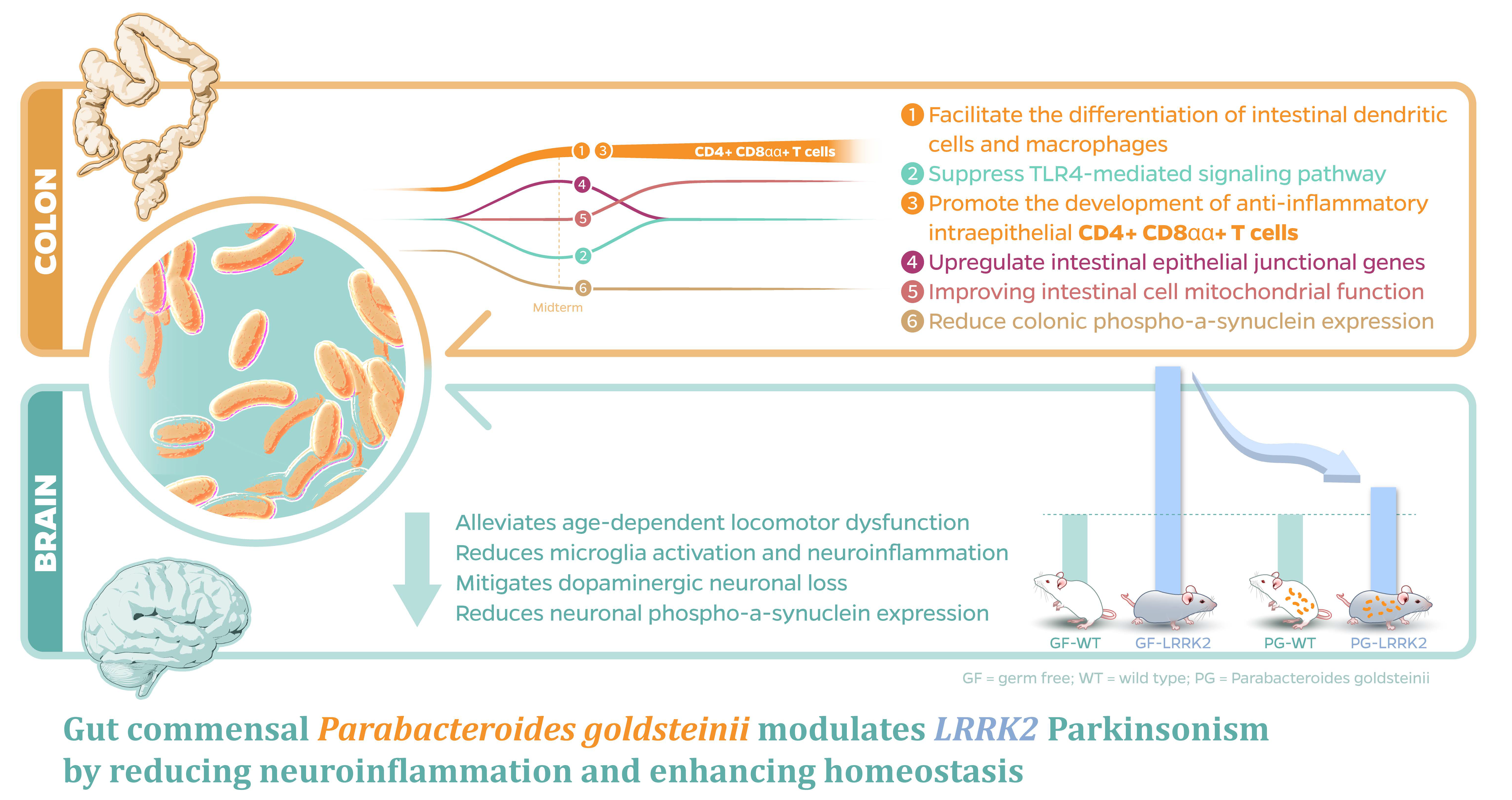

Researchers in Taiwan have shown that a single oral dose of a common gut bacterium, given before any movement problems appeared, protected mice carrying a Parkinson's-linked gene mutation from losing the brain cells that control movement. The bacterium worked by calming inflammation in the intestine, which in turn kept the brain's own immune cells quiet.
Mice carrying the Parkinson's-linked LRRK2 G2019S mutation were raised germ-free. Those given a single oral dose of the gut bacterium Parabacteroides goldsteinii at five months of age — before any movement problems began — kept a sealed, uninflamed gut, showed quieter immune activity and fewer protein clumps in the brain, retained their dopamine-producing neurons and moved far better than untreated mice.
National Taiwan University
Parkinson's disease is usually thought of as a brain disease, but many patients notice gut trouble — constipation above all — years or even decades before their hands begin to tremble. That timing has led researchers to ask whether the illness sometimes begins in the intestine, and whether treating the gut early could change what later happens in the brain.
A team at National Taiwan University and National Taiwan University Hospital, working with colleagues at Chang Gung University and the National Laboratory Animal Center, has now tested that idea directly. They studied mice carrying G2019S, a mutation in a gene called LRRK2 that is one of the most common inherited risk factors for Parkinson's disease — and that also raises the risk of inflammatory bowel disease. The mice were raised completely germ-free, so the researchers could control exactly which bacteria entered their guts. The study is published in Journal of Advanced Research.
At five months of age, before the animals showed any movement problems, some were given a single oral dose of Parabacteroides goldsteinii, a harmless bacterium that normally lives in the human intestine and is found at reduced levels in people with Parkinson's disease. The microbe settled in and persisted for more than a year.
Five months later the difference was clear. Mice that had received the bacterium moved far better than those that had not. Their brains contained fewer clumps of alpha-synuclein — the protein deposits that are the hallmark of Parkinson's disease — showed less activation of microglia, the brain's resident immune cells, and had lost far fewer of the dopamine-producing neurons that control movement.
The explanation lay in the gut. The bacterium turned down a key inflammatory switch called TLR4, strengthened the molecular seals between intestinal cells so the gut became less leaky, improved the energy supply of those cells, and expanded a population of calming immune cells in the intestinal lining. With less inflammation travelling out of the gut, the brain stayed quieter, and a growth-supporting signal reaching neurons was strengthened at the same time.
The findings point to the window before symptoms appear as the moment when gut-directed treatment might do the most good. The work was done in mice, and trials in people would be needed before any such approach could be offered to patients.
"Our results suggest that the years before movement symptoms appear may be a window of opportunity rather than a waiting period," says co-corresponding author Chin-Hsien Lin, M.D., Ph.D., professor of neurology and director of the Clinical Center for Neuroscience and Behavior at National Taiwan University Hospital.
"If we can keep the gut calm during that window, we may be able to slow what happens in the brain — and that is a very different goal from treating symptoms once they have already begun."
Prof. Chin-Hsien Lin, Department of Neurology, National Taiwan University Hospital, Taipei, Taiwan
Email: [email protected]
Advertisement