

Lingnan University and the University of Bologna in Italy co-host the 2nd International Workshop on Technologies for AI Governance (TAIG).
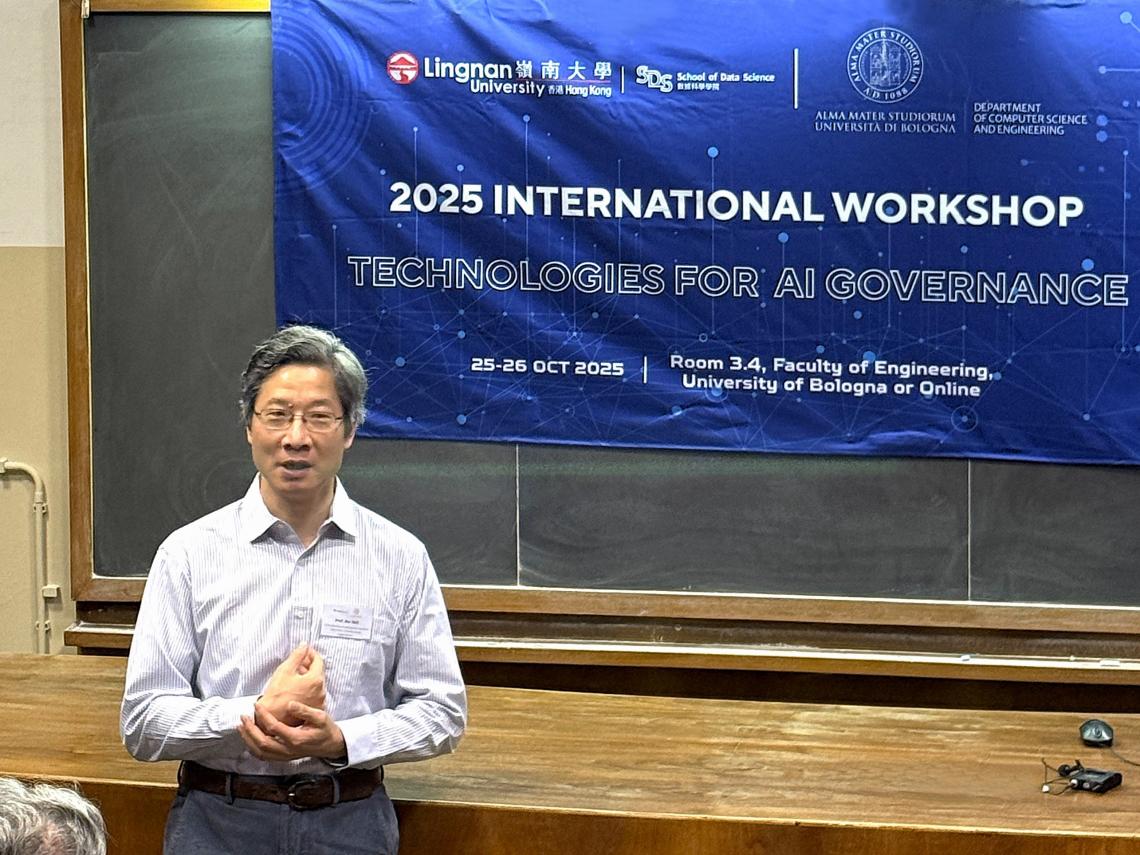
Prof Xin Yao, Vice-President (Research and Innovation) and Tong Tin Sun Chair Professor of Machine Learning at Lingnan University, delivers the keynote speech.
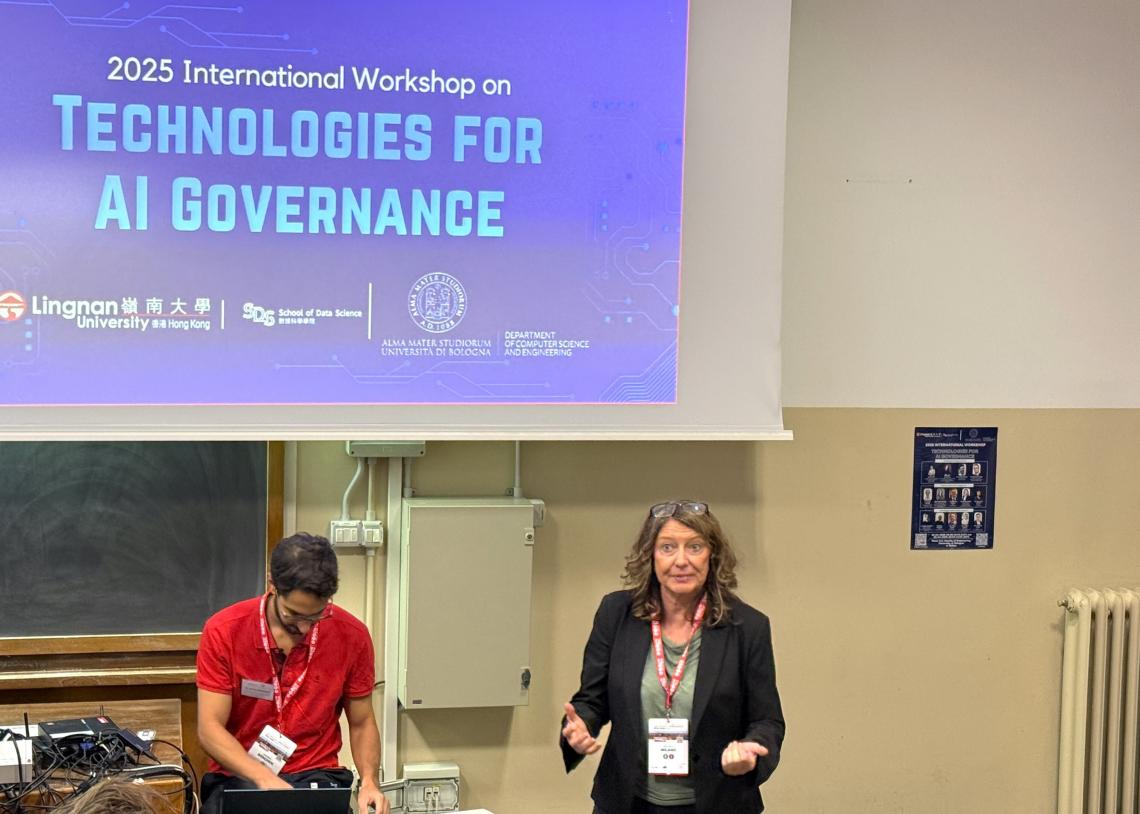
Prof Michela Milano, Full Professor of the Department of Computer Science and Engineering at the University of Bologna, delivers the keynote speech.
Held in a hybrid format, both online and on-site at the Faculty of Engineering, University of Bologna, the workshop focused on three core themes: (1) Governance of Open-Source AI; (2) Risks and Governance of Agentic AI; and (3) Technologies Towards Human-Centric AI.
Prof Xin Yao, Vice-President (Research and Innovation) and Tong Tin Sun Chair Professor of Machine Learning at Lingnan University, delivered a keynote speech on Open-Source AI Governance. He pointed out that AI is rapidly transforming the world, yet the reasoning behind AI-generated recommendations or decisions remains vague. He emphasised the necessity for the industry to enhance the transparency and explainability of AI models through technology. Prof Yao said: "Regulating AI is not merely an ethical or legal issue; it also requires leveraging technology to support monitoring, auditing, and accountability. This will help build safer, more transparent, and governable AI systems. We aim to bring an 'Asian perspective' to the European discussion platform on AI governance, while learning from Europe’s experiences to enhance global blueprints for AI development and applications."
Dr Takayuki Osogami, Senior Technical Staff Member at IBM Research – Tokyo, noted that certain AI systems can make autonomous decisions, plan ahead, and even devise strategies. Without proper regulation, such agentic AI could pose serious risks, including threats to human safety and global-scale crises. He observed that most existing regulatory efforts focus on computational scale, which is insufficient to gauge actual risk. Instead, he proposed assessing the degree of an AI system's autonomy — that is, how many decisions it can make independently—as a more accurate indicator of potential risk than existing metrics that rely on observing environmental states.
Ms Emanuela Girardi, President of the European Association for AI, Data, and Robotics, highlighted that the recent emergence of agentic and physical AI systems that act autonomously in digital and physical environments poses fundamental governance challenges. These technologies operate with unprecedented independence, yet they exceed traditional regulatory mechanisms designed for human-operated systems. For example, agentic AI can pursue goals through unexpected pathways, potentially causing unintended harm or manipulating users through sophisticated psychological techniques. Physical AI systems present additional safety concerns, from autonomous vehicles to household robots operating in unpredictable human environments, where failures can result in physical harm or property damage. Whether it is the potential for psychological manipulation by AI companions or the deployment of industrial and domestic automated robots, it demonstrates that governments and institutions are still struggling to keep pace with rapidly evolving new technologies.
She further pointed out that current global AI regulations are fragmented and uncoordinated. While numerous countries have approved ethical principles and charters, binding frameworks remain absent. She proposed that both European and global levels need frameworks that address the unique characteristics of autonomous systems while ensuring alignment with human values and meaningful oversight as technological capabilities accelerate.
Professor Matti Mäntymäki, Professor of Information Systems Science at the University of Turku, stated that industry must translate abstract governance ideals, such as regulatory requirements and ethical principles, into concrete decision-making and accountability structures. He shared insights from a five-year collaborative research project with industry, presenting an AI governance framework specifically designed for different types of organisations. The practical application of this framework provided valuable experiences and lessons, offering clear guidance for various enterprises to build reliable AI governance capabilities.
The other speakers and guests at the workshop were renowned and highly influential scholars from various fields, including academia, industry, and government across the globe. They included: Prof Jialin Liu, Associate Professor of the Division of Industrial Data Science of the School of Data Science; Prof Christoph Lütge, Director of the Institute for Ethics in AI (IEAI) at Technical University of Munich; Prof Mirco Musolesi, Professor of Computer Science at the Department of Computer Science at University College London; Prof Fabrizio Riguzzi, Full Professor of Computer Science at the Department of Mathematics and Computer Science of the University of Ferrara; Prof Antonino Rotolo, Professor of legal theory and AI & Law, and philosophy of law at the University of Bologna; Dr Elliot Mckernon, AI Safety Researcher at Convergence Analysis; Dr Daniele Proverbio, postdoctoral researcher at the University of Trento, Mr Tomer Jordi Chaffer, Researcher at McGill University; Ms Rebekka Görge, Senior Data Scientist of the Fraunhofer Institute for Intelligent Analysis and Information Systems in Germany; and Ms Anni Lai, Co-Chair of the Generative AI Commons, LF AI & Data.