
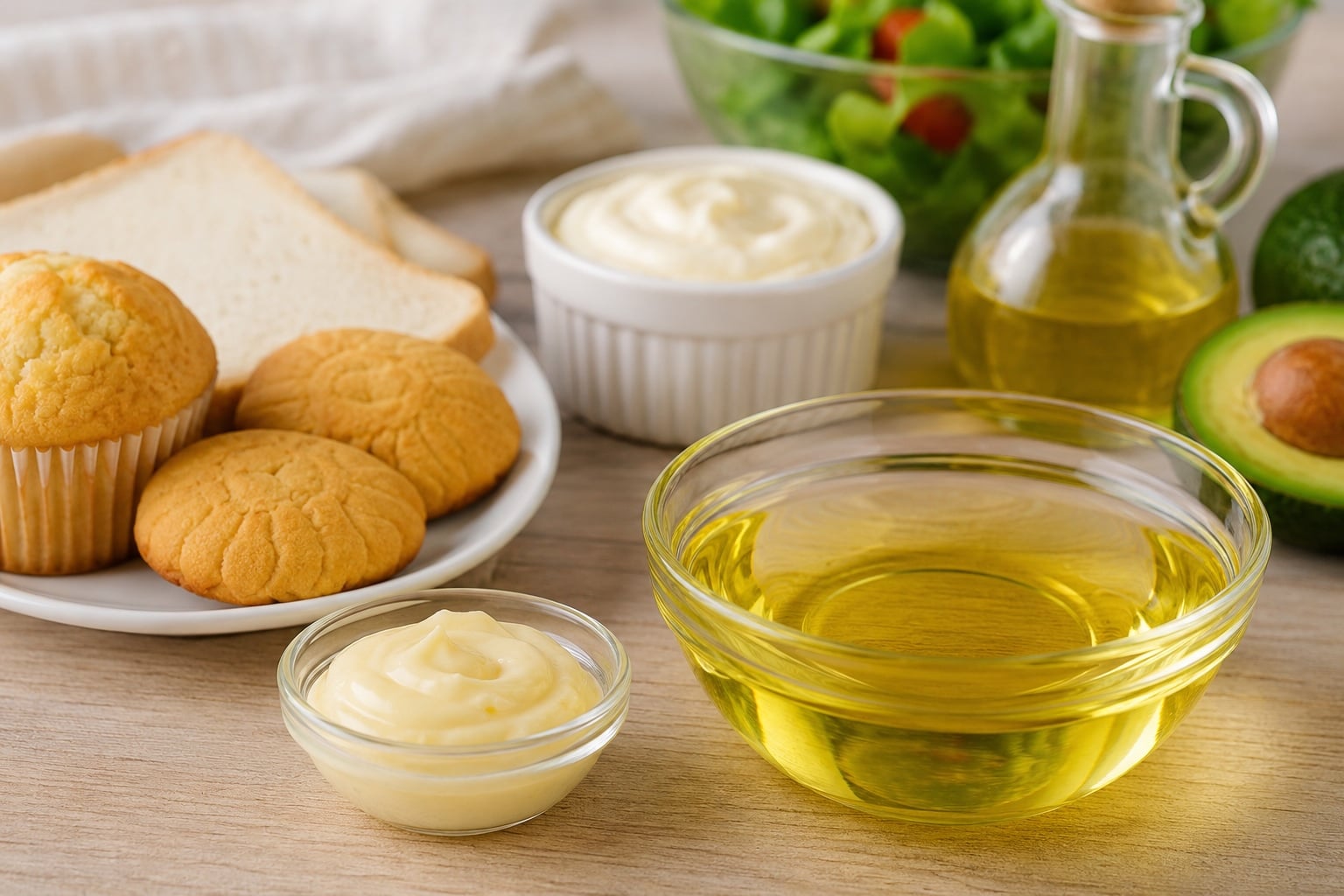
Diacylglycerols are being explored as functional oil ingredients for cleaner processing, healthier edible oils and improved food formulations.
A new review charts how enzyme technology could advance cleaner production of diacylglycerols for functional foods, medical nutrition and next-generation edible oils.
Fats and oils are essential to life. They provide energy, support the absorption of fat-soluble vitamins, contribute to the structure of cell membranes, and give foods their flavour, texture and mouthfeel. Yet the way fats are produced, processed and consumed is changing. Food manufacturers are under pressure to develop ingredients that are not only safe and stable, but also better aligned with health, sustainability and clean-label expectations.
One group of lipid molecules attracting renewed attention is diacylglycerols, or DAG. These naturally occur in small amounts in edible oils, but they can also be produced and concentrated for use as functional food ingredients. Unlike conventional triacylglycerol-rich edible oils, DAG molecules contain two fatty acid chains on a glycerol backbone rather than three. This structural difference affects how they are digested, processed and used in food systems.
A new review published in Journal of Future Foods brings together recent advances in the enzymatic synthesis, purification and functional characterisation of DAG. The article was written by researchers from the Oil Crops Research Institute of the Chinese Academy of Agricultural Sciences, the University of Manchester, Newcastle University in Singapore, and Jing Brand Research Institute.
The review is significant because it does more than summarise a narrow technical topic. It maps an emerging landscape at the intersection of lipid chemistry, enzyme engineering, food processing, nutrition, safety and functional food design. For companies and researchers working in oils and fats, medical nutrition, bakery products, emulsions, health foods or sustainable processing, the review provides a clear technical guide to where the field now stands and where collaboration is needed next.
DAG has attracted attention because of its potential physiological and functional benefits. The review discusses evidence that DAG-rich oils may support metabolic regulation, including effects on postprandial lipids, body-fat outcomes, blood glucose regulation and inflammatory pathways. The authors are careful, however, not to present DAG as a stand-alone treatment for obesity or metabolic disease. Instead, they describe DAG oil as a triacylglycerol alternative with potential for modest health-related benefits when used appropriately in food systems.
This balanced view matters. Functional foods need strong science, not exaggerated claims. The review helps separate promise from overstatement by looking at DAG from several angles: how it is made, how it is purified, how it behaves in food, what physiological effects have been reported, and what safety and stability issues still need to be addressed.
A central theme of the review is enzymatic production. Traditional chemical methods for producing DAG can involve high temperatures, higher energy consumption, unwanted side reactions and concerns about process contaminants such as glycidyl esters. By contrast, enzymatic synthesis can offer milder reaction conditions, higher selectivity, lower energy use and fewer by-products.
The review compares four major enzymatic routes: esterification, partial hydrolysis, transesterification and glycerolysis. These routes differ in their raw materials, enzyme requirements, reaction conditions, yield, purity and suitability for scale-up. The pathway diagram in the review shows how triacylglycerols, glycerol, fatty acids and monoacylglycerols can be converted into DAG through different lipase-catalysed reactions.
This is important for industry because there is no single universal route to DAG production. A process that works well for one oil source, product specification or health application may not be optimal for another. The review therefore gives researchers and manufacturers a practical foundation for selecting synthesis routes, enzymes, reactor systems and downstream purification strategies.
Purification is another major bottleneck. DAG production typically generates mixtures containing monoacylglycerols, free fatty acids, triacylglycerols and other lipid components. To meet food, pharmaceutical or chemical-industry requirements, these mixtures often need further separation. The review examines solvent crystallisation, chromatography, molecular distillation and supercritical carbon dioxide extraction, highlighting both their strengths and limitations.
Molecular distillation, for example, is widely used for lipid purification, but high-temperature separation may increase energy use and can raise concerns about heat-sensitive compounds and process contaminants. Chromatography can achieve high purity but is often too expensive for large-scale production. Supercritical carbon dioxide extraction offers a greener alternative, but high pressure and cost remain barriers to broader industrial adoption.
The review also shows why DAG should not be viewed only as a “health oil”. DAG can act as an emulsifier, crystallisation modifier, fat substitute and functional ingredient in food systems. It has potential applications in mayonnaise, ice cream, margarine, shortening, bakery products, cooking oils and specialised nutrition products. The review’s food-application diagram summarises these roles, showing how DAG can contribute to emulsion stability, crystallisation control, bakery performance and cooking-oil substitution.
For food companies, this is where the opportunity becomes especially interesting. DAG may help reformulate products not only for health positioning, but also for texture, stability, aeration, mouthfeel and processing performance. In bakery products, for example, DAG-rich fats have been reported to influence batter aeration, cake volume, moisture retention, biscuit texture and oil migration. In emulsified foods, DAG’s amphiphilic structure can help stabilise oil-water systems.
At the same time, the authors emphasise that technical challenges remain. DAG-rich oils can have lower oxidative stability than conventional oils. They may also be vulnerable to the formation of process contaminants such as 3-MCPD esters and glycidyl esters under certain processing conditions. These issues must be managed through better process design, milder purification, antioxidant strategies, suitable fatty-acid selection and careful product formulation.
The review’s outlook points to several directions for future work. These include thermostable engineered enzymes, continuous-flow reactors, greener purification technologies such as supercritical carbon dioxide extraction, medium-chain or mixed-fatty-acid DAG, microencapsulation, and synthesis pathways that minimise process-contaminant formation. The authors also note that recent advances in low-temperature enzymatic hydrolysis and high-purity purification technologies have created a stronger foundation for larger-scale DAG production.
This makes the review particularly timely. The next phase of functional oil research will not be driven by one discipline alone. It will require collaboration among lipid chemists, enzyme technologists, food scientists, process engineers, nutrition researchers, safety specialists and industry partners. The review offers a shared map for that collaboration.
For academic and industrial partners, the message is clear: DAG is not only a molecule of nutritional interest. It is a platform for rethinking how edible oils and fat-based ingredients can be designed, produced and used.
The authors welcome collaboration with researchers and companies interested in enzymatic lipid modification, high-value oils, functional foods, medical nutrition, sustainable food processing, oil purification, food safety and product formulation.
Paper details
The review article, “Recent advances in enzymatic synthesis, purification and functional characterization of diacylglycerols: A review”, is published in Journal of Future Foods. DOI: 10.1016/j.jfutfo.2025.12.004.
Authors and affiliations
The review was written by Run Liu, Yi Zhang, Yufei Zhang and Mingming Zheng from the Oil Crops Research Institute, Chinese Academy of Agricultural Sciences, Hubei Key Laboratory of Lipid Chemistry and Nutrition, Hubei Hongshan Laboratory, and Key Laboratory of Oilseeds Processing, Ministry of Agriculture, China; Zhiming Feng from the University of Manchester, United Kingdom; Kheng-Lim Goh from Newcastle University in Singapore; and Qiang Yang, Yin Xu and Kai Chen from Hubei Provincial Key Lab for Quality and Safety of Traditional Chinese Medicine Health Food, Jing Brand Research Institute, Jing Brand Co., Ltd., China.
For further details, contact Associate Professor Yi Zhang at [email protected], or Associate Professor Kheng-Lim Goh at [email protected].