

A team of international researchers has developed alternatives to antibiotics that prevent infection of cow udders, called bovine mastitis, to address rising antibiotic resistance and concerns around milk contamination from antibiotic residues.
(From left) Prof Mary Chan from Nanyang Technological University, Singapore, Dr Kaixi Zhang from the Singapore-MIT Alliance for Research and Technology, and Prof Paula Hammond from the Massachusetts Institute of Technology were involved in developing a safer and more sustainable antimicrobial compound (blue-dyed liquid in tube) to prevent infection in cow udders. The compound, which was applied to cow udders, also did not affect the quality of cows’ milk (white liquid in tube).
Credit: NTU Singapore
The dairy industry has been plagued by a persistent global problem for decades – bacterial infection of cow udders that significantly reduces milk production.
The condition, known as bovine mastitis, is estimated to cause annual global losses of US$22 billion (S$28 billion).[1] While antibiotics have been used to treat the infection in dairy cattle, there are issues such as rising antibiotic resistance and concerns around milk contamination from antibiotic residues.
Now, a team of international researchers has developed alternatives to antibiotics that prevent infection through a novel mechanism they discovered.
The scientists were led by Nanyang Technological University, Singapore (NTU Singapore), in collaboration with the Antimicrobial Resistance (AMR) Interdisciplinary Research Group at the Singapore-MIT Alliance for Research and Technology (SMART), Massachusetts Institute of Technology’s (MIT) research enterprise in Singapore. Their findings were recently published in the scientific journal Nature Communications.
In a preliminary farm trial, the new antimicrobial compounds were applied on cow teats and shown to stave off udder infection after the animals were exposed to bacteria.
“Our study has unveiled an alternative class of potent antimicrobial compounds that could be used in the agriculture industry to combat multi-drug-resistant bacteria that cause bovine mastitis,” said Professor Mary Chan, one of the co-leads of the research from NTU Singapore’s School of Chemistry, Chemical Engineering and Biotechnology, and the Lee Kong Chian School of Medicine, as well as a Principal Investigator at SMART AMR. “The compounds are also promising as they did not cause significant adverse effects in cattle in our tests. They didn’t spoil the cows’ milk nor make it unsafe for consumption as well.”
The new compounds have since attracted interest from several agricultural companies in Australia, Belgium, Malaysia and New Zealand. The businesses are keen as they are seeking substitutes that are safer and more environmentally friendly than existing compounds in preventing the infection of cow teats.
Professor Paula Hammond, Institute Professor and Executive Vice Provost at MIT and Principal Investigator at SMART AMR, who is one of the co-authors of the research, said: “With the success of our initial study in both the laboratory and in the field, we are now planning to work closely with industry partners to scale up and do larger trials in dairy cattle, with the aim of commercialising the novel antimicrobial compounds.”
Professor Kevin Pethe, the study’s other co-lead from NTU’s Lee Kong Chian School of Medicine and Principal Investigator at SMART AMR, noted that the new compounds are also very effective in killing multi-drug-resistant bacteria in mice at doses that were not noticeably harmful to the rodents in the team’s study. “This opens the way for the compounds to be further developed and optimised for other therapeutic applications in the biomedical field in the future,” he said.
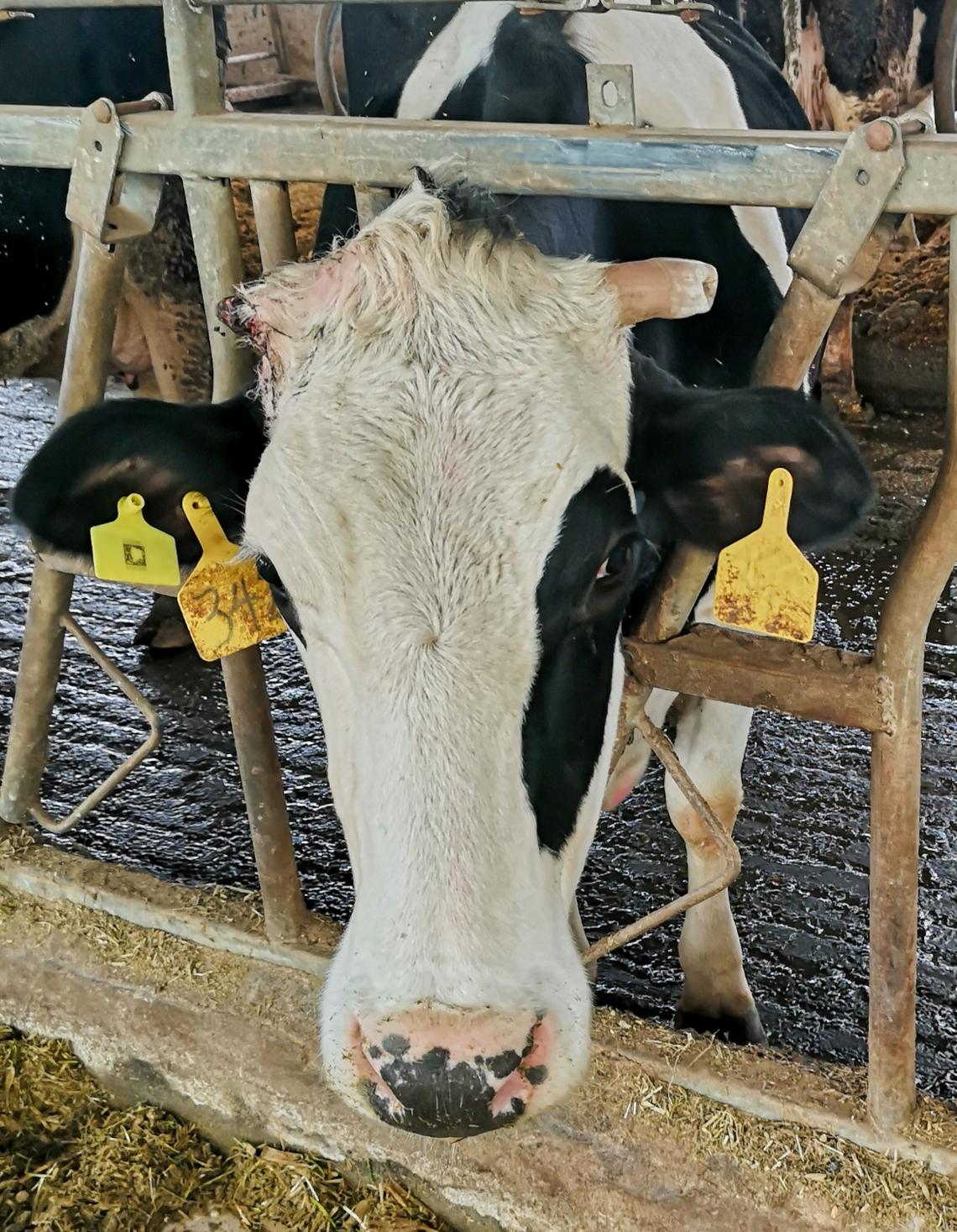
The researchers conducted an initial farm trial on their safer and more sustainable antimicrobial compound.
Credit: Kaixi Zhang
Udder concerns
When cattle udders get infected, the antibiotics used to treat them often end up in their milk in high concentrations for some time, so the milk cannot be consumed or sold under existing rules. Bacteria resistant to such antibiotic treatments have surfaced too.
To prevent the infection of cow teats, farmers typically dip udders in antiseptic solution, such as those containing iodine or chlorhexidine, to kill bacteria on them. However, the disinfectants’ long-term use can irritate udders or cause their skin to crack, which increases the risk of infection.
There are also concerns that after cleaning the udders of the antiseptics, iodine and chlorhexidine may find their way into the environment and cause problems like disrupting the nutrient balance in nature and harming aquatic life respectively. And when the chemicals come into contact with milk, like when udders are not properly cleaned, they become less effective at killing bacteria.
The NTU-led scientists realised that these challenges in the dairy business could be addressed with novel compounds called “oligoimidazolium carbon acids” (OIMs) that they initially developed as alternatives to fight antibiotic-resistant bacteria.
They found that OIMs kill bacteria in a new way, unlike traditional “cationic” antimicrobials studied now as antibiotic substitutes. Parts of the OIMs convert into structures called carbenes, which lets them slip past the bacteria’s protective membranes quickly to damage their DNA and kill them. This killing method is more potent than for typical cationic antimicrobials. So, lower doses of OIMs are needed, which reduces the chance of side effects.
Commercial potential
The research team tested if OIMs could be used as an antiseptic dip to prevent bovine mastitis in a preliminary farm trial led by SMART AMR. Cows whose teats were dipped in the compounds did not develop udder infection over time after being exposed to bacteria.
The OIMs also did not irritate the cows’ udders nor cause the animals to behave abnormally – for example, they were not restless and did not kick, which are signs of itching and irritation. The compounds were easily washed off as no traces of them were detected on the udders or in the cows’ milk after the teats were cleaned.
They have a sustainable advantage as well. “The OIMs are biodegradable and break down into natural molecules that are neither toxic nor polluting, so we expect them to be more environmentally friendly than using iodine or chlorhexidine,” explained Dr Kaixi Zhang, Research Scientist at SMART AMR and a co-author of the study.
Tests showed that the OIMs do not affect the quality of the milk too. Furthermore, unlike iodine and chlorhexidine, the OIM’s ability to kill bacteria was unaffected by milk.
Going forward, the scientists are commercialising the OIMs through a spin-off company, and a large farm trial has been started in Malacca, Malaysia, to optimise the antimicrobial compounds. Several agricultural companies in Australia, Belgium, Malaysia and New Zealand have expressed interest in exploring the commercial use of the antimicrobial compounds in preventing, and possibly treating, bovine mastitis in dairy cattle.
The dairy industry has been actively searching for new compounds that are much less toxic, more effective and more sustainable to replace existing iodine- and chlorhexidine-based products, which have been used to prevent bovine mastitis for decades. Coupled with increased scrutiny of the dairy business following rising incidents of adulterated milk, companies have thus shown interest in the researchers’ new antimicrobial compounds.
The research conducted at SMART is supported by the National Research Foundation Singapore under its Campus for Research Excellence and Technological Enterprise (CREATE) programme. The farm trial study was supported by a grant from the SMART Innovation Centre, which helps researchers commercialise their technologies and turn them into successful ventures.
Paper: “Carbene formation as a mechanism for efficient intracellular uptake of cationic antimicrobial carbon acid polymers” published in Nature Communications, 12 July 2025. https://doi.org/10.1038/s41467-025-61724-y
[1] Rasmussen et al (2024). Global losses due to dairy cattle diseases: A comorbidity-adjusted economic analysis. Journal of Dairy Science. https://pubmed.ncbi.nlm.nih.gov/38788837/
Media contacts:
Mr Kenny Chee
Senior Assistant Director
Media, Research and Executive Communications
Corporate Communications Office
Nanyang Technological University, Singapore
Email: [email protected]
Ms Sneha Saha
Consultant
Blue Totem Communications on behalf of SMART
Email: [email protected]
About Nanyang Technological University, Singapore
A research-intensive public university, Nanyang Technological University, Singapore (NTU Singapore) has 35,000 undergraduate and postgraduate students in the Business, Computing & Data Science, Engineering, Humanities, Arts, & Social Sciences, Medicine, Science, and Graduate colleges.
NTU is also home to world-renowned autonomous institutes – the National Institute of Education, S Rajaratnam School of International Studies and Singapore Centre for Environmental Life Sciences Engineering – and various leading research centres such as the Earth Observatory of Singapore, Nanyang Environment & Water Research Institute and Energy Research Institute @ NTU (ERI@N).
Under the NTU Smart Campus vision, the University harnesses the power of digital technology and tech-enabled solutions to support better learning and living experiences, the discovery of new knowledge, and the sustainability of resources.
Ranked amongst the world’s top universities, the University’s main campus is also frequently listed among the world’s most beautiful. Known for its sustainability, NTU has achieved 100% Green Mark Platinum certification for all its eligible building projects. Apart from its main campus, NTU also has a medical campus in Novena, Singapore’s healthcare district.
For more information, visit www.ntu.edu.sg
About Singapore-MIT Alliance for Research and Technology (SMART) [新加坡-麻省理工学院科研中心]
Singapore-MIT Alliance for Research and Technology (SMART) is MIT’s Research Enterprise in Singapore, established by the Massachusetts Institute of Technology (MIT) in partnership with the National Research Foundation of Singapore (NRF) since 2007. SMART is the first entity in the Campus for Research Excellence and Technological Enterprise (CREATE) developed by NRF. SMART serves as an intellectual and innovation hub for research interactions between MIT and Singapore. Cutting-edge research projects in areas of interest to both Singapore and MIT are undertaken at SMART. SMART currently comprises an Innovation Centre and six Interdisciplinary Research Groups (IRGs): Antimicrobial Resistance (AMR), Critical Analytics for Manufacturing Personalized-Medicine (CAMP), Disruptive & Sustainable Technologies for Agricultural Precision (DiSTAP), Mens, Manus and Machina (M3S), Wafer-scale Integrated Sensing Devices based on Optoelectronic Metasurfaces (WISDOM), and Wearable Imaging for Transforming Elderly Care (WITEC).
SMART research is funded by the National Research Foundation Singapore under the CREATE programme.
For more information, please visit http://smart.mit.edu
About Antimicrobial Resistance Interdisciplinary Research Group (AMR IRG)
The AMR IRG is a translational research and entrepreneurship program that tackles the growing threat of antimicrobial resistance. By leveraging talent and convergent technologies across Singapore and MIT, we aim to tackle AMR head-on by developing multiple innovative and disruptive approaches to identify, respond to, and treat drug-resistant microbial infections. Through strong scientific and clinical collaborations, our goal is to provide transformative, holistic solutions for Singapore and the world.
For more information, please log on to: http://amr.smart.mit.edu/#home
Advertisement