
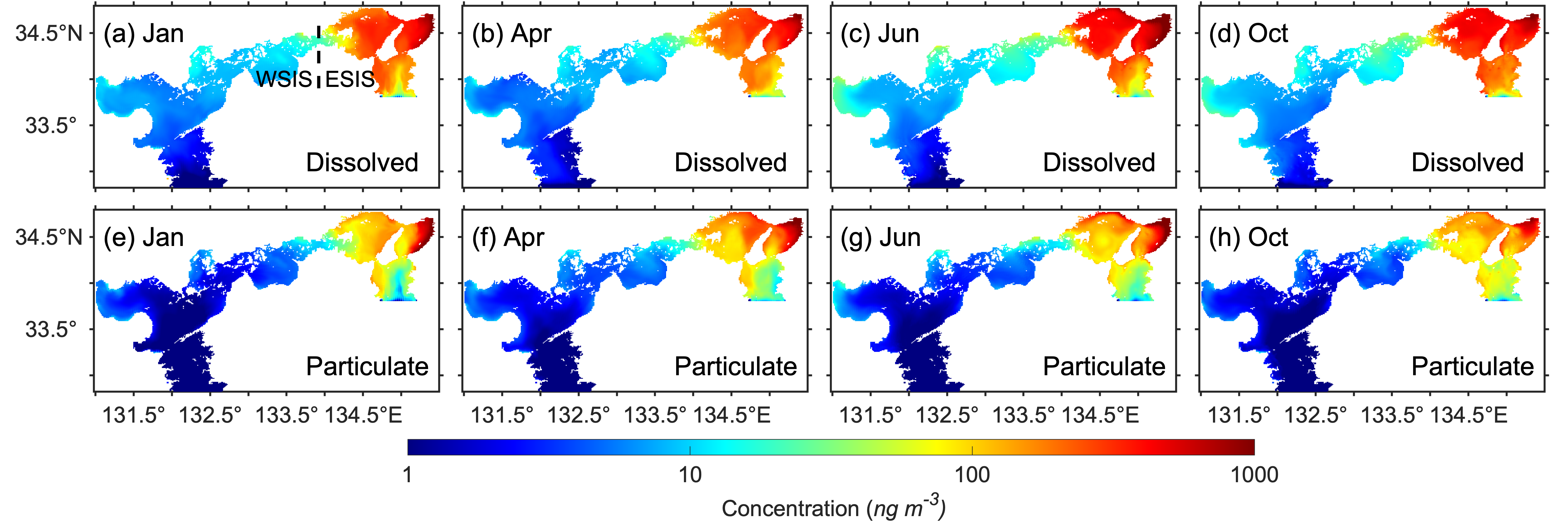
【Distributions of PFOA concentrations in the Seto Inland Sea.】
The horizontal distributions of vertically averaged concentrations of (a–d) dissolved and (e–h) particulate PFOA in January, April, June, and October. The dotted black line in (a) represents the boundary between the western and eastern parts of the Seto Inland Sea.
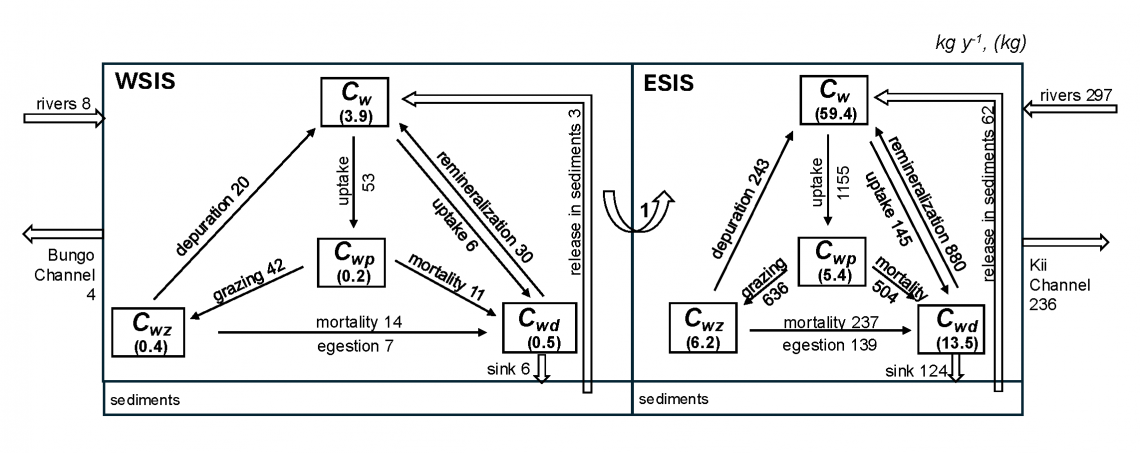
【Mass budget of PFOA for Seto Inland Sea.】
Annual mass budget of PFOA for the western and eastern part of Seto Inland Sea. The value with the arrow has a unit of kg/y^1, which represents the total mass involved in physical and biogeochemical processes over a year. The value inside parentheses has a unit of kg, representing the inventory in each area. The lateral flux between the western and eastern part of Seto Inland Sea is 1 kg/y^1 with a direction from western and eastern part.
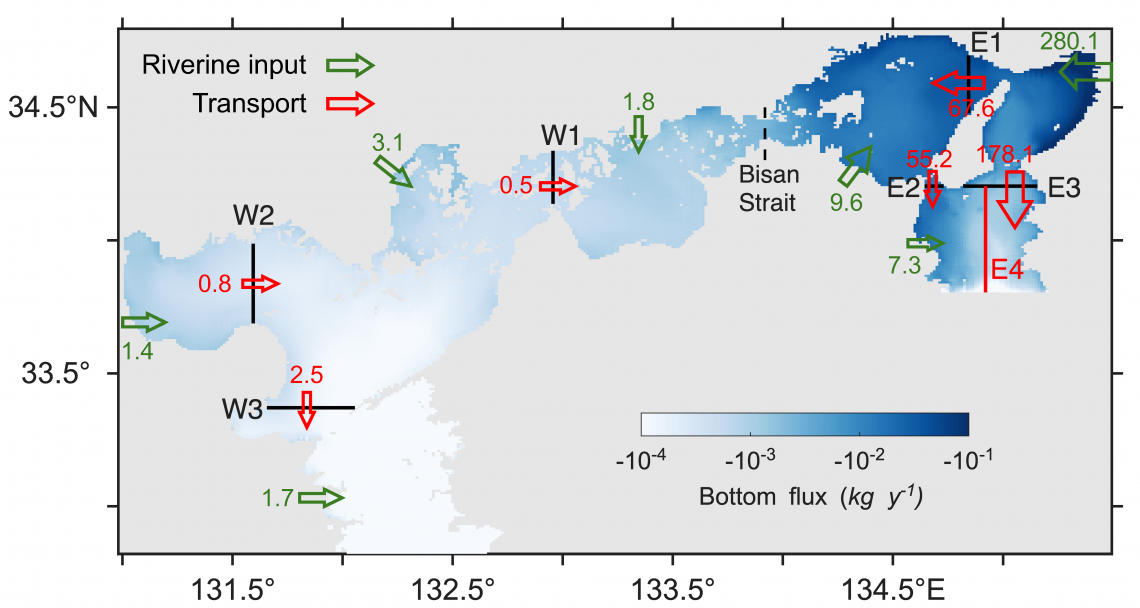
【The annual transport of total PFOA in the Seto Inland Sea.】
The annual transport of total PFOA in the Seto Inland Sea. Background shading shows the annual downward bottom fluxes of PFOA. Solid lines with names of W1-W3 and E1-E4 show the locations of the sections. Red arrows show the direction of PFOA transport, while the values behind the arrows denote the amount of PFOA transport. Green arrows show the riverine PFOA inputs into the sub-regions bounded by these sections. The unit of all values is kg/y^1.
Perfluorooctanoic Acid (PFOA) is one of the per- and polyfluoroalkyl substances (PFAS), which are a class of substances within a broader universe of organofluorine compounds. PFOA has potential adverse effects on human health and environmental safety due to its toxicity and bioaccumulation. Its innate chemical stability, top usage, and long-range transport result in PFOA ubiquity in the global environment.
The rivers around the Seto Inland Sea have high perfluorooctanoic acid (PFOA) concentrations, and the Seto Inland Sea is expected to be a PFOA source for the Pacific Ocean. To investigate the variability, transport, and fate of riverine PFOA in this sea, we use a coupled hydrodynamic-ecosystem-PFOA model to simulate the behaviors of dissolved and biogenic particle phases of PFOA in the Seto Inland Sea.
The sum of dissolved and particulate PFOA presents a mean concentration of 468.5ng m-3 in the eastern part of Seto Inland Sea, which is much higher than that in the western part (11.5ng m-3). The partitioning between particulate and dissolved phases is higher in nearshore than in offshore areas. The inputs from the Yodo and Yamato Rivers dominate the PFOA levels in the eastern Seto Inland Sea.
After entering Osaka Bay, 25% of the PFOA is transported to Harima Nada, while 63% is transported to the Kii Channel. The latter is transported farther to the Pacific Ocean through the upper 20m of the Kii Channel, which is the dominant fate of PFOA in the Seto Inland Sea. We use the proportions of PFOA outflow to the Pacific Ocean from the rivers discharging into Osaka Bay (88%) and Suo Nada (57%) as upper and lower limits, respectively, to estimate the amount of PFOA from the rivers along the coast south of Japan toward the Pacific Ocean. The annual amount is 328.0–348.9kg, to which the Seto Inland Sea contributes the largest part.