
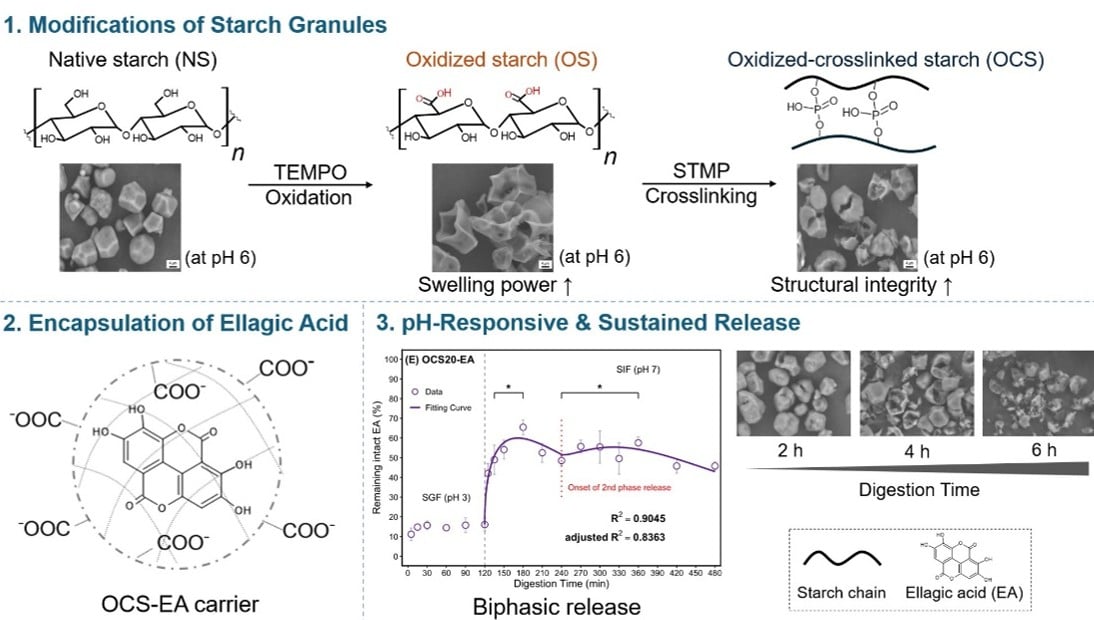
Figure: Smart Starch-Based Carrier Achieves Controlled Release of Antioxidant Ellagic Acid.
Researchers have developed a novel, pH-responsive nutrient delivery system using modified starch granules. (1) Starch Modification: Native starch (NS) undergoes TEMPO-mediated oxidation to form oxidized starch (OS), increasing its swelling capacity. It is then crosslinked with STMP to produce oxidized-crosslinked starch (OCS), significantly enhancing its structural durability. (2) Nutrient Encapsulation: This engineered OCS matrix effectively encapsulates Ellagic Acid (EA), a potent natural antioxidant, utilizing negative charge repulsions (\(COO^{-}\)) to stabilize the OCS-EA carrier. (3) Smart Release: The carrier exhibits a smart biphasic release profile. It remains stable in simulated gastric fluid (SGF, pH 3) but triggers a sustained, long-term release of Ellagic Acid upon reaching simulated intestinal fluid (SIF, pH 7) as the starch granules gradually digest over 6 hours.
Taipei, Taiwan – Inside the human body, powerful natural antioxidants often face a destructive journey. Ellagic acid, a bioactive polyphenol abundant in berries and walnuts, possesses remarkable antioxidant, anti-inflammatory, and health-promoting properties.
However, when ingested, its therapeutic potential is severely limited. The harsh, highly acidic environment of our stomach rapidly degrades this sensitive compound before it can ever reach the intestines to be absorbed. Delivering such fragile nutrients safely to their target site of the body has long been a major challenge for scientists.
In a study published in Carbohydrate Polymers, researchers at National Taiwan University report the creation of smart, pH-responsive starch granules that act as a protective cellular platform for the targeted gastrointestinal delivery of ellagic acid.
Starch is a natural, biocompatible carbohydrate made of glucose units organized into semi-crystalline granules. While ordinary starch breaks down too easily, the team used a special, environmentally friendly chemical process to transform it into a highly stable, "oxidized-crosslinked" starch network. This clever modification greatly enhances the stability and swelling power of the tiny starch packages, allowing them to perfectly wrap around and lock fragile ellagic acid inside.
The release of the encapsulated nutrients depends entirely on the surrounding chemical environment, specifically the pH levels of the digestive system. To move from one stage of digestion to the next, the carrier must adapt to drastic changes in acidity. In the stomach, the fluid is highly acidic, whereas the small intestine is near-neutral. High acidity typically triggers premature leakage if the carrier structure is unstable.
Once the packages move out of the stomach and enter the small intestine, they sense the change in environment. The lower acidity triggers the starch packages to swell up and quickly open. This releases the intact ellagic acid exactly where the body can absorb it best. This green, food-grade technology offers a simple and safe method for companies to create much more effective dietary supplements.
“Our dynamic biopolymer platform successfully preserves the chemical integrity of fragile nutrients, paving the way for next-generation clean-label functional foods that maximize real health benefits,” says corresponding author Hsi-Mei Lai, distinguished professor of agricultural chemistry at National Taiwan University.
Prof. Hsi-Mei Lai's email address: [email protected]