

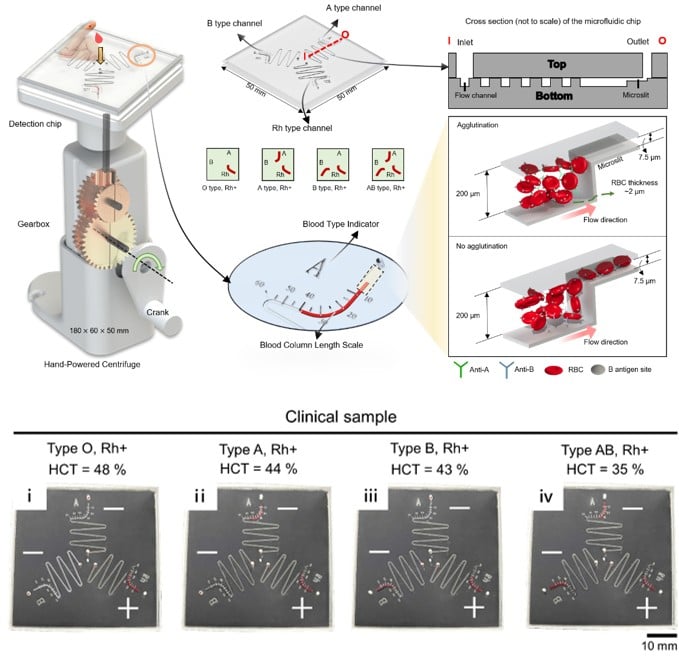

Researchers at National Taiwan University have built a small hand-cranked spinner and a plastic chip that, from a single drop of blood, can identify a person's blood type and estimate how much of their blood is made up of red blood cells. The test takes about one minute and needs no electricity, making it suited to ambulances, disaster zones and remote clinics.
A drop of blood from a finger prick is placed on a small plastic chip, which is spun using a hand-cranked centrifuge. Red bands appearing in the A, B and Rh channels reveal the blood type. A tiny slit at the end of each channel traps clumped red blood cells while letting single cells pass through. The length of the red band, read against a printed scale on the chip, indicates the hematocrit, the proportion of red blood cells in the blood.
National Taiwan University
When someone is badly injured, doctors urgently need two facts: the patient's blood type, so that a transfusion is safe, and their hematocrit, the share of the blood made up of red blood cells, which reveals blood loss or anemia. Hospitals measure both with large machines that need electricity and trained staff, which are often unavailable in ambulances, disaster zones or remote clinics.
A team led by Prof. Chien-Fu Chen at National Taiwan University has developed a simple alternative: a small plastic chip spun by a hand-cranked centrifuge that needs no electricity. It uses only about 3 microliters of finger-prick blood. The study is published in Biosensors and Bioelectronics.
Turning the crank pushes the blood through winding channels pre-loaded with reagents for the A, B and Rh blood groups. If the blood matches, its red blood cells clump together and are trapped at the channel's end by a gap roughly one-tenth the width of a human hair, forming a red band that shows the blood type at a glance. The band's length also reveals the hematocrit: more red blood cells make a longer band read against scale marks on the chip.
In tests on 21 hospital patient samples, the results closely matched those of standard hospital analyzers, and readings stayed consistent no matter how fast the crank was turned. The whole test takes about one minute.
"Our goal is to bring two essential blood tests out of the laboratory and into the hands of first responders, with no electricity or specialized training needed," says corresponding author Chien-Fu Chen, distinguished professor of Institute of Applied Mechanics at National Taiwan University.
Prof. Chien-Fu Chen’s email address: [email protected]
Advertisement