
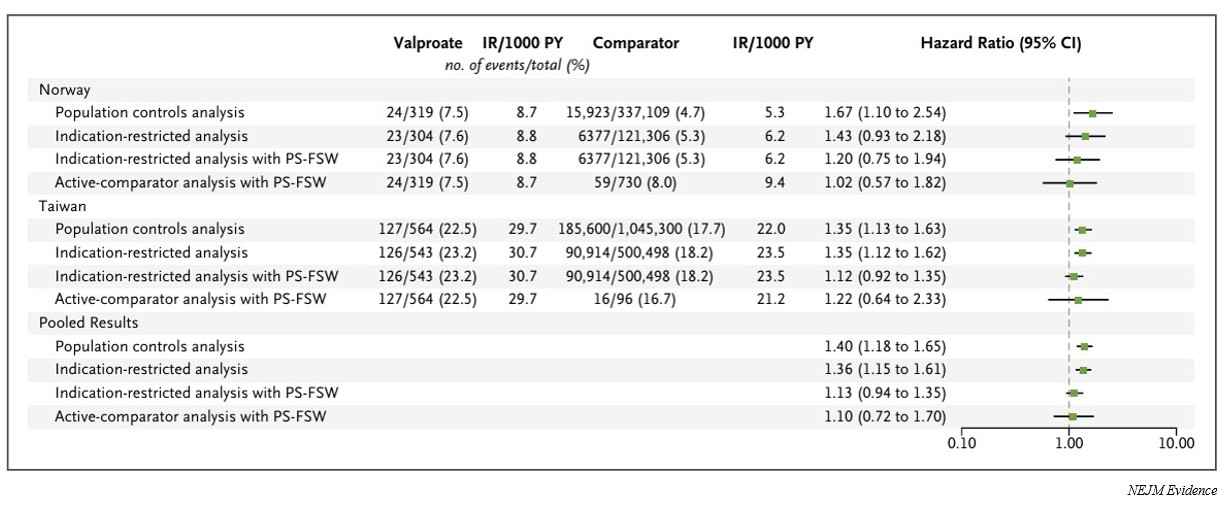
Associations between Paternal Valproate Monotherapy and Risk of Any Neurodevelopmental Disorder in Children. Hazard ratios and 95% confidence intervals for any neurodevelopmental disorders are shown for paternal valproate monotherapy during the 90-day preconception period. Analyses include population control analyses, indication-restricted analyses, propensity score fine stratification weighting–adjusted models, and active-comparator models for both the Norwegian and Taiwanese cohorts.
In a significant contribution to medication-safety science, a research team led by Prof. Fei-Yuan Hsiao and her students — including first author Lin-Chieh Meng — at National Taiwan University, together with Prof. Hedvig M. E. Nordeng at University of Oslo, has addressed a question worrying many men with epilepsy who hope to become fathers: "Is it safe to take valproate in the months before trying to conceive?"
The concern is recent. An earlier European study suggested that fathers who took the antiseizure medicine valproate in the 90 days before conception had a modestly higher risk of neurodevelopmental disorders (NDDs) in their children. On that basis, regulators in Europe and the UK introduced precautionary measures in 2024, advising men of reproductive age on valproate — and their partners — to use effective contraception. But the supporting evidence was limited.
This study — published in the prestigious NEJM Evidence — set out to test that signal on a much larger and more diverse population. The team linked two of the world's most complete national health systems, drawing on Norway's birth and health registries and Taiwan's nationwide birth, maternal-and-child health and National Health Insurance datasets. In total, the analysis followed more than 1.3 million children — 339,500 in Norway and 1,051,488 in Taiwan — for at least six years.
What distinguished the work was its methodological care. Rather than a single comparison, the researchers tested the question three ways: against the general population, against children of fathers with a medical reason to be prescribed antiseizure medication, and directly against children of fathers taking the alternatives lamotrigine or levetiracetam. To separate the drug's effect from that of the conditions it treats, they applied propensity-score fine-stratification weighting to filter out confounding.
The results were revealing. In the simple, unadjusted comparison, children of valproate-exposed fathers did appear to face a higher risk of NDDs — hazard ratios of 1.67 in Norway and 1.35 in Taiwan. But once the analyses accounted for the fathers' underlying conditions and other confounders, the association weakened and lost statistical significance — adjusted hazard ratios of 1.20 (95% CI, 0.75 to 1.94) in Norway and 1.12 (95% CI, 0.92 to 1.35) in Taiwan. Much of the earlier signal, in other words, reflects who takes valproate and why, rather than harm from the drug itself.
For families, this offers reassurance at a stressful moment. For clinicians, it provides real-world evidence to weigh against current restrictions — important because valproate remains one of the most effective treatments for certain seizure types, and switching medication carries its own risks.
"Caution was the right instinct while the evidence was thin," said co-corresponding authors Prof. Fei-Yuan Hsiao and Prof. Hedvig M. E. Nordeng. "By combining high-quality data from two very different health systems and carefully accounting for confounding, we found that the apparent risk largely reflects the conditions valproate is used to treat. We hope these findings help men with epilepsy and their doctors make better-informed decisions."
The authors do not overstate the result. The adjusted estimates still sat slightly above one and the number of exposed children was small, and the findings concern paternal exposure only — the well-established risks of valproate use during pregnancy are unchanged. Rather than closing the question, the study substantially strengthens the evidence on which future guidance will rest, and reinforces Taiwan's growing leadership in pharmacoepidemiology and medication-safety research.
Co-corresponding author: Prof. Fei-Yuan Hsiao, [email protected]