
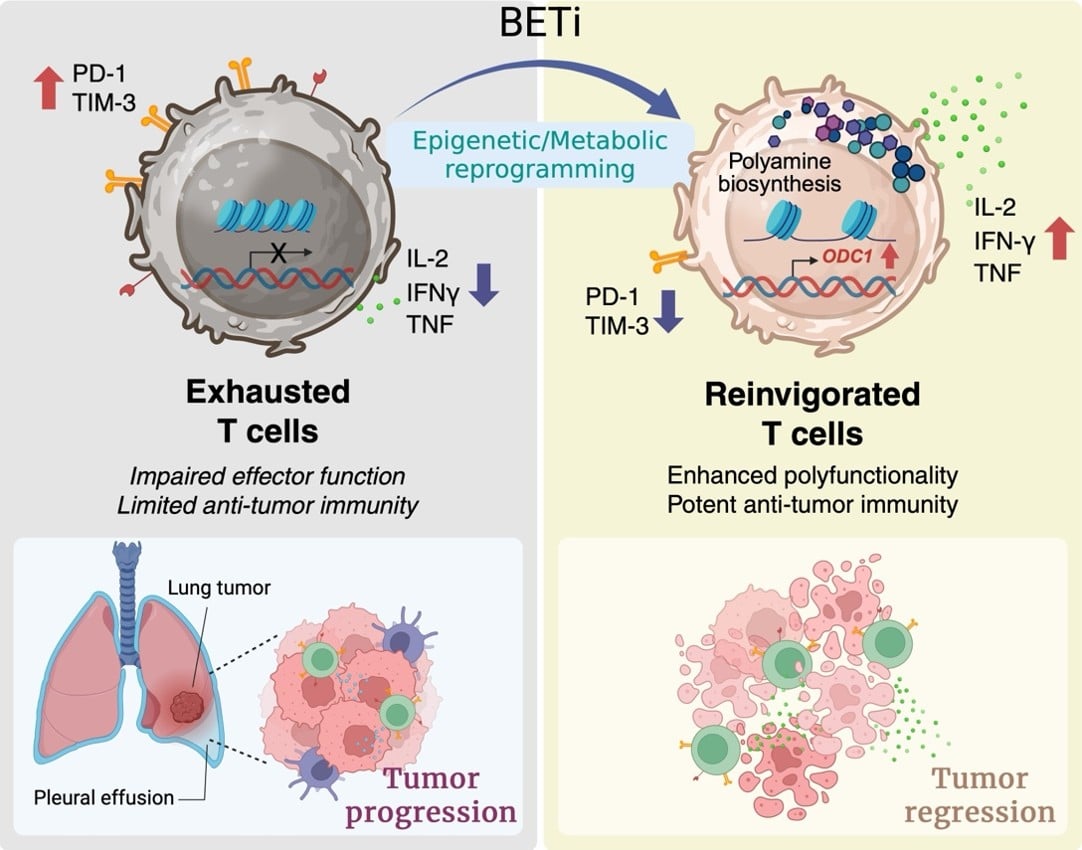
Bromodomain and extraterminal domain inhibitors (BETis) reverse T-cell exhaustion and enhance anti-tumor immunity in lung cancer through epigenetically driven metabolic reprogramming. By promoting polyamine biosynthesis, BETis restore T-cell function, as evidenced by increased production of effector cytokines, including IL-2, IFN-γ, and TNF, and reduced expression of the inhibitory receptors PD-1 and TIM-3. This reinvigoration of T cells leads to more robust anti-tumor immune responses and tumor regression in preclinical lung cancer models.
The human immune system is designed to recognize and destroy abnormal cells, including cancer. Yet for many people with advanced cancer, their immune cells known as T cells eventually become exhausted after a prolonged battle against tumors. While current immunotherapy with immune checkpoint inhibitors may help T cells regain their cancer-fighting abilities, they do not work for everyone. In some patients, T cells become so deeply exhausted that they can no longer be effectively reactivated.
Now, researchers from National Taiwan University (NTU), National Taiwan University Hospital (NTUH) and Academia Sinica have discovered a promising way to revive these worn-out immune cells. In a study published in Nature Immunology, the team found that a group of compounds known as BET inhibitors can restore the function of exhausted T cells by rewiring their metabolism.
"Our research shows that these cells may not be permanently disabled," said Dr. Hsing-Chen Tsai, a pulmonologist at NTUH and Associate Professor at NTU College of Medicine and corresponding author of the study. "By changing how T cells use energy and regulate their metabolism, we can help them recover and become active again."
To identify new ways of rejuvenating exhausted T cells, the researchers screened compounds that influence epigenetics, the molecular mechanisms that control gene activity. Bromodomain and extraterminal domain (BET) inhibitors emerged as the most promising candidates. When the team tested these compounds on exhausted T cells collected from patients with advanced lung cancer, the cells began producing more cancer-fighting molecules and showed signs of renewed activity.
Lead author Yi-Chieh Wu, a researcher at the Graduate Institute of Toxicology, NTU College of Medicine, said, “The findings revealed an unexpected link between gene regulation and T cell metabolism.”
"We were surprised to find that these drugs did not simply boost T-cell function. Instead, they appeared to reprogram the cells, helping them regain the flexibility needed to respond to cancer."
The researchers found that BET inhibitors enhanced a metabolic pathway involving naturally occurring molecules known as polyamines. This pathway appeared to be essential for restoring T-cell activity. The team also evaluated this approach in mouse models of lung cancer. Mice treated with BET inhibitor–primed T cells developed smaller tumors and exhibited prolonged survival compared with untreated controls.
For Prof. Chong-Jen Yu, pulmonologist, Superintendent of NTUH, and senior author of the study, the findings could help address an important clinical challenge. "As physicians, we see many patients whose cancers stop responding despite receiving modern immunotherapies," said Yu. "Our findings suggest a new way to restore the patient's own immune response and potentially improve the effectiveness of existing cancer treatments."
While additional studies are needed before the strategy can be tested in patients, the researchers believe the findings open a promising new direction for cancer treatment.
"Our goal is not simply to attack cancer directly," added Tsai. "We want to empower the immune system to do what it was designed to do. By restoring the function of exhausted T cells, we hope to create new treatment opportunities for patients who currently have limited options."
Prof. Hsing-Chen Tsai's email address: [email protected]
About National Taiwan University
National Taiwan University (NTU) is Taiwan’s leading research university and one of Asia’s premier institutions of higher education and scientific innovation. As the nation’s most comprehensive and representative public university, NTU is renowned for excellence across medicine, biomedical sciences, engineering, humanities, and interdisciplinary scholarship. Guided by a commitment to advancing knowledge and creating societal impact, NTU fosters world-class research, global partnerships, and the development of next-generation leaders.
About National Taiwan University Hospital
National Taiwan University Hospital (NTUH) is Taiwan’s premier academic medical center and one of Asia’s leading teaching hospitals. Affiliated with National Taiwan University College of Medicine, NTUH is internationally recognized for excellence in patient care, medical education, biomedical research, and public health. Through its commitment to clinical innovation and translational medicine, NTUH bridges scientific discovery and patient care, advancing healthcare and improving lives in Taiwan and beyond.