

Researchers from the Institute of Industrial Science, The University of Tokyo reveal how crystal symmetry determines whether hydrogen follows the rules of quantum or classical physics
Tokyo, Japan – As interest in clean hydrogen power grows, so does the need for safe storage and transportation materials. One such material, vanadium, is a leading candidate because it readily absorbs hydrogen and allows it to move through its crystal structure. However, hydrogen displays varying behavior when in the presence of vanadium, with the underlying cause remaining unclear.
In an article recently published in Nature Communications, researchers from the Institute of Industrial Science, The University of Tokyo have now uncovered a key piece of this puzzle. By combining measurements of hydrogen's structure and diffusion with quantum mechanical calculations, the team discovered how crystal symmetry controls whether hydrogen behaves as a quantum wave or a classical particle inside vanadium.
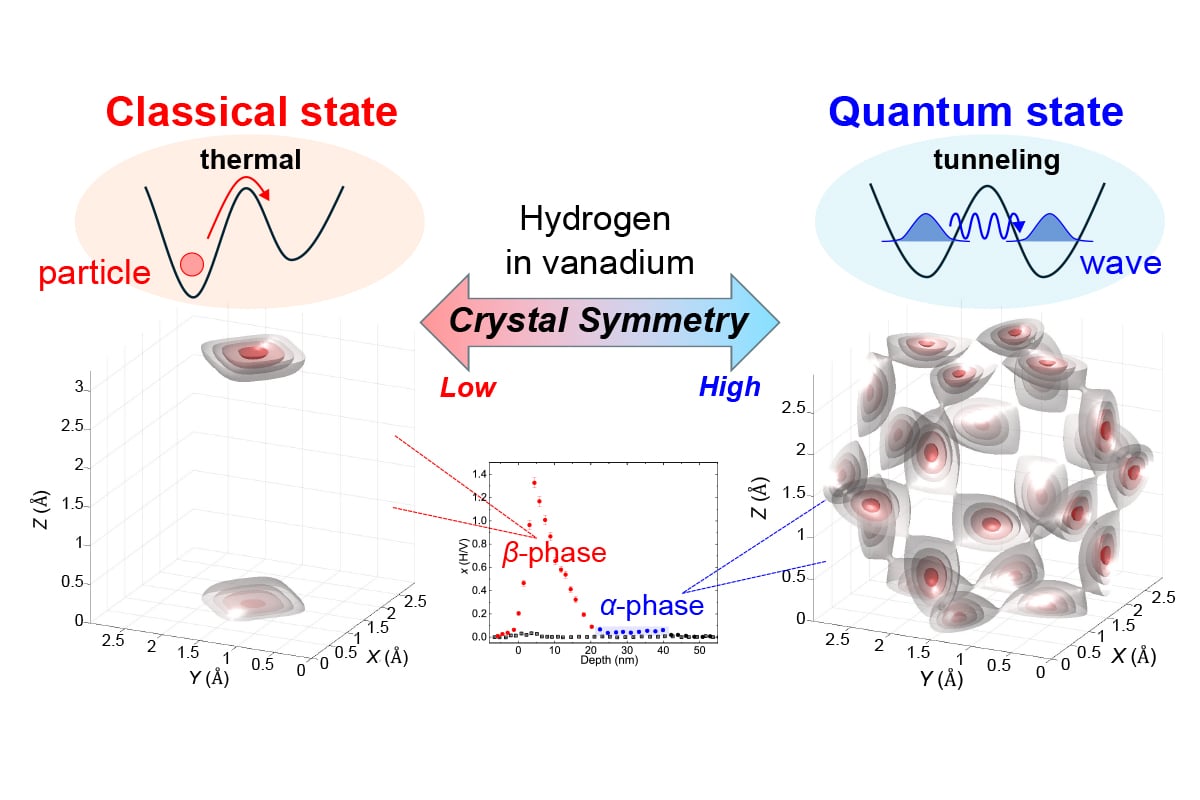
Hydrogen moves through vanadium by hopping between interstitial spaces in the crystal lattice. In some cases, it behaves like a classical particle and must overcome energy barriers to move to neighboring sites; other times, it can take a quantum shortcut by ‘tunneling' between sites, moving like a wave through these barriers. Understanding what governs whether hydrogen exhibits quantum or classical behavior could help scientists develop more efficient hydrogen storage and energy technologies.
"Our results show that crystal symmetry is key to controlling hydrogen's quantum behavior," says corresponding author, Takahiro Ozawa. "Highly symmetric structures allow hydrogen to tunnel, while distorted structures suppress this effect."
When hydrogen concentrations are low, the crystal retains a highly symmetric structure. Under these conditions, hydrogen atoms readily tunnel between neighboring sites, forming delocalized quantum states spread across neighboring atomic sites. At higher hydrogen concentrations, however, the crystal becomes distorted, suppressing tunneling and causing hydrogen to behave more like a classical particle.
“Crystal symmetry is the underlying switch that turns quantum behavior on or off,” explains senior author Katsuyuki Fukutani. “In a symmetric structure, hydrogen finds equivalent pathways that allow it to tunnel between sites. Distort that symmetry — as happens at higher hydrogen concentrations — and tunneling is suppressed, forcing hydrogen to rely on thermal energy to hop between sites instead.”
This new understanding can inform a practical strategy for developing materials designed to control hydrogen’s quantum behavior. Such materials have the potential to contribute to future technology, including those developed to carry clean energy.
“The ability to control how hydrogen behaves could improve materials used for hydrogen storage and diffusion control,” remarks Sudhansu Sekhar Das, lead author. “These advances may benefit a wide range of hydrogen-based technologies involving transport and purification.”
As researchers continue to investigate hydrogen as a cleaner energy source, understanding and ultimately controlling its behavior at the atomic scale will become increasingly important. By uncovering the role of crystal symmetry, this research provides the foundation for a new generation of advanced materials, designed for the next phase of energy technologies.
###
The article, “Impact of Crystal Symmetry Lowering on Proton Tunneling,” was published in Nature Communications at DOI: 10.1038/s41467-026-75020-w.
About Institute of Industrial Science, The University of Tokyo
The Institute of Industrial Science, The University of Tokyo (UTokyo-IIS) is one of the largest university-attached research institutes in Japan. UTokyo-IIS is comprised of over 120 research laboratories—each headed by a faculty member—and has over 1,200 members (approximately 400 staff and 800 students) actively engaged in education and research. Its activities cover almost all areas of engineering. Since its foundation in 1949, UTokyo-IIS has worked to bridge the huge gaps that exist between academic disciplines and real-world applications.
Advertisement