
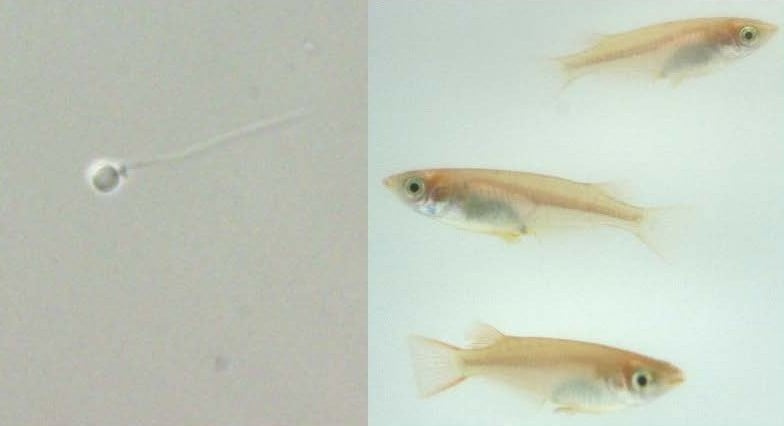
Medaka sperm assessment: Male Japanese rice fish were studied in a mating experiment to assess sperm reduction.
Oryzias latipes, commonly known as Medaka, are small fish measuring about 2–3 cm in length that exhibit highly active spawning behavior during the breeding season. Previous research by an Osaka Metropolitan University research team showed that males can spawn at an average of 19 times per day and up to 27 times in environments with many females. It was also found that after around 10 consecutive mating events, sperm count per spawn decreases and is associated with a sharp decline in fertilization rates. However, the changes in sperm velocity with repeated spawning have remained unclear.
The team, led by Specially Appointed Assistant Professor Yuki Kondo and Professor Satoshi Awata at Osaka Metropolitan University’s Graduate School of Science, conducted an experiment to assess whether sperm depletion reduced sperm velocity. Medaka reproduce through external fertilization by the synchronized release of eggs and sperm into the water. Because both disperse quickly, the speed at which sperm can reach the eggs heavily influences the success of fertilization. Therefore, speed is a crucial trait directly linked to whether a male can pass on its genes.
In the two experiments conducted, the researchers placed one male medaka in tanks with only one or fifteen females. After confirmed mating, female medaka were returned to stock tanks and males were taken for sperm quality assessments.
Post-spawning results showed that sperm from male medaka that had engaged in consecutive spawning showed about a 20% reduction in swimming velocity during the first 30 seconds after sperm activation compared to sperm from males that had spawned only once. After 40 seconds, however, no significant difference was observed between the two groups.
“Previous studies have mainly focused on sperm quantity, but our findings show that it is also necessary to consider changes in sperm quality,” said Dr. Kondo. “We hope that these results will provide important insights for achieving a more accurate understanding of reproductive strategies in animals.”
Furthermore, in the final dataset from the sperm assessment, sperm counts varied between the groups with 2,538 from 12 males in the single-mating group and 1,265 from 10 males in the multiple-mating group.
“In future studies, it will be necessary to determine the extent to which reductions in sperm count and decreases in swimming velocity each affect fertilization success. Another key challenge will be to determine the physiological mechanisms underlying the decline in sperm swimming velocity associated with repeated spawning,” stated Professor Awata.
The findings were published inthe Journal of Ethology.
Competing interests
The authors declare that they have no competing interests.
###
About OMU
Established in Osaka as one of the largest public universities in Japan, Osaka Metropolitan University is committed to shaping the future of society through the “Convergence of Knowledge” and the promotion of world-class research. For more research news, visit https://www.omu.ac.jp/en/ and follow us on social media: X, Instagram, LinkedIn.