

Wooden Kareau statue to avert evil spirits, Nicobar Islands, India, c. late 19th–early 20th century.
These fearsome-looking figurines are hantakoi or “scare-devils” from the islands of Nicobar, in the East Indian Ocean. The indigenous inhabitants of the Nicobar islands, the Nicobarese community, lived in settled, coastal villages, and headed out for periodic hunts and expeditions to procure resources for their subsistence. In their spiritual cosmology, the laws of attraction and repulsion were the singular forces that guided them not only in their religious life but also in the organisation of their daily work. The boats for these expeditions would thus be carved and colourfully bedecked to attract good spirits and repel bad ones. A similar logic was followed in the creation of the hantakoi, which were carved by spiritual healers, known as menluana, to fight malevolent spirits.
These figurations are categorised into two types: human figures, known as kareau, and zoomorphic figures. According to their cosmology, the kareau represent benevolent ancestors or the iwika, which are often carved in frightening and active poses to ward off evil spirits, or iwipot. Kareau figures are carved by a menluana in case of severe illness or accident and act as intermediaries between the human and the spirit world.
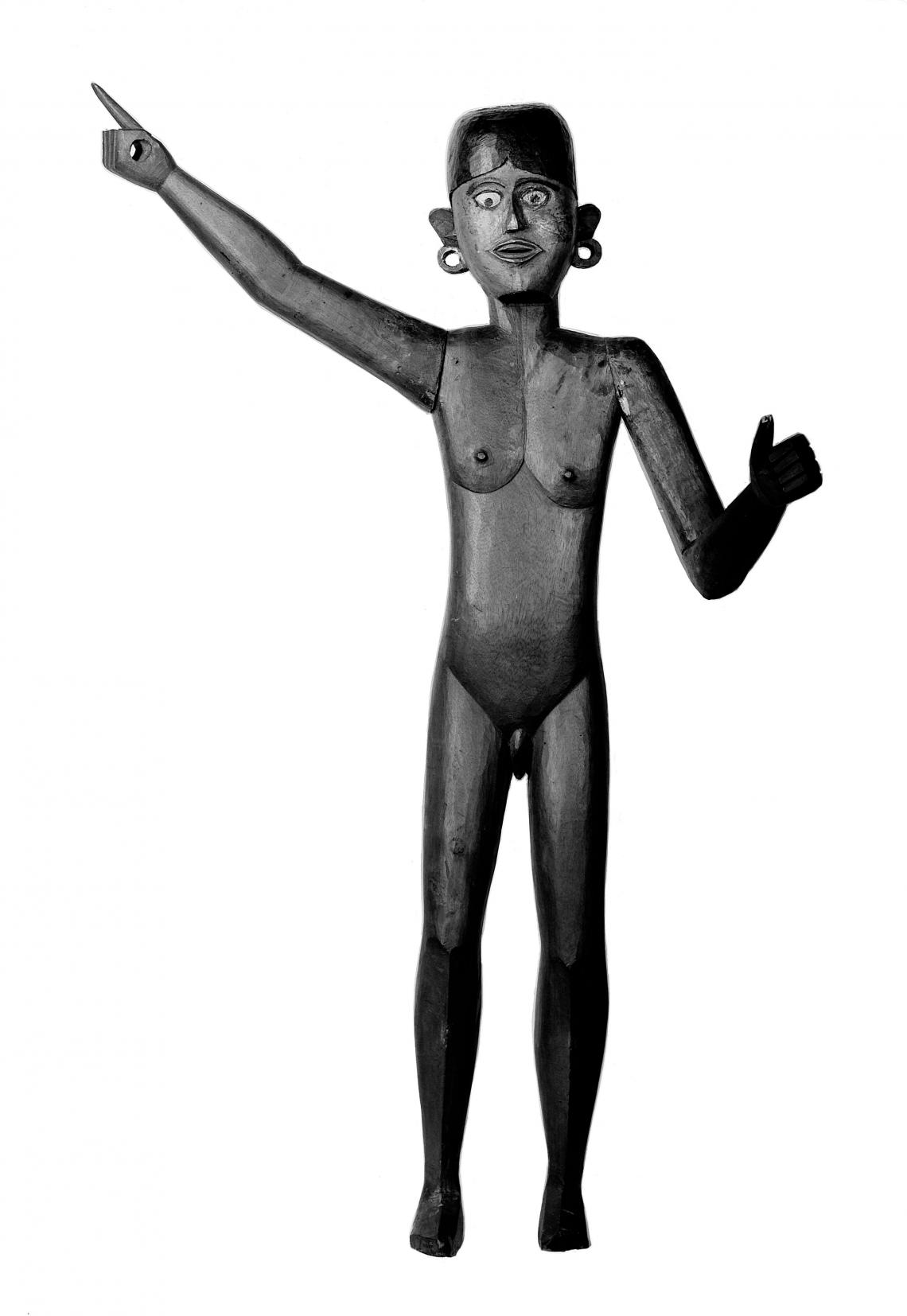
Wooden Kareau statue to avert spirits of disease, Nicobar Islands, India, c. late 19th–early 20th century.
The hantakoi was an expansive tradition that was transformed through years of commercial and political contact with traders from Myanmar, Malaysia and Sri Lanka; Jesuit missionaries; and even from the remains of shipwrecks. These figures represent a unique glimpse into the proliferation of trade and commerce as well as Nicobarese societies’ encounters with the world. Some figures bear a Malayan chin-strap helmet with a pointed top, suggesting the influence of and affinity with the material cultures of the Malayan peninsula.
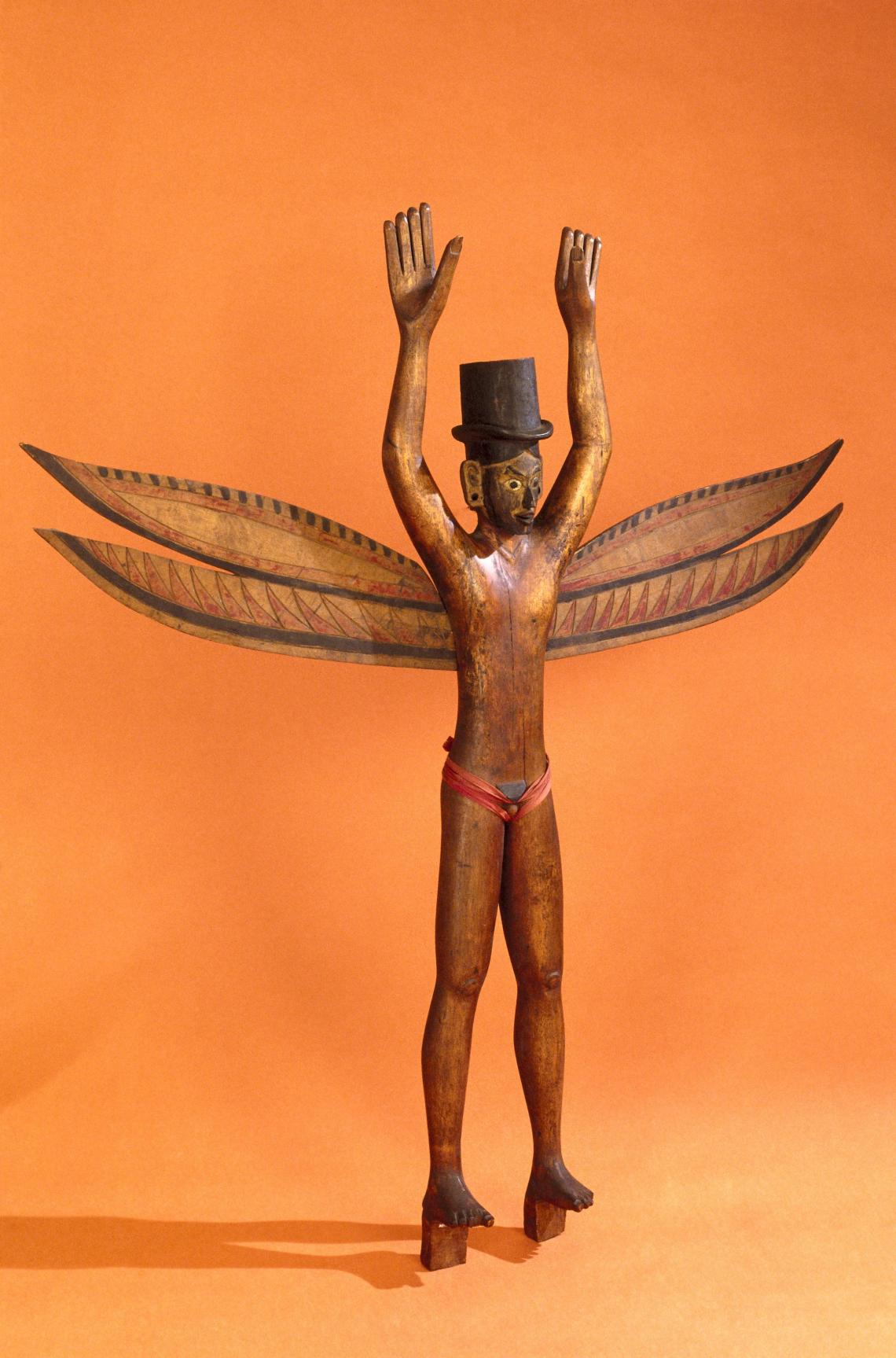
Wooden statue, Nicobar Islands, India, c. late 1880–1925.
With the advent of European presence in the subcontinent, the figures began to be carved in costumes resembling European uniforms, incorporating objects such as top hats, coats and pants. Sometimes, the figures would also have their faces painted white, suggesting a distrust in the white European faces on the island. While the Nicobar islands were first colonised by the Danish in 1756 before being sold to the British in 1869, they were also briefly occupied by the Japanese during the Second World War, during which time the kareau figures began to represent Japanese soldiers in their helmets.
The addition of these new paraphernalia and accents to hantakoi offer us an insight into what was perceived as exotic by the island’s inhabitants, such as sailing ships, compasses, pocket watches, telescopes and envelopes. At the same time, this hybridity in the hantakoi figures was not just a simplistic phenomenon of cultural assimilation but also had political undercurrents; the imminent threat of foreign domination and infiltration was felt by the people, who witnessed the enforcement of extractive trade relations and the uninvited presence of colonial officers. Thus, hantakoi, central to Nicobarese worldview, became a broad category that encompassed other cultural totems. Subsequently, the flags of different nations on their ships were seen as their hantakois, and the incorporation of the foreigners’ accessories became a complicated rite in social ritual and sympathetic magic, that in a way updated the repertoire of these dolls, and trained them to identify and nullify the pressure of these strange forces.
This article was originally published by the MAP Academy, an open-access online resource focused on South Asian art and cultural histories.