

Nature Communications
About Nature Communications
Nature Communications is an open access journal that publishes high-quality research from all areas of the natural sciences. Papers published by the journal represent important advances of significance to specialists within each field.
- Website: https://www.nature.com/ncomms/
News
08 Feb 2017
Nagoya University
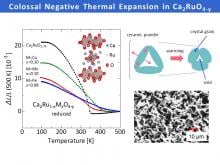
Researchers based at Nagoya University discover ceramic material that contracts on heating by more than twice the previous record-holding material.
01 Feb 2017
Tohoku University
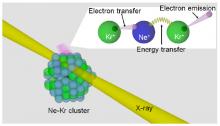
Researchers led by Kiyoshi Ueda of Tohoku University have investigated what x-rays in matter really do and identified a new mechanism of producing low-energy free electrons. Since the low-energy electrons cause damage to the matter, the identified process might be important in understanding and designing radiation treatment of illnesses.
24 Jan 2017
Ulsan National Institute of Science and Technology (UNIST)
A new study, affiliated with South Korea's Ulsan National Institute of Science and Technology (UNIST), has introduced a new novel design strategy for synthesizing various forms of metal–organic materials (MOMs).
17 Jan 2017
Tohoku University
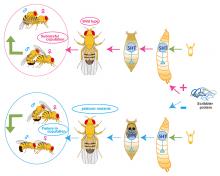
By studying the sexual behavior of a mutant strain of fruit fly called "platonic," researchers at the Tohoku University Graduate School of Life Sciences have found parallels between humans and flies in the neural control of copulation.

04 Jan 2017
Ulsan National Institute of Science and Technology (UNIST)
A new study, affiliated with Ulsan National Institute of Science and Technology has introduced a new artificial leaf that generates hydrogen, using the power of the sun to mimic underwater photosynthesis.
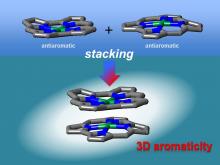
15 Dec 2016
Nagoya University
International collaboration led by Nagoya University uses two-dimensional antiaromatic materials to realize three-dimensional aromatic structures.
08 Dec 2016
Ulsan National Institute of Science and Technology (UNIST)
A research team, affiliated with South Korea's Ulsan National Institute of Science and Technology (UNIST), has developed liquid-like TE materials that can be painted on almost any surface. This new technology can convert exhaust heat into electricity for vehicles and other applications.
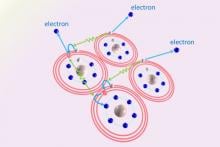
06 Dec 2016
Tohoku University
Researchers are investigating novel ways by which electrons are knocked out of matter. Their research could have implications for radiation therapy.

30 Nov 2016
Hokkaido University
Tiny “walking” proteins could be used to investigate mechanical deformations in soft materials according to Hokkaido University researchers.
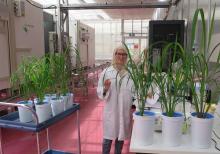
23 Nov 2016
King Abdullah University of Science and Technology (KAUST)
KAUST genetic detailing of rice plants in real-time highlights the roles of different loci in response to salt stress during growth.

13 Sep 2016
King Abdullah University of Science and Technology (KAUST)
Satellite radar image analysis reveals that rifting in Iceland exhibits simultaneous horizontal and sideways movement.
27 Jul 2016
King Abdullah University of Science and Technology (KAUST)
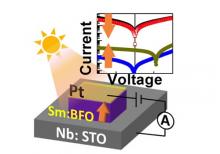
Ferroelectric tunnel junction promises low-power, high-density data storage.

27 Jul 2016
Tohoku University
Gold had long been considered a non-magnetic metal. But researchers at Tohoku University recently discovered that gold can in fact be magnetized by applying heat.
27 Jul 2016
The Agency for Science, Technology and Research (A*STAR)
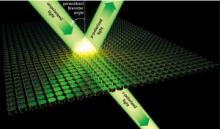
Manipulating magnetic and electric dipoles inside nanostructured insulators enables newfound control of light polarization at any angle.
14 Jul 2016
National Institute for Materials Science (NIMS)
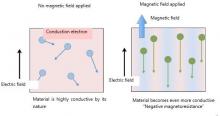
An international group of researchers measured the magnetoresistive effects of palladium–cobalt oxide (PdCoO2), a non-magnetic, highly conductive material. When a magnetic field was applied to PdCoO2, they observed significant phenomena, the conductivity of PdCoO2 greatly increased with increasing magnetic field.
14 Jul 2016
The Agency for Science, Technology and Research (A*STAR)
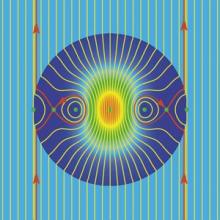
A mysterious effect in which particles do not scatter light has been observed at optical wavelengths for the first time.
20 Jun 2016
Hokkaido University
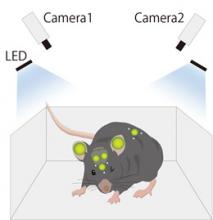
Scientists have found a way to simultaneously monitor the switching on and off of circadian “clock” genes and their effects on mouse behaviour in real-time.
17 Jun 2016
Tohoku University
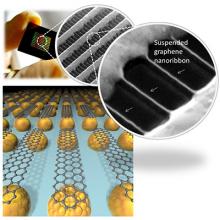
Researchers at Tohoku University have realized wafer-scale and high yield synthesis of suspended graphene nanoribbons. The unique growth dynamic has been elucidated through comparing experiments, molecular dynamics simulations and theoretical calculations made with researchers from the University of Tokyo and Hokkaido University.

15 Jun 2016
National Institute for Materials Science (NIMS)
Scientists in Japan have successfully recorded the atomic bonds between diamond and cubic boron nitride: the hardest known materials on earth. This feat could ultimately lead to the design of new types of semiconductors.

15 Jun 2016
Hokkaido University
Scientists are getting closer to understanding the anti-cancer mechanism of the naked mole rat by making induced pluripotent stem cells.
03 Jun 2016
Korea Advanced Institute of Science and Technology (KAIST)
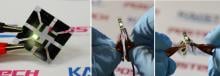
A Korean research team developed an ideal electrode structure composed of graphene and layers of titanium dioxide and conducting polymers, resulting in highly flexible and efficient OLEDs.
08 Apr 2016
Ulsan National Institute of Science and Technology (UNIST)
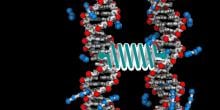
The team—made up of scientists from the University of Illinois Center for the Physics of Living Cells in the United States, Johns Hopkins University in the United States, and UNIST—discovered DNA molecules directly interact with one another based on sequence even in the absence of protein molecules.
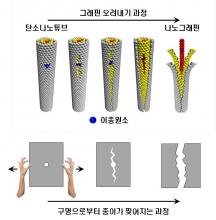
22 Mar 2016
Korea Advanced Institute of Science and Technology (KAIST)
A research team at Korea Advanced Institute of Science and Technology (KAIST) has developed a technique, which enables unzipping of the graphene plane without uncontrollable damage.
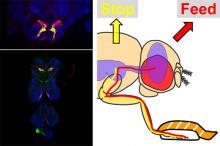
22 Feb 2016
Tohoku University
Feeding is essential for survival. Senses such as smell or sight can help guide us to good food sources, but the final decision to eat or reject a potential food is controlled by taste.
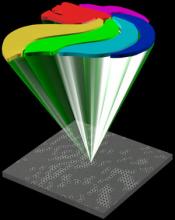
21 Jan 2016
The Agency for Science, Technology and Research (A*STAR)
Bio-inspired algorithms enable a pattern of thousands of nanoscale holes into metal films for high-tech optical security.
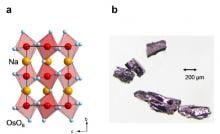
13 Jan 2016
National Institute for Materials Science (NIMS)
The Study May Contribute to the Development of High-Performance Functional Materials in Information & Communication and Electronics.
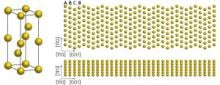
02 Dec 2015
The Agency for Science, Technology and Research (A*STAR)
Nanoscale ribbons of a new phase of gold have been produced with a different crystalline structure.

14 Oct 2015
Tohoku University
A research group in Japan has successfully constructed a Japanese population reference panel, from the genome information of 1,070 individuals. They have produced a basic analysis tool for the large-scale identification and study of the genes related to the physical constitution and diseases that are peculiar to the Japanese.
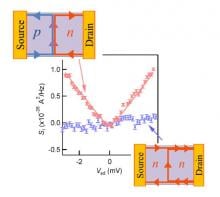
01 Oct 2015
National Institute for Materials Science (NIMS)
Toward the realization of electron interferometer devices which utilize the wave nature of electrons.
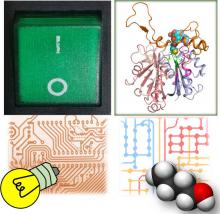
23 Sep 2015
Korea Advanced Institute of Science and Technology (KAIST)
Two Korean research teams have succeeded in uncovering the redox-switch of thiolase, a key enzyme for n-butanol production in Clostridium acetobutylicum, one of the best known butanol-producing bacteria.