
□ The research team led by Jeongmin Kim and Donghwan Kim from DGIST's Division of Nanotechnology (under President Kunwoo Lee) has developed a new grain boundary diffusion source coating technology for Nd-Fe-B permanent magnets that overcomes the limitations of existing methods. This research outlines a technological approach to significantly reduce the use of heavy rare earths while preserving magnet performance.
□ With the recent rise in demand for high-efficiency motors and power generation systems such as electric vehicles and wind power, the importance of technologies to enhance the performance of Nd-Fe-B permanent magnets, which can maintain magnetic properties even at high temperatures, is increasing. While heavy rare earths (Tb, Dy) are commonly used to address this challenge, their high costs and instability in supply highlight the need for a process strategy that minimizes their use while still ensuring performance.
□ A key technology addressing this demand is the Grain Boundary Diffusion Process (GBDP). This method improves magnetic properties by coating a magnet with heavy rare earths that diffuse into it and form a heavy rare earth shell on the grain surface. However, current slurry-based wet coating methods face limitations, such as difficulty in precisely controlling the coating quantity and surface area, as well as producing waste diffusion sources during the process, leading to considerable loss of resources.
□ To address these limitations, the research team of Jeongmin Kim and Donghwan Kim developed a new dry stamp coating technology that selectively and precisely coats only the necessary surfaces using powdered diffusion sources. This technology can replace slurry-based wet coating, decrease the production of waste diffusion sources, and furthermore, it is easier to inhibit oxidation due to its powder-based nature. Additionally, since it does not require a slurry manufacturing process, it can simplify the overall process and greatly improve process efficiency.
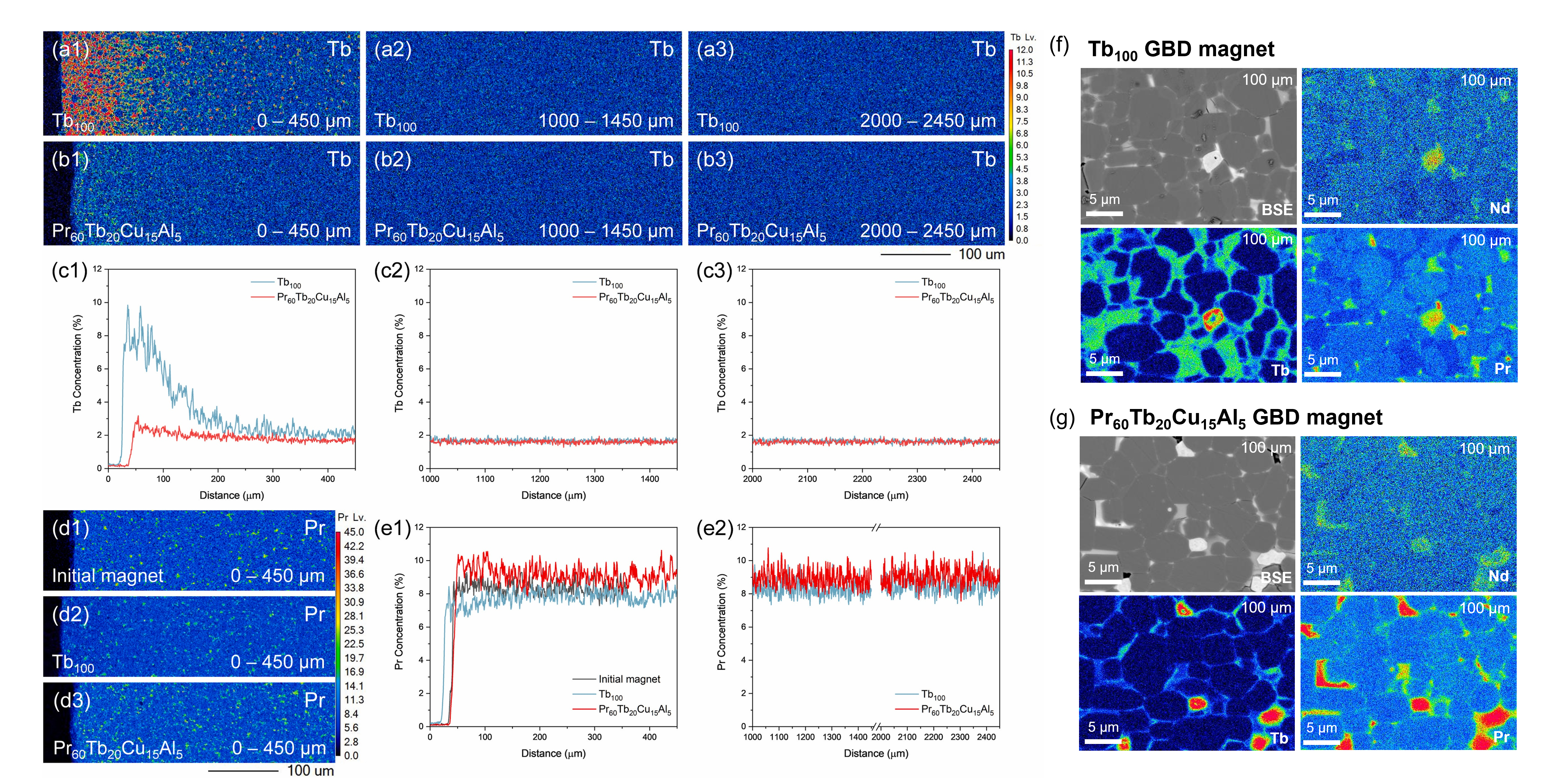
□ The research team also confirmed the performance of the stamp coating technology. Specifically, by designing the diffusion source composition, they replaced heavy rare earths with light rare earths and transition metals, moving away from the previous strategy of using only heavy rare earths and reducing heavy rare earth use by about 80%. Additionally, it increased Tb utilization efficiency by improving magnet surface accumulation and exhaustion issues that occur when Tb is diffused alone. This presented a new direction for diffusion source design that both reduces heavy rare earths and achieves high performance.
□ Principal Researcher Jeongmin Kim stated, "This study addresses the limitations of existing coating processes and introduces a diffusion source composition design strategy, proposing a technological approach that greatly reduces heavy rare earth usage while maintaining permanent magnet performance. We believe this will significantly advance high-performance permanent magnet technology essential for eco-friendly mobility and the energy industry."
□ This research was funded by the DGIST’s institutional projects, Kyungpook National University's Carbon Neutral Intelligent Energy System Regional Innovation Leading Research Center, and Star Group Ind. Co., Ltd. The findings were published in the Journal of Materials Research and Technology, an international journal in the field of metal materials, and a domestic patent was registered in 2025.
Advertisement