


This study proposes a thin, compact system for enabling high-contrast projection mapping in brightly lit environments. By precisely controlling light so that only the target object remains unilluminated, high-contrast images can be projected onto the object without darkening the entire space. In contrast to existing large-scale illumination systems, the proposed system employs an LED display panel with an aperiodic lens array, enabling next-generation immersive spatial experiences in commercial facilities, exhibition spaces, and public environments.
Fig. 1
Projection mapping achieved under “target-excluding illumination,” which avoids illuminating only the projection target, enabling sharp and high-contrast imagery even in a brightly lit environment (left). (Right: comparison of projection mapping in a dark room and under typical ambient lighting.)
Original content, No restrictions., Daisuke Iwai
Researchers from The University of Osaka have developed a projection mapping technique that keeps images clear even in bright indoor environments by illuminating the surrounding space while avoiding light on the projection surface.
Osaka, Japan – Projection mapping has the potential to create shared immersive experiences in exhibitions, commercial facilities, and public spaces. However, the technique is highly sensitive to ambient lighting, meaning that clear projected images are typically only possible when the surrounding environment is darkened.
Now, researchers at The University of Osaka have developed a method that allows projection mapping to remain vivid even in brightly lit indoor environments. Their system uses a compact illumination device based on a digital signage LED display panel combined with a specially arranged lens array.
“Projection mapping has traditionally been difficult to use in bright environments,” explains Kotaro Fujimura, lead researcher of the study. “We wanted to overcome that limitation by exploring the idea of illumination that deliberately avoids shining light on the target surface.”
Previous approaches have attempted to use projectors themselves as lighting devices that illuminate the surrounding environment while avoiding the projection surface. However, such methods often require multiple projectors, which can lead to large and complex systems that are difficult to deploy in practical environments.
Instead of using projectors for ambient illumination, the researchers repurposed a digital signage LED display as a spatial light source. Each pixel of the LED panel emits light through a lens array that directs the light toward different parts of the room, allowing the surrounding environment to be illuminated.
The researchers also developed an optimization technique that arranges the lenses in a non-repeating pattern, helping distribute unwanted optical interference and preventing visible dark artifacts from appearing when the target-avoiding illumination is used.
To determine which parts of the LED panel should illuminate the environment, the system calculates the region of pixels whose light would reach the projection surface. Those pixels are then selectively turned off so that the target surface remains unlit while the surrounding environment is illuminated naturally.
“To keep the projection surface dark, we simply prevent the pixels that would illuminate that region from emitting light,” explains Daisuke Iwai, senior author of the study. “This allows us to maintain high-contrast projected imagery while keeping the surrounding space brightly lit.”
The system operates in real time and enables projection mapping that remains clear even in bright indoor environments. This approach could enable new forms of visual experiences in commercial facilities, exhibition spaces, and public environments, where projection mapping can be enjoyed without dimming the room lights.
###
This research is to be presented as an oral presentation at the IEEE Conference on Virtual Reality and 3D User Interfaces, and it received Honorable Mention Award.
The article, “High-Contrast Projection Mapping under Light Field Illumination with LED Display and Aperiodic Lens Array,” is to be published in IEEE Transactions on Visualization and Computer Graphics at DOI: https://doi.org/10.48550/arXiv.2603.11573
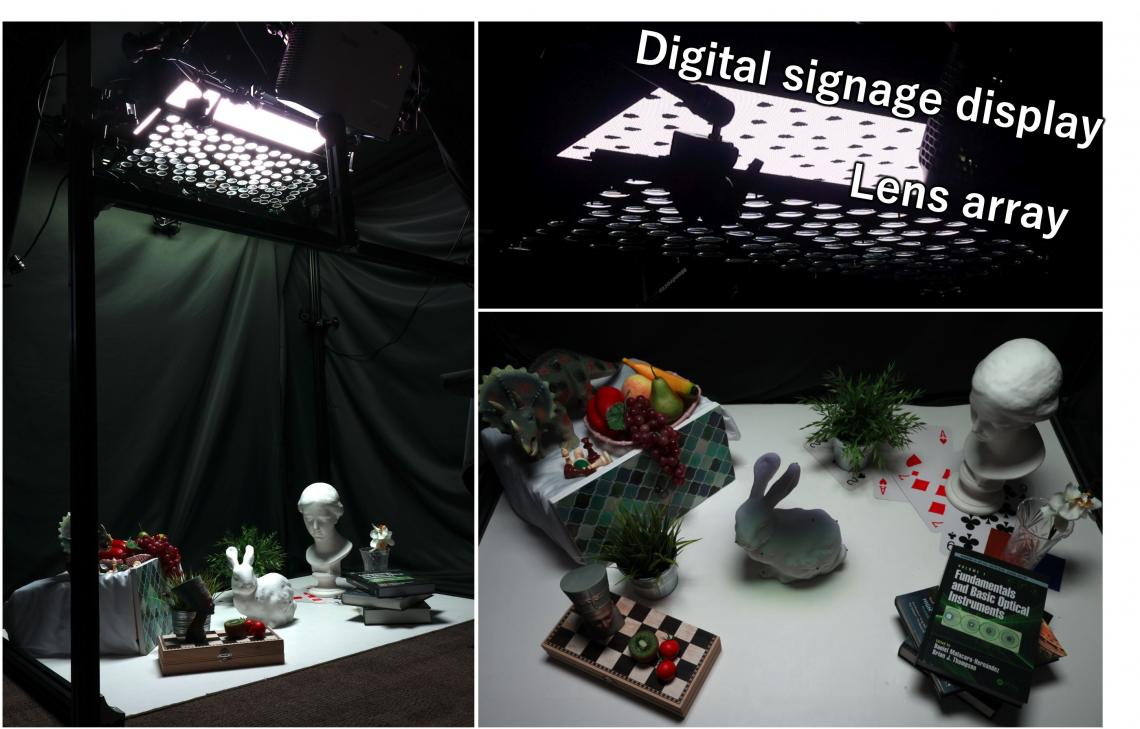
Fig. 2
Overview of the proposed system. A digital signage panel is installed on the ceiling and combined with a densely arranged lens array composed of more than 100 lenses. The lower right image shows the scene under target-excluding illumination before image projection.
Original content, No restrictions., Daisuke Iwai
Project video©Original content, No restrictions., Daisuke Iwai
About The University of Osaka
The University of Osaka was founded in 1931 as one of the seven imperial universities of Japan and is now one of Japan's leading comprehensive universities with a broad disciplinary spectrum. This strength is coupled with a singular drive for innovation that extends throughout the scientific process, from fundamental research to the creation of applied technology with positive economic impacts. Its commitment to innovation has been recognized in Japan and around the world. Now, The University of Osaka is leveraging its role as a Designated National University Corporation selected by the Ministry of Education, Culture, Sports, Science and Technology to contribute to innovation for human welfare, sustainable development of society, and social transformation.
Website: https://resou.osaka-u.ac.jp/en
Advertisement