
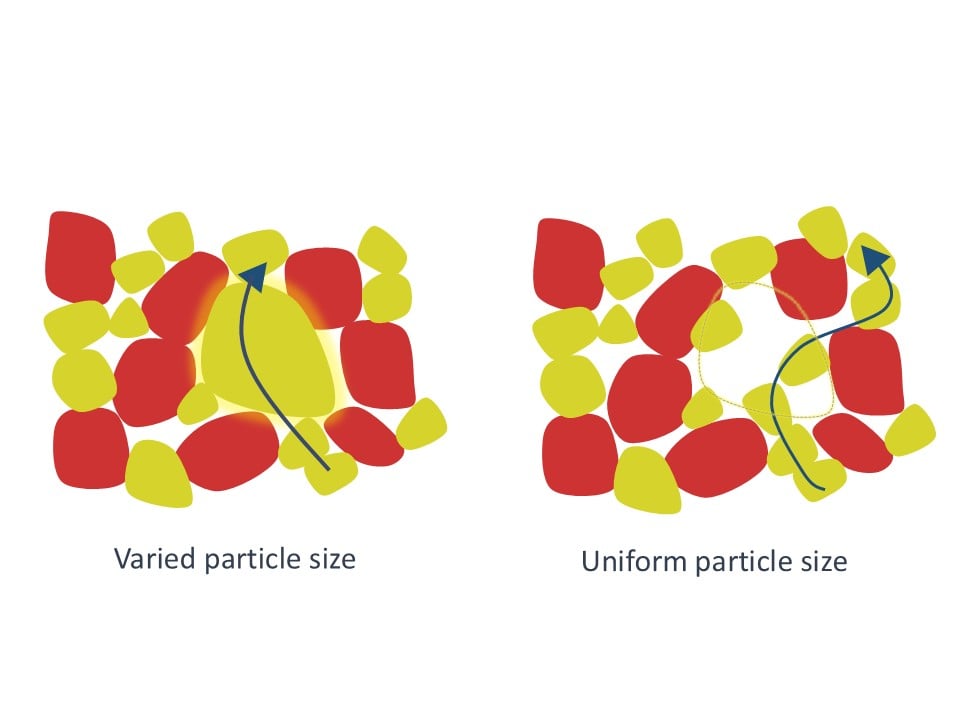

Solid electrolyte particle sizes affect ion pathways
Particle size affects ion pathway: Varied particle sizes in the solid electrolyte improve ion conductivity.
Osaka Metropolitan University
Carbon neutrality may come in the form of a battery.
All-solid-state batteries (ASSBs) are gaining traction in the energy and electric vehicle industries as potentially safer alternatives to the standard, flammable liquid batteries on the market today. However, complex challenges currently stand in the way of making this a reality.
Improving the ionic conductivity efficiency of lithium-ion transport within the electrodes is one such challenge. Ion transport pathways play a dominant role in battery performance, but the network structure and configuration can be influenced by the state of the solid electrolyte (SE) particles. Inside the electrode, SE particles are intricately packed, forcing ions to weave their way through narrow gaps. This tortuosity, complex winding, of the ion‑transport pathways are a major source of conductive resistance.
Looking to shorten the path to ASSB reality, a research team led by Associate Professor Shuji Ohsaki at Osaka Metropolitan University’s Graduate School of Engineering investigated how the size of SE particles affects ionic conductivity. The team fabricated electrode layers with controlled particle-size distributions by adjusting the grinding conditions of Lithium Phosphorus Sulfur Chloride (LPSCl), a sulfide-based solid electrolyte material, then evaluated the structure and electrical properties. The Discrete Element Method (DEM) computer simulation and a shortest-path algorithm were used to visualize and quantify the microscopic ion‑conduction pathways within the electrode.
The researchers found that the overall tortuosity of the electrode lessened when particles of diverse sizes were mixed, compared with electrodes composed of uniformly sized particles. The larger particles penetrated the clusters of smaller particles, effectively acting as bypass pathways for ion transport. As a result, the number of particle–particle interfaces that ions must traverse is reduced, enabling the formation of transport routes that approach the shortest possible distance.
“This study identifies particle size distribution as a key factor that reduces electrode tortuosity and improves ionic transport,” said Professor Ohsaki. “By applying these findings, it becomes possible to significantly enhance the performance of all‑solid‑state batteries simply by optimizing the particle‑size distribution of existing materials without the need to develop costly new ones. This advancement could improve the fast charging and discharging capabilities of electric vehicles (EVs) and increase the efficiency of manufacturing processes.”
The findings were published in the Journal of Energy Storage.
Declaration of competing interest
The authors declare that they have no known competing financial interests or personal relationships that could have appeared to influence the work reported in this paper.
###
About OMU
Established in Osaka as one of the largest public universities in Japan, Osaka Metropolitan University is committed to shaping the future of society through the “Convergence of Knowledge” and the promotion of world-class research. For more research news, visit https://www.omu.ac.jp/en/ and follow us on social media: X, Instagram, LinkedIn.
Advertisement
Advertisement