
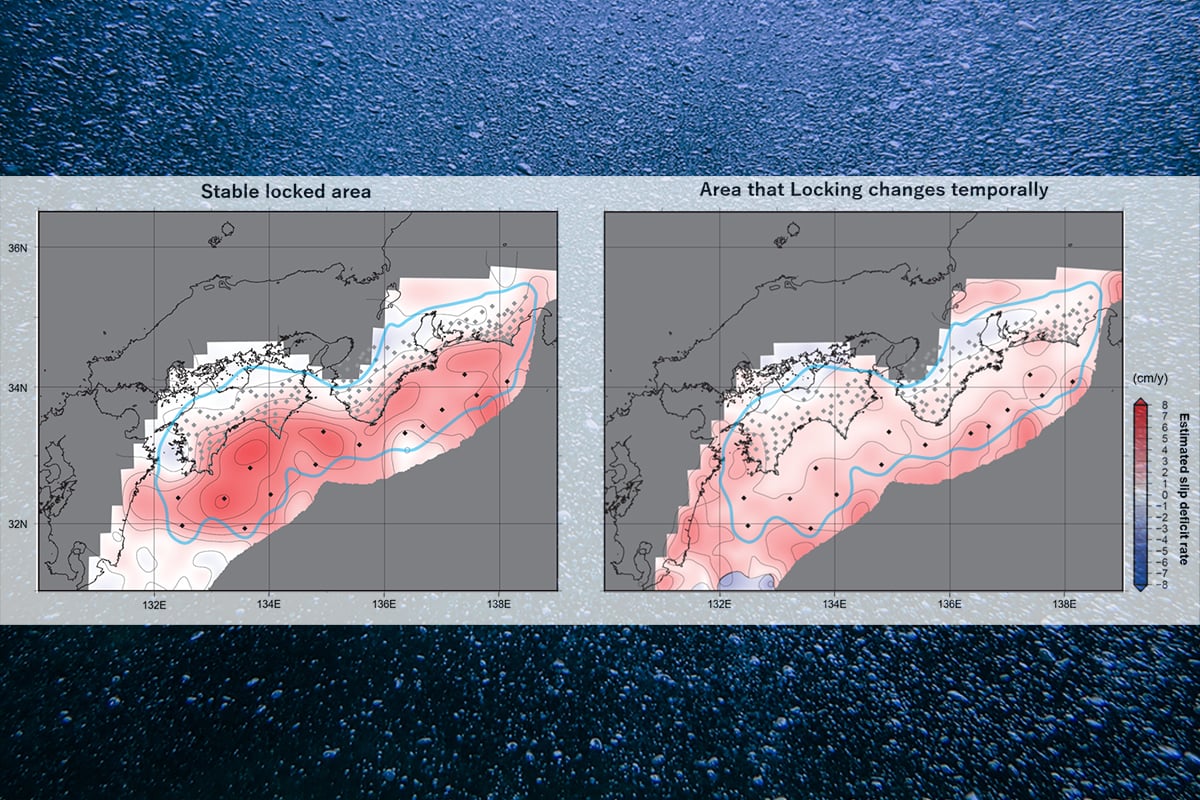
Tokyo, Japan – Off the southern coast of Japan, the Philippine Sea Plate lies underneath the Japanese mainland. The locked tectonic plates threaten to unleash a catastrophic megathrust earthquake, likely within the next few decades. Given the potential devastation a large quake could evoke, constant developments in predictive technology must be sought. However, predicting the unpredictable movement of the seafloor requires innovative thought.
Now, new research is allowing unprecedented insight into the movement of the Nankai Trough, promoting better understanding of future earthquakes. In a study set to be published in Earth, Planets and Space, researchers at the Institute of Industrial Science, The University of Tokyo analyzed data collected between 2013 and 2023 by the Seafloor Geodetic Observation-Array (SGO-A), operated by the Japan Coast Guard.
Previously, monitoring of plate boundary conditions in high-risk subduction zones like the Nankai Trough has relied on sparse datasets providing temporally averaged ‘snapshots’ of the friction conditions at the boundaries between plates. The SGO-A, however, with an observation frequency of about four times per year, allows for unprecedented precision in subduction-zone monitoring.
According to lead author Yusuke Yokota, “With this new dataset, using both horizontal and vertical displacement data, we have successfully identified temporal variations of the locking state of the Nankai Trough. This reveals the regions of the tectonic plates that have been locked for long periods of time, as well as changes in the strength of locking.”
The locking of plates at subduction zones, preventing small, stress-relieving earthquakes, can lead to particularly high risk for powerful earthquakes, elucidating why obtaining this information is crucial. The higher-resolution identification and tracking capabilities shown in this study, including the measures of geographic and temporal distribution, will be invaluable for preparedness and disaster mitigation.
For example, variability in locking strength was found particularly in the shallowest parts of the plate boundary. These variations can influence the strength and size of any earthquakes originating from these areas.
“Better understanding of the temporal variations of locking will not only advance seismological understanding of the Nankai Trough but also play an important role in earthquake disaster prevention,” explains senior author Tadashi Ishikawa. “However, as the dataset only covers one decade, continuing SGO-A monitoring can reveal further variability patterns and help future prevention efforts.”
The findings of this study represent a new frontier in preparation efforts for catastrophic megathrust earthquakes. Implementing similar geodetic observation arrays in other high-risk areas, such as the Cascadia subduction zone and the Peru–Chile Trench, could significantly improve monitoring of major seismic threats around the world.
###
The article, “Decadal seafloor geodesy reveals constantly locked areas and temporal changes in the slip deficit rate along the Nankai Trough,” was published in Earth, Planets and Space at DOI:10.1186/s40623-026-02472-1.
About Institute of Industrial Science, The University of Tokyo
The Institute of Industrial Science, The University of Tokyo (UTokyo-IIS) is one of the largest university-attached research institutes in Japan. UTokyo-IIS is comprised of over 120 research laboratories—each headed by a faculty member—and has over 1,200 members (approximately 400 staff and 800 students) actively engaged in education and research. Its activities cover almost all areas of engineering. Since its foundation in 1949, UTokyo-IIS has worked to bridge the huge gaps that exist between academic disciplines and real-world applications.