
Researchers at Kanazawa University discover how the microenvironment fuels double-negative castration-resistant prostate cancer (DNPC) and demonstrate the therapeutic potential of pan-KRAS inhibitors.
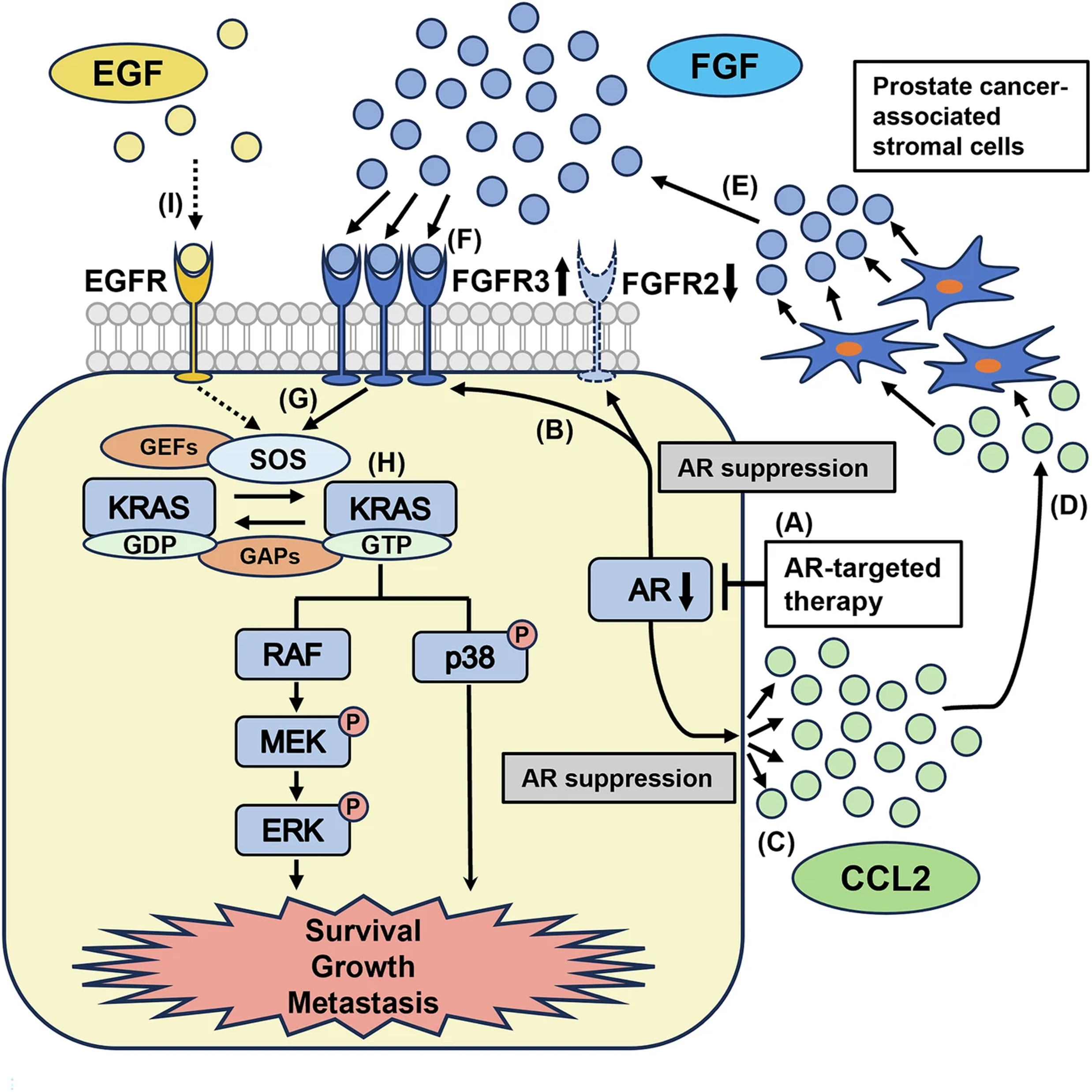
(A) AR signaling is suppressed by androgen deprivation therapy. (B) AR suppression leads to increased FGFR expression in prostate cancer cells. (C) AR suppression also raises CCL2 secretion from prostate cancer cells. (D) CCL2 influences AR-independent prostate cancer-associated stromal cells. (E) CCL2 stimulates FGF secretion from AR-independent prostate cancer-associated cells. (F) The released FGF binds to the upregulated FGFR in prostate cancer cells. (G) FGFR signaling activates KRAS through SOS. (H) Activated KRAS enhances downstream signaling and promotes prostate cancer progression. (I) EGF is scarce in the prostate cancer microenvironment, and KRAS is less activated by EGFR signaling compared to FGFR. GEFs guanine nucleotide exchange factors, GAPs GTPase-activating proteins.
Kamijima et al., Cell Death & Disease (2026), CC BY 4.0.
KANAZAWA, JAPAN – A research team at Kanazawa University, led by Professor Atsushi Mizokami, Associate Professor Koji Izumi, and Specially Appointed Assistant Professor Taiki Kamishima (4th-year doctoral student at the Graduate School of Medical Sciences), has elucidated a novel molecular mechanism driving the progression of "Double-Negative Castration-Resistant Prostate Cancer (DNPC)"—one of the most treatment-resistant forms of prostate cancer.
[Background and the Clinical Threat] In recent years, the widespread use of potent, novel androgen receptor-targeted therapies has led to a rapid surge in DNPC cases. DNPC poses a critical clinical challenge because it progresses and metastasizes without causing elevations in conventional tumor markers such as Prostate-Specific Antigen (PSA) or neuroendocrine markers (NSE, ProGRP), making it difficult to detect via routine blood tests. Consequently, DNPC represents a severe and growing threat in clinical oncology, with no established effective therapies.
[Key Findings] The study revealed that when androgen receptor (AR) signaling is intensively suppressed by hormone therapy, a vicious reciprocal interaction is triggered between prostate cancer cells and the surrounding prostate stromal cells (fibroblasts). Specifically, cancer cell-derived CCL2 stimulates stromal cells to secrete FGF8b, which in turn aberrantly activates the KRAS oncogene pathway in cancer cells. This cancer-stromal interaction allows the cancer cells to evade apoptosis (programmed cell death) and continue growing.
Furthermore, the research team demonstrated that a pan-KRAS inhibitor successfully suppressed the proliferation, migration, and invasion of prostate cancer cell lines exhibiting DNPC characteristics, effectively inducing apoptosis. These findings are expected to pave the way for the development of novel therapeutic strategies for DNPC patients who currently face limited options.
[Future Outlook] "Double-negative prostate cancer (DNPC) has recently emerged as a daunting clinical challenge due to its stealthy progression and lack of effective treatments," the research team noted. "Focusing on prostate stromal cells and capturing the precise, dynamic interactions between them and prostate cancer cells was an experimentally challenging and arduous process. However, by overcoming these hurdles, we were able to identify the exact mechanism of KRAS signaling activation within the prostate microenvironment—a setting that much more closely mimics actual clinical conditions. This discovery opens up an entirely new dimension for therapeutic intervention."
With the global landscape of KRAS inhibitors advancing at an unprecedented pace, the research group next aims to further evaluate these laboratory findings using other cutting-edge agents. "Our next step is to validate the efficacy of the latest advanced KRAS-targeted agents," the investigators added. "Ultimately, we envision exploring synergistic combination therapies that pair KRAS inhibitors with FGFR or beta-catenin inhibitors. By directly disrupting the vital communication between cancer cells and the prostate stroma, this approach has the potential to establish a completely paradigm-shifting therapeutic strategy for intractable DNPC."
Advertisement