
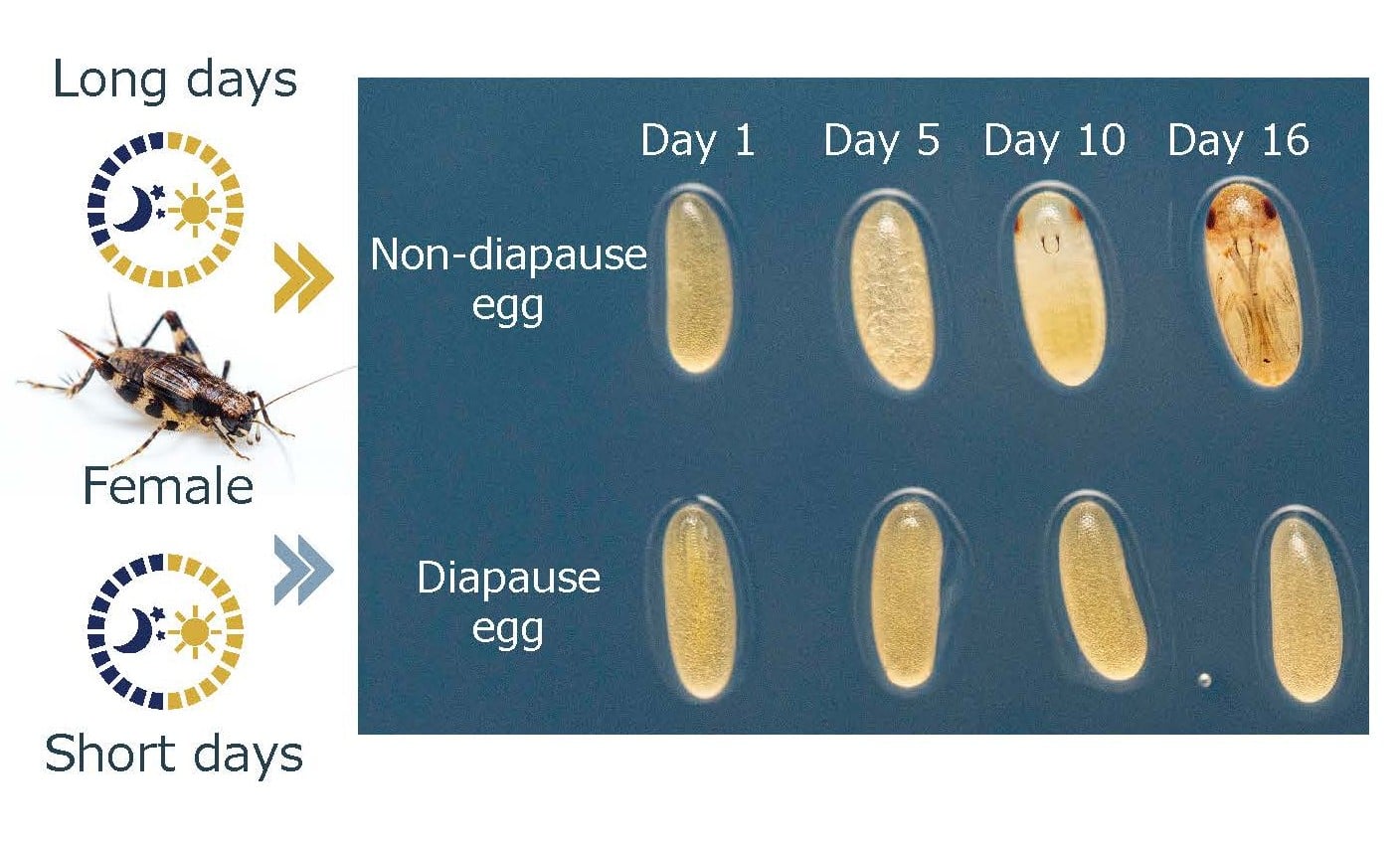
Differences in growth between diapause and non-diapause cricket eggs: At 16 days, the non-diapause eggs are developed and almost ready to hatch. On the other hand, the diapause eggs are in a similar state to day 1.
Diapause is a fascinating form of biological dormancy that is employed by a broad array of animals as a survival strategy to endure adverse environmental conditions. To overcome the problems associated with seasons that are unsuitable for reproduction and/or development, many temperate insects enter diapause.
Some insect species exhibit maternal diapause induction, in which environmental cues are perceived by the mother and determine the developmental fate of the offspring. Although maternal diapause induction is found in many species, its underlying molecular physiological mechanisms remain largely unknown.
A research group led by Professor Shin Goto and Dr. Yuta Shimizu at the Graduate School of Science, Osaka Metropolitan University, focused on the band-legged ground cricket Dianemobius nigrofasciatus, which produces non-diapause eggs that develop without interruption in summer and diapause eggs that undergo developmental arrest in autumn. To elucidate the molecular and physiological events occurring before and after the onset of diapause, the researchers comprehensively analyzed changes in gene expression across these stages.
In the diapause eggs, they found that the expression of genes involved in chromatin remodeling increased 24 hours after egg laying. Chromatin structure is associated with the activation and silencing of gene expression.
The researchers identified reduced chromatin accessibility of genes involved in neural development and the cell cycle in the diapause eggs. This suggests that preparatory processes for growth arrest are already underway prior to the onset of diapause.
“In diapause eggs, many genes involved in amino acid and carbohydrate metabolism were expressed,” Dr. Shimizu said. “This suggests that diapause eggs generate energy to sustain long-term survival.”
These findings deepen our understanding of insect diapause. Because ectothermic animals, such as insects, are particularly vulnerable to cold, diapause represents an important survival strategy.
Although the band-legged ground cricket is not an agricultural pest, similar processes are likely to occur in many pest species that damage crops. “Understanding the genes and mechanisms that regulate diapause may lead to the development of novel insecticides and new pest management strategies, such as delaying pest emergence until after crop harvest,” Professor Goto explained.
Competing Interest Statement
The authors have no competing interests to disclose.
###
About OMU
Established in Osaka as one of the largest public universities in Japan, Osaka Metropolitan University is committed to shaping the future of society through “Convergence of Knowledge” and the promotion of world-class research. For more research news, visit https://www.omu.ac.jp/en/ and follow us on social media: X, Instagram, LinkedIn.