
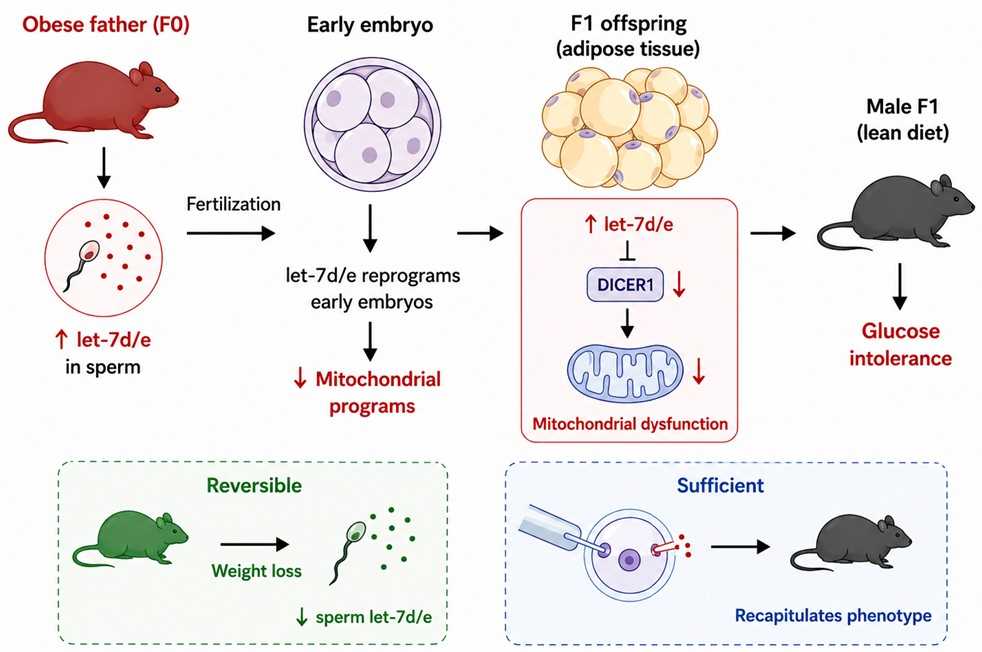

Researchers at National Taiwan University and the University of Southern Denmark show that obesity in male mice raises let-7 microRNAs in sperm, which silence the enzyme DICER1 and impair mitochondrial function in the fat tissue of their offspring. Weight loss reverses part of the effect in both mice and men.
Paternal obesity elevates sperm-borne let-7d/e microRNAs, which silence DICER1 and disable mitochondrial oxidative phosphorylation (OxPhos) in offspring white adipose tissue. Weight loss partially reverses this effect.
National Taiwan University
TAIPEI, TAIWAN, 6 July 2026 — A father's weight before conception can quietly reshape his children's metabolic health for years afterward. A new study led by researchers at National Taiwan University (NTU) and the University of Southern Denmark (SDU), together with international partners in Sweden, Germany, Brazil and Poland, has now identified the molecular messenger that carries this signal from father to child: a tiny piece of RNA in sperm called let-7.
Published in Nature Communications, the team fed male mice a high-fat diet to model obesity, then allowed a subset to slim down again on a low-fat diet. Both the obese fathers and their male pups showed poor glucose tolerance and impaired mitochondrial gene activity in white fat tissue even though the pups themselves had never eaten a high-fat diet. When the fathers lost weight, most of these changes reverted, both in the fathers and, remarkably, in their sons.
Looking for the molecular go-between, the team traced the effect to a family of small non-coding RNAs called let-7d and let-7e, which rose in both the fat and the sperm of obese males. Injecting physiological amounts of these microRNAs into normal one-cell mouse embryos reproduced the same metabolic problems in the resulting mice.
Single-cell RNA sequencing of early embryos showed that let-7 shut down genes needed for mitochondrial oxidative metabolism from the earliest stages of development. In fat cells, let-7 acted by silencing DICER1, the enzyme that processes other microRNAs, throttling mitochondrial respiration.
To test whether the same mechanism operates in people, the team analysed sperm from 15 men with obesity enrolled in a lifestyle-based weight-loss programme at Zealand University Hospital in Denmark. As body weight dropped, sperm-borne HSA-LET-7D and HSA-LET-7E fell in step, suggesting that the pathway is conserved between mice and humans and importantly that it is reversible.
"Our findings show that a father's metabolic health is not just his own concern. It is written into his sperm and delivered to the next generation, but it is also reversible. Losing weight before conception may give the offspring generation a healthier start," says first author Assistant Professor Chien Huang, from the Department of Animal Science and Technology at National Taiwan University.
Asst. Prof. Chien Huang's email address: [email protected]
Advertisement