

Research comparing Dunlop and Talalay processing offers practical guidance for better natural latex foam products.
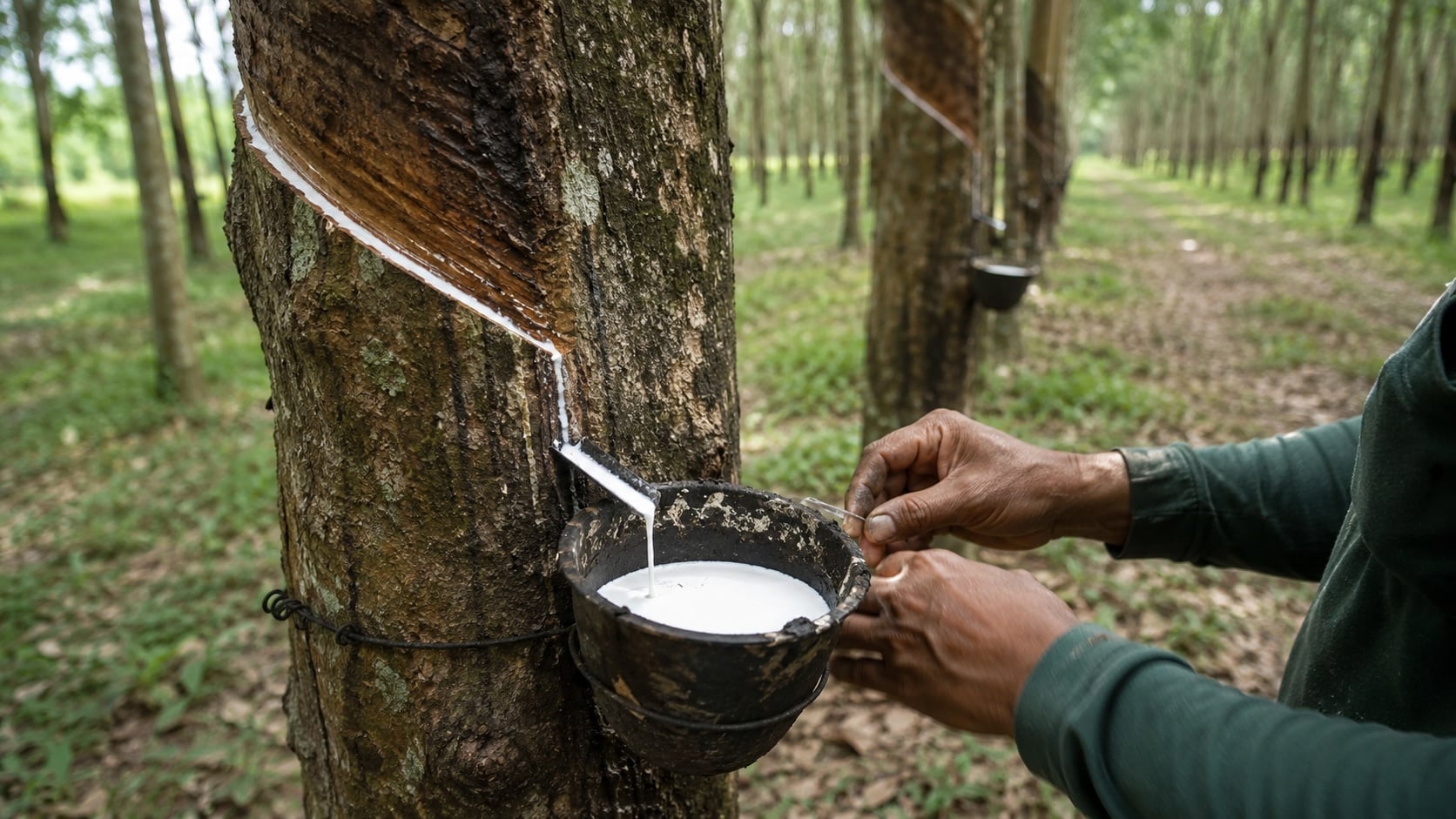
Natural rubber latex is harvested from rubber trees in plantations, providing the renewable raw material for natural latex foam products.
A 2024 study comparing Dunlop and Talalay processing gives manufacturers useful evidence for tuning natural latex foam properties for bedding, cushioning, packaging and lightweight products.
Natural latex foam is already used in many familiar products, from mattresses and pillows to furniture, footwear and cushioned seats. But as manufacturers seek materials that are comfortable, durable, lightweight and based on renewable resources, the question is no longer simply whether natural latex foam works. The more important question is how its properties can be deliberately controlled for different applications.
That is why a 2024 study published in Industrial Crops and Products remains relevant now. The work provides practical process-level evidence for companies working with natural rubber foam, especially those deciding between Dunlop and Talalay processing or exploring surfactant blends to improve foam structure and performance.
The study compared natural latex foams produced using the Dunlop method and a custom in-house Talalay method. It examined how processing route and surfactant treatment affect foam morphology, mechanical properties, energy absorption and thermodynamic behaviour.
An international collaborative team from Kasetsart University in Thailand and Newcastle University in Singapore investigated how process design and surfactant treatment can be used to tune the properties of natural latex foams for different industrial applications.
Natural latex foam is produced from concentrated latex harvested from rubber trees such as Hevea brasiliensis. Its internal structure consists of a rubber matrix containing many interconnected pores. This cellular structure gives latex foam its characteristic softness, resilience and ability to absorb energy under compression.
The two processes studied are widely relevant to industry. The Dunlop method involves mixing latex with chemical agents, pouring the mixture into a mould, allowing it to gel, and then heating, washing and drying the foam. The Talalay method includes additional vacuum, freezing and carbon dioxide gelation steps, which can modify the internal cell structure of the foam. The paper’s process diagram shows these differences clearly, with the Talalay route adding vacuum expansion, cooling and CO₂ gelation before vulcanisation.
The researchers compared foams produced using potassium oleate alone with foams treated using blended surfactants, including pluronic and potassium laurate. They used scanning electron microscopy and three-dimensional micro-computed tomography to examine the pore structure, and compression testing and dynamic mechanical analysis to assess performance.
The results showed that surfactant blends can significantly influence foam structure. Adding pluronic or potassium laurate generally reduced porosity, increased foam density and improved mechanical properties. In the Dunlop process, the sample containing a 50:50 pluronic/potassium oleate blend showed the highest energy absorption among the tested Dunlop foams, reaching 134 kJ/m³ compared with 88 kJ/m³ for the Dunlop control sample.
The comparison between Dunlop and Talalay processing is particularly useful for manufacturers because it shows that the two routes produce different performance profiles. Foams produced by the Dunlop method generally showed narrower cell-size distributions and higher compressive strengths. Foams produced using the custom Talalay method had broader cell-size distributions, lower density and lower energy loss. The paper reports that Talalay-produced foams showed about 20% lower compressive strength and 7% lower energy absorption than Dunlop-produced foams, regardless of formulation.
This is not a simple case of one process being better than the other. The significance of the study is that it gives industry a clearer basis for choosing the right process for the right product. Where higher compressive strength and energy absorption are needed, Dunlop processing may be more suitable. Where lower density, softer feel and reduced energy loss are more important, Talalay processing may offer advantages.
The findings are relevant to several product areas. Bedding and furniture manufacturers may use this type of information to tune comfort, firmness and resilience. Footwear and cushioning manufacturers may benefit from better control of energy absorption under compression. Packaging and transport-related applications may also benefit from foam structures designed for impact resistance and lightweight performance.
The study also provides useful design insight because the researchers observed a power-law relationship between energy absorption and compression speed. This means the foam’s energy absorption changes predictably with loading rate, which matters for products exposed to different compression speeds, such as cushions, vibration-damping components and impact-protection materials.
For natural rubber-producing countries, the work supports a higher-value approach to natural latex. Instead of treating latex foam as a standard commodity material, manufacturers can use process control, surfactant formulation and structural characterisation to design foams for specific market needs.
This is why the study remains worth reporting. It connects agricultural raw material, rubber processing and product performance. It also gives manufacturers practical evidence for improving natural latex foam products without moving away from a renewable rubber resource.
The study is not a commercial product launch. It is a process–structure–property study that helps explain why different latex foam processes produce different performance outcomes. Its value lies in giving industry a clearer technical basis for designing natural latex foam products for specific applications.
Paper details
The paper, “A comparative study of surfactant-treated natural latex foam morphology, thermodynamic relationships and energy absorption: Talalay vs. dunlop processing”, is published in Industrial Crops and Products. DOI: 10.1016/j.indcrop.2024.118631.
Authors and affiliations
The study was carried out by Noppawan Tundiew, Peerayut Kunklang, Supitta Suethao, Jirasak Wong-Ekkabut, Jukkrit Mahujchariyawong and Wirasak Smitthipong from Kasetsart University, Thailand; and Kheng Lim Goh from Newcastle University in Singapore.
For further details, contact Dr Wirasak Smitthipong at [email protected], or Dr Kheng Lim Goh at [email protected].
Advertisement
Advertisement