
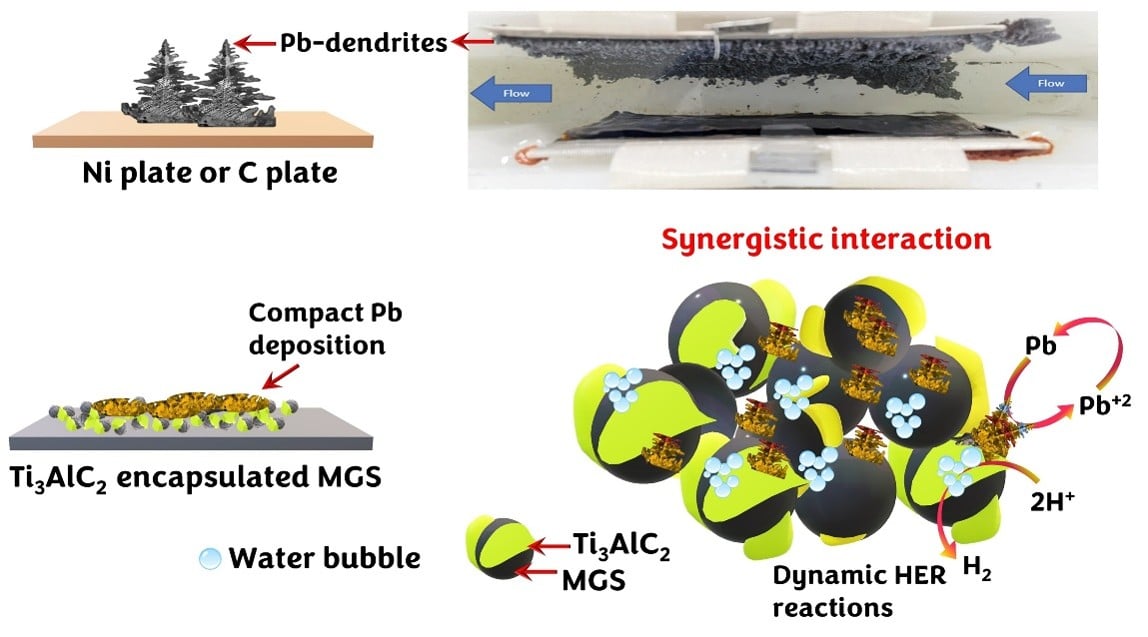

Layered carbide-carbon hybrids offer scalable, high-rate SLFB electrode platforms for improved wettability and enhanced electrolyte-electrode interaction and redox kinetics.
Engineered anode with graphite spheres/Ti₃AlC₂ compositing promotes rapid ion transport and facilitates compact Pb deposition, in turn prolong lifetime of SLFBs.
Journal of Energy Storage
As global demand for electricity storage grows alongside the rise of renewable energy and AI-driven data centers, researchers are racing to find battery technologies that can store large amounts of energy cheaply and safely over long periods. Soluble lead flow batteries are a strong candidate: they are inexpensive, easy to scale up, and built from lead that can be recycled from the existing lead-acid battery supply chain.
However, these batteries have long been held back by a stubborn problem: their carbon-based electrodes repel the water-based electrolyte, making it difficult for the liquid to reach the electrode's surface and slowing down the chemical reactions that store and release energy.
Researchers led by Prof. Hsun-Yi Chen at Department of Biomechatronics Engineering and Bioenergy Research Center, National Taiwan University, have now addressed this bottleneck by engineering the electrode's surface at the nanoscale.
The team coated porous graphite spheres with a thin layer of a two-dimensional ceramic-metal hybrid material known as a MAX phase (Ti3AlC2), transforming the electrode from water-repelling to water-attracting. This simple modification allowed the electrolyte to penetrate the electrode far more effectively, easing the "traffic jam" of ions that had previously limited performance. The study is published in Journal of Energy Storage.
The improvement was substantial: batteries built with the modified electrode ran steadily for 943 charge-discharge cycles while maintaining strong efficiency throughout. The team also built and tested a modular prototype battery, successfully powering LED lights and a small fan, demonstrating that the technology works beyond the lab bench.
"By simply re-engineering the electrode surface, we were able to unlock significantly longer battery life without redesigning the entire system, which is an important step toward making long-duration, grid-scale energy storage more practical and affordable," says corresponding author Prof. Hsun-Yi Chen.
The team believes this surface-engineering strategy could extend beyond lead flow batteries to help solve similar transport limitations in other battery chemistries as well.
Prof. Hsun-Yi Chen's email address: [email protected]
Advertisement