
Researchers at Academia Sinica and National Taiwan University used advanced methyl NMR spectroscopy to reveal how dozens of cancer-associated mutations disrupt the long-range communication network that enables the tumor suppressor BAP1 to function, creating the largest experimental molecular map of BAP1 mutations to date. The findings uncover a previously hidden mechanism underlying cancer-associated BAP1 dysfunction and provide a foundation for developing future therapies that target protein dynamics and allosteric regulation rather than the active site alone.
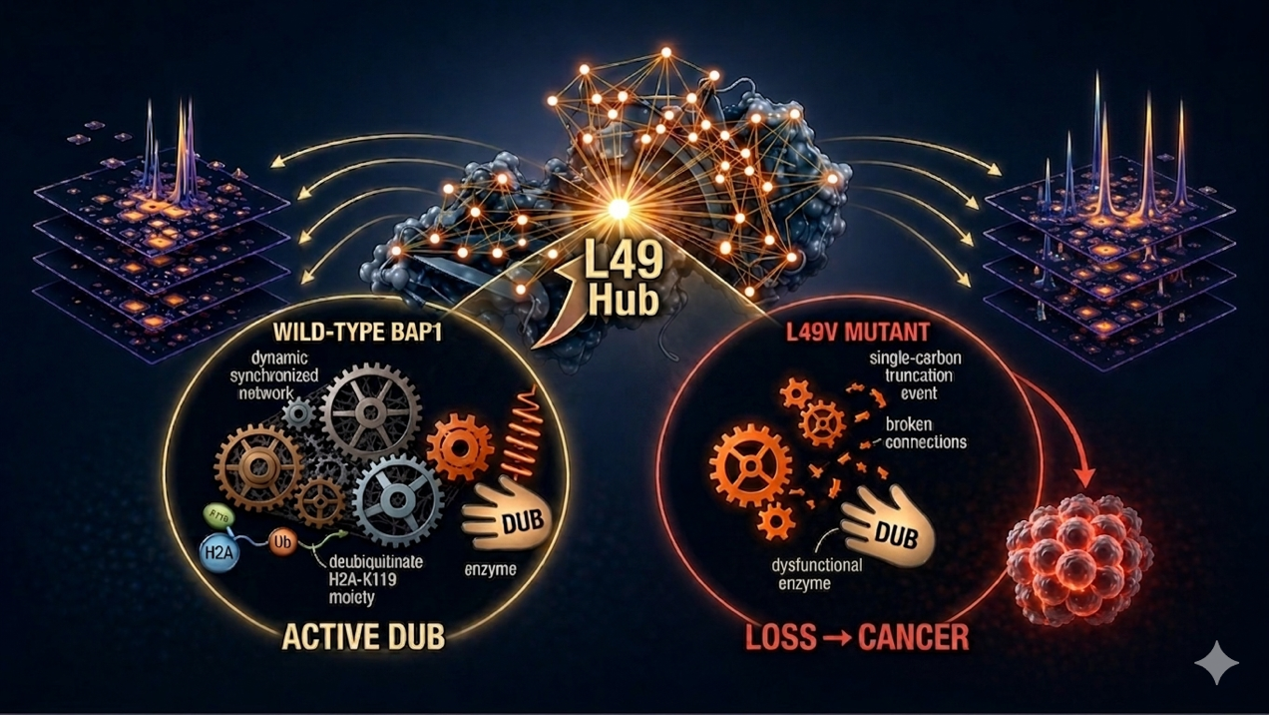
The internal communication network within the deubiquitinase (DUB) domain of BAP1 is reconstructed by comparing the methyl NMR spectra of dozens of single mutations. L49 is found to be the signaling hub of BAP1, and the removal of a single carbon – L49V mutation – decouples the internal dynamics thereby abrogating the DUB activity of BAP1, associated with oncogenesis.
National Taiwan University
Scientists at the Institute of Biochemical Sciences, National Taiwan University, have uncovered how tiny genetic changes can disable one of the body's most important tumor-suppressing proteins. Their study published in Nature Communications reveals how cancer-associated mutations interfere with the function of BRCA1-associated protein 1 (BAP1), a protein that helps maintain normal cell growth and is frequently mutated in cancers such as mesothelioma, uveal melanoma, and kidney cancer.
Although many cancer mutations in BAP1 have been identified over the years, it has remained unclear exactly how they impair the protein. To answer this question, the research team examined nearly 50 cancer-associated mutations using advanced nuclear magnetic resonance (NMR) spectroscopy, together with computer simulations and biochemical experiments.
Rather than simply determining the three-dimensional structure of BAP1, the researchers tracked how different parts of the protein move and communicate with one another. They discovered an intricate communication network that allows distant regions of the protein to work together. At the center of this network is a single amino acid, known as L49, which acts like a communication hub.
Surprisingly, removing just one carbon atom from this amino acid—as occurs in a cancer-associated mutation—was enough to disrupt the entire network and greatly reduce the protein's activity, even though its overall structure remained almost unchanged.
By systematically analyzing almost 50 mutations, the team has created the largest experimental map to date linking cancer mutations in BAP1 to their molecular effects. The findings provide new insights into how cancer develops and could help scientists design future drugs that restore protein function by targeting these communication networks rather than the active site alone.
"Proteins are not static objects—they are constantly moving and communicating internally. Our study shows that even the smallest molecular change can interrupt this communication network and lead to disease. Understanding these hidden dynamic networks opens new opportunities for developing precision medicines that target protein function in entirely new ways," says corresponding author Prof. Shang-Te Danny Hsu from Academia Sinica Institute of Biological Chemistry and National Taiwan University Institute of Biochemical Sciences.
Prof. Shang-Te Danny Hsu's email address: [email protected]
Advertisement