

Researchers at the University of Osaka have developed a new mathematical framework that helps identify optimization problems that can be solved efficiently using optical computing hardware. The approach allows complex, high-dimensional problems to be transformed into forms compatible with spatial photonic Ising machines and can also accelerate computation using fast Fourier transforms. These findings could broaden the applications of optical computing to areas such as logistics, data analysis, and infrastructure optimization.
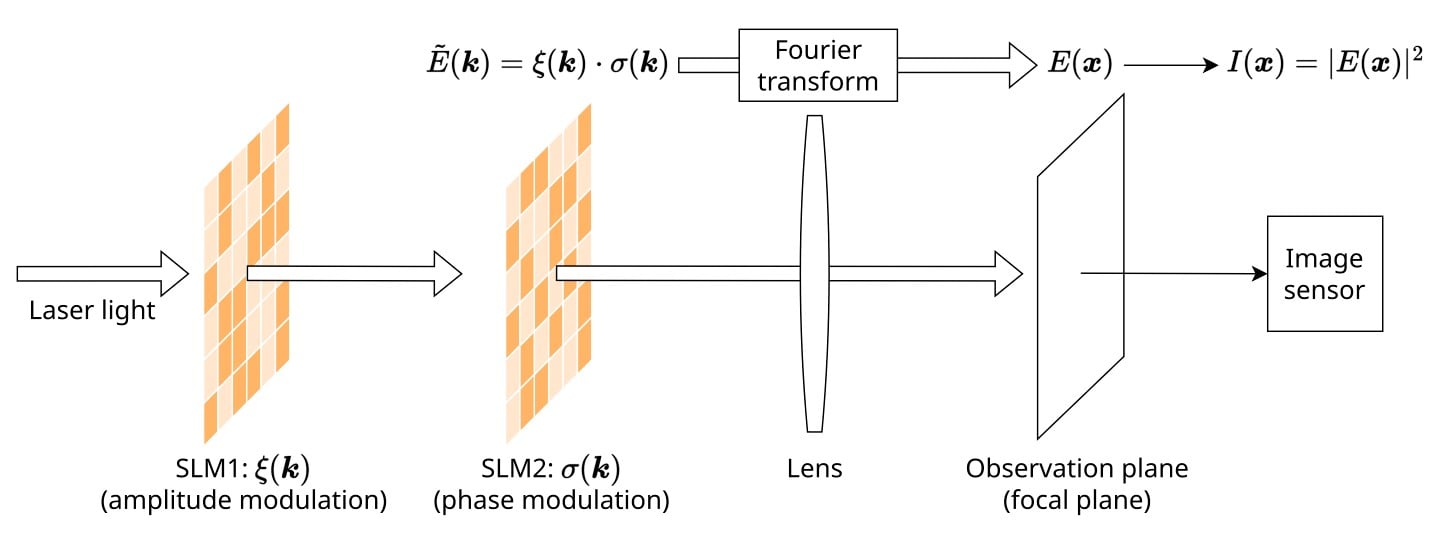
Fig. 1
A schematic of the architecture of SPIM. Many variables are represented by the spatial pattern of laser light, enabling parallel processing.
CC BY, 2026, Hiroshi Yamashita et al., Convolutional Formulation of Large-Scale Quadratic Unconstrained Binary Optimization with Dense Interactions, Communications Physics
A new mathematical approach developed at the University of Osaka helps computers tackle larger, more complex optimization problems
Osaka, Japan – From planning transportation networks to organizing massive datasets, many of society’s most important challenges boil down to an optimization problem: finding the best solution among an enormous number of possibilities. As these problems increase in size and scope, however, the computational resources required to solve them can increase dramatically. Now, researchers from Japan have identified a new way to tackle a broad class of optimization problems while keeping computational demands manageable.
In an article recently published in Communications Physics, researchers from the University of Osaka have revealed a hidden mathematical structure shared by many real-world problems and shown how such problems can be reformulated to take advantage of emerging optical computing technologies.
Unlike conventional computers, where information moves through electronic circuits, optical computers process information using beams of light. Because light can travel and interact in parallel, these systems are particularly promising for solving optimization problems, where the sheer number of interactions between elements makes traditional approaches computationally expensive.
“Instead of considering every possible interactions one by one, optical systems can rapidly measure how good a candidate solution is by encoding it as a pattern of light. This makes it possible to search through enormous numbers of possibilities far more efficiently than conventional electronics,” explains lead author Hiroshi Yamashita. “This is well suited for solving optimization problems, where the goal is to identify the best option from a vast number of possibilities.”
The team found that many real-world problems share a common structure: the outcome depends on spatial relationships between elements like distances. A key challenge has been handling problems with dense interactions, where many variables influence each other simultaneously, without overwhelming the hardware. The new framework directly addresses this.
“We take advantage of the fact that these problems use a common mathematical language,” says Hideyuki Suzuki, senior author. “By identifying patterns based on relative positions and distances, we show that a wide range of real-world challenges can be represented in a form that is amenable to optical computation.”
By exploiting repeating patterns within the data, the framework reduces computational demands for large-scale problems. Its convolutional structure also enables acceleration using fast Fourier transforms, offering efficiency gains even on conventional hardware.
“To demonstrate the method, we solved problems involving facility placement and data clustering. These tests show that complex optimization challenges can be translated into the new framework while preserving the information needed to find solutions,” remarks Yamashita.
The team’s findings support the development of faster, more energy-efficient systems. By broadening the range of problems handled by optical hardware, including optimization of social infrastructure and industrial systems, such advances could contribute to a more carbon-neutral future. As optical computing continues to progress, advances like this one could help transform humble beams of light into powerful problem-solving tools.
###
The article, “Convolutional Formulation of Large-Scale Quadratic Unconstrained Binary Optimization with Dense Interactions,” will be published in Communications Physics at https://doi.org/10.1038/s42005-026-02747-9
Funded by: Japan Science and Technology Agency (JST) through the Advanced Technologies for Carbon-Neutral (ALCA-Next) Program.
About The University of Osaka
The University of Osaka was founded in 1931 as one of the seven imperial universities of Japan and is now one of Japan's leading comprehensive universities with a broad disciplinary spectrum. This strength is coupled with a singular drive for innovation that extends throughout the scientific process, from fundamental research to the creation of applied technology with positive economic impacts. Its commitment to innovation has been recognized in Japan and around the world. Now, The University of Osaka is leveraging its role as a Designated National University Corporation selected by the Ministry of Education, Culture, Sports, Science and Technology to contribute to innovation for human welfare, sustainable development of society, and social transformation.
Website: https://resou.osaka-u.ac.jp/en
Advertisement